
Councils across Australia are under increasing pressure to improve sustainability outcomes while continuing to deliver practical and cost-effective infrastructure works.
While much of the industry focus is now on battery-electric machinery, automation, and low-emission fleets, many councils will continue relying on existing diesel-powered equipment for years to come.
What has changed immediately is the expectation around efficiency, waste reduction, and environmental responsibility.
Sustainability is no longer only about what powers a machine, it is also about how efficiently that machine is used.
Across road maintenance, drainage works, parks and gardens, landfill operations, and civil projects, large amounts of material are still commonly removed, transported away, dumped, and replaced – even when much of that material can often be reused on site.
By screening and separating material directly on site, councils can reduce unnecessary haulage, lower landfill volumes and recover usable material that would otherwise be discarded.
Road base can often be screened and reused rather than replaced. Trenching spoil can be cleaned and returned to site. Soil, green waste, and aggregates can be processed and reused instead of transported away.
This helps reduce:
- Truck movements
- Imported material costs
- Fuel usage
- Double handling
- Landfill disposal
- Overall site disruption
Rather than following the traditional process of dig, haul, dump and replace, councils can instead move toward a more efficient process of dig, screen and reuse.
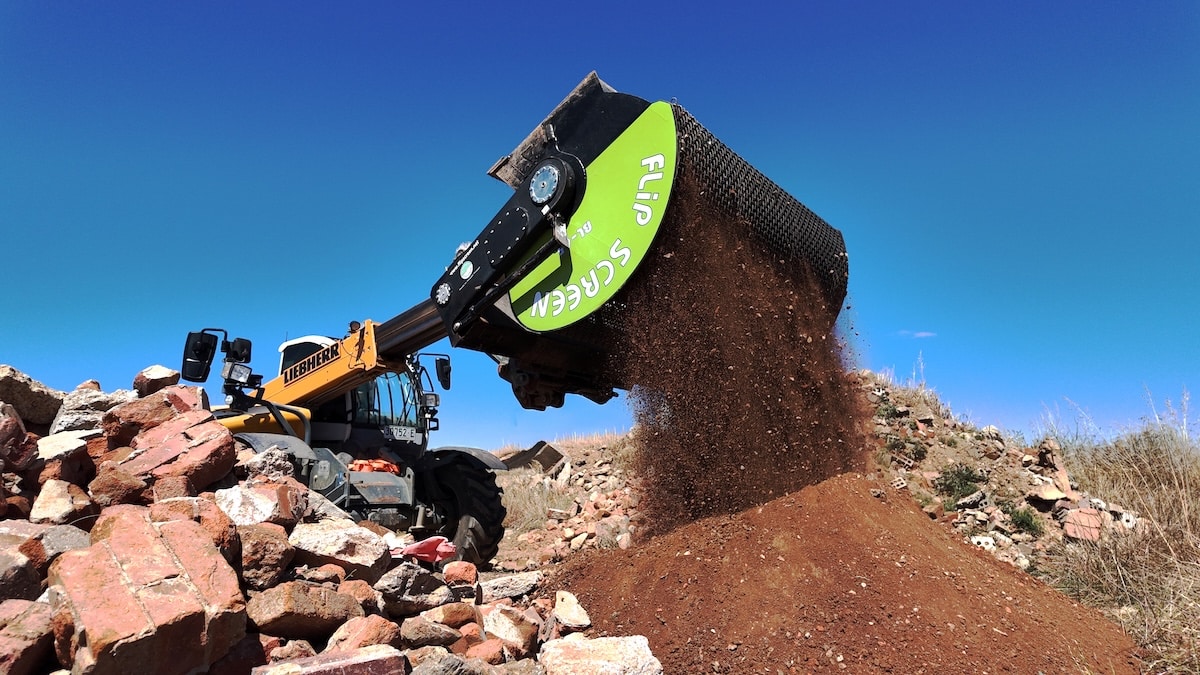
FlipScreen screening buckets are designed to support that shift by allowing operators to screen and separate material directly from the carrier machine already on site.
Mounted to excavators, loaders, skid steers and other machinery, the system allows material to be processed without requiring dedicated screening plants or additional equipment.
Interchangeable screens make the system adaptable across a wide range of council applications including:
- Road and shoulder maintenance
- Drainage and trenching works
- Soil and green waste processing
- Parks and landscaping
- Landfill and recycling operations
- Civil infrastructure projects
The result is not simply cleaner material, it is fewer movements, less waste and improved operational efficiency across the entire site.
This approach also aligns closely with the future direction of council fleet management.
As councils continue transitioning toward greener fleet options, including battery-electric and hybrid machinery, efficiency will become even more important. Every unnecessary movement or transport cycle draws on available runtime and energy capacity.
FlipScreen integrates into existing fleet infrastructure while also aligning with future fleet transitions. Operating hydraulically from the carrier machine itself, the system remains compatible regardless of whether the machine is powered by diesel, hybrid, or battery-electric technology.
While the power source driving the machine may change over time, hydraulic systems will continue to remain a core part of heavy equipment operation. In electric machinery, those hydraulic systems are simply powered electrically rather than through traditional diesel-driven systems.
This allows councils to improve sustainability outcomes immediately using their current fleet, while remaining compatible with the transition toward lower-emission and battery-powered machinery in the future.
Reducing waste, recovering usable material, and minimising unnecessary transport are practical steps councils can take today to improve both environmental and operational outcomes — without requiring a complete fleet overhaul.
To find out more, visit flipscreen.net













Leave a comment