
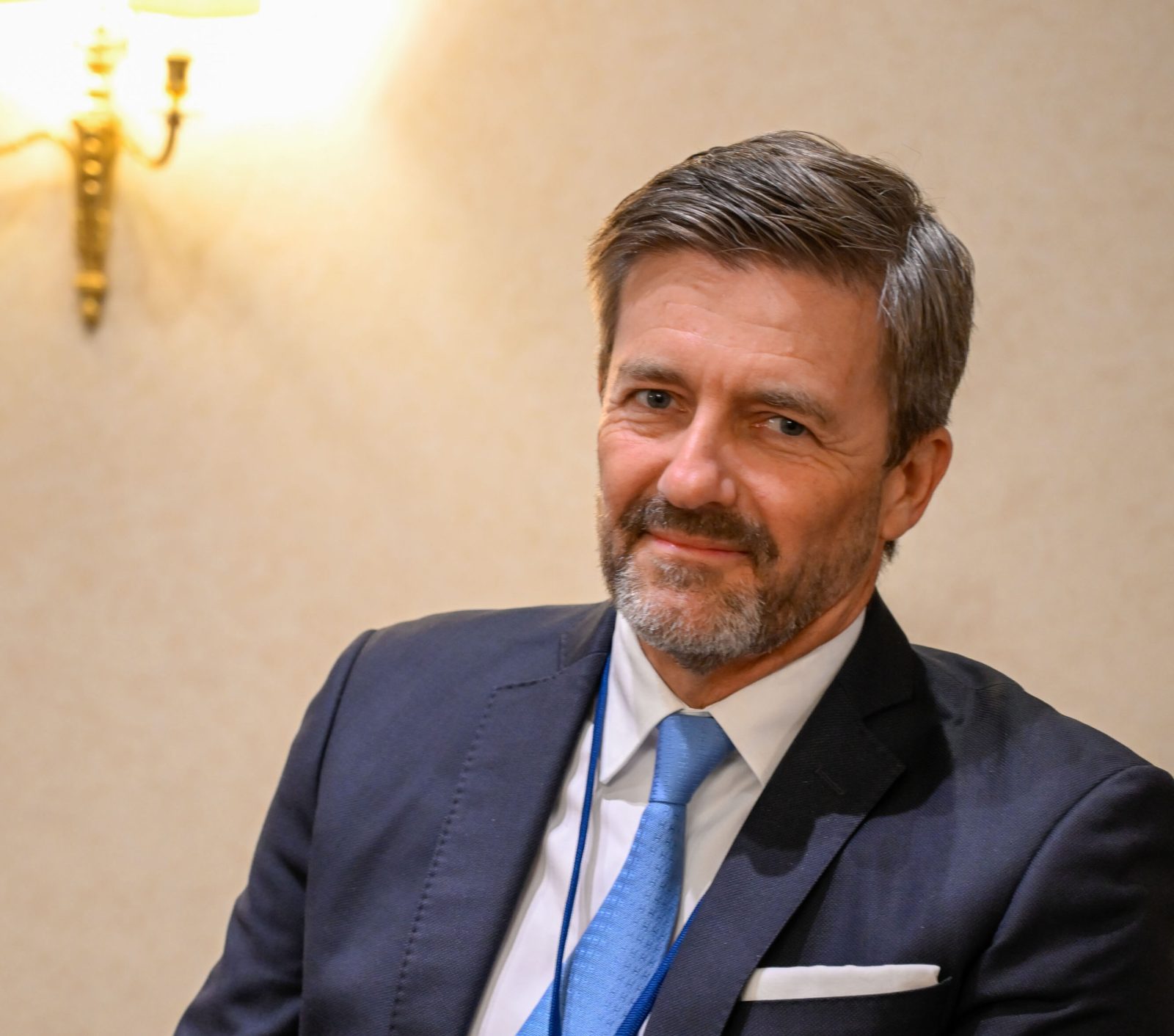
Private equity has long sold itself on a formula of financial engineering and the promise of outsized returns. But for Deram, chief executive and managing partner of Natixis’ private equity boutique Flexstone Partners, the old playbook has run out of steam.
In its place comes a more demanding model: lower risk, deeper diversification and greater emphasis on operational growth.
In a world of higher financing costs, slower exits and persistent geopolitical uncertainty, private equity managers must work harder for the same outcome.
“Today your 5% gross rate that was necessary for the 2.5x return becomes 12%,” Deram says. “That’s why twelve is the new five.’”
It is a memorable line, and a useful distillation of how sharply the market has changed as interest rates have risen over the past five years. The days when managers could rely on cheap leverage, five-year holding periods and a generous uplift in exit multiples are largely gone.
According to Deram, value creation is shifting away from capital structure optimisation and toward the tougher work of improving underlying businesses.
That view matters because Flexstone occupies a distinctive place in private markets. Rather than operating as a classic buyout house taking control of a small stable of companies, it builds private equity portfolios for clients across funds, co-investments, secondaries and separate managed accounts.
The firm, which manages roughly $13bn, is therefore exposed to a very broad cross-section of the market. Flexstone has between 6,000 and 7,000 underlying portfolio companies, with around 150 direct co-investments and the remainder held through fund and secondary positions. It holds no majority stakes in any of its portfolio companies.
This is private equity as a portfolio-construction business rather than a concentrated control strategy, and that identity shapes both the firm’s philosophy and its risk appetite.
The 60-year-old father of three founded the predecessor business in 2005 under the name Euro Private Equity, before selling a majority stake to Paris-based Natixis Investment Managers in 2013, which resulted in the firm moving its headquarters from Geneva to Paris, though Deram – himself a French citizen – continues to live just outside Geneva.
The attraction, he says, was Natixis’s multi-boutique structure: the support and infrastructure of a large institution combined with day-to-day autonomy. “I felt that it was kind of the best of two worlds,” he says, allowing Flexstone to keep managing the firm “in an autonomous way” while benefiting from the scale required in a more heavily regulated post-crisis industry.
That post-crisis shift is central to Deram’s account of how the asset class has evolved. In his telling, the global financial crisis triggered both a regulatory overhaul and a wave of consolidation, making it increasingly difficult for smaller firms to remain fully independent.
Flexstone’s later reorganisation into a single global platform spanning Paris, Geneva, Singapore and New York reflected that broader industry trend.
The firm’s current name also says something about how Deram thinks about the business. “Flexstone” was chosen to capture two ideas: flexibility and real assets. Two-thirds of assets under management are in bespoke programmes, he notes, making adaptability central to the model.
Yet if flexibility is one pillar of the strategy, conservatism is the other.
Deram repeatedly returns to the idea that private equity investors should be humble about forecasting and obsessive about downside protection.
Flexstone’s first major client, he notes, was a conservative Swiss state pension fund mandate that has been managed since 2006. That heritage still informs the firm’s approach. “We pride ourselves in losing as little as possible for our clients,” he says. Indeed, he adds that “no clients of Flexstone have lost money with us.”
That helps explain why the firm does not run a sector-specialist strategy. Flexstone prefers highly diversified portfolios and tends to avoid making large thematic bets over 10-year investment horizons.
Deram is sceptical of fashion in markets and wary of pretending to know what the world will look like even a year ahead. “We have no idea what the world will look like next year,” he says, arguing that portfolio design should reflect that uncertainty.
There are, however, clear tilts. The firm avoids sectors such as oil and gas and excludes areas constrained by ESG policies, including tobacco. It likes unregulated healthcare, capital-light industrials and selected business services.
More strikingly, it has been significantly underweight in software. Deram says software accounts for about 5% of Flexstone’s assets under management, compared with an industry benchmark more like 20% to 25%. That underweighting is deliberate, rooted partly in his experience of the dotcom crash.
This is not a manager chasing the hottest narrative. Deram openly says the firm is not into “sexy deals” and tends to favour companies whose products and services “you and I use every day”.
That may be less glamorous than backing the latest artificial intelligence darlings or any of the luxury brands for which France and Switzerland are famous, but it is consistent with a house style focused on durable cash generation and low loss ratios.
It also informs the firm’s use of leverage. Deram says many investments do employ debt, directly or indirectly, but “conservatively so”.
On co-investments, average leverage is around four times EBITDA, which he says is one to two turns below the market benchmark.
The reason is straightforward: businesses loaded with debt focus on repayment rather than growth investment. “The investment thesis of most of our investments is growth, as opposed to deleveraging,” he says.
That is especially relevant now. If higher rates persist, private equity firms can no longer assume debt will magnify returns as painlessly as before. This is the deeper meaning of Deram’s Twelve is the new Five argument.
In an earlier era, private equity could deliver a 2.5x money multiple with only modest growth at the underlying company, because leverage was cheaper and exit multiples could expand.
Today that cushion has eroded. Managers need stronger earnings growth and more hands-on operating capabilities, including M&A execution and buy-and-build expertise.
The practical consequence is longer holding periods for private equity firms before they look to sell out. Deram notes that industry averages have moved from around five years in 2021 to seven years in 2026, reflecting a slower exit environment.
Flexstone’s own history, he says, is probably closer to five or six years than seven, partly because it plays more in the small-cap market and has therefore been less affected than larger-cap managers. Still, the direction of travel is clear.
Evergreen structures are one response. Flexstone launched an evergreen private equity programme last year and has set a target return of 12% net.
Because the vehicle must hold about 20% in cash to meet potential redemptions, its return target is naturally lower than the 15% to 20% net IRRs Deram says the firm aims to generate in its traditional private equity funds.
The appeal of evergreen funds, in his view, is partly structural: they can hold investments longer, which is increasingly valuable when exits are harder to time. But they also come with familiar liquidity-management challenges, especially in semi-liquid formats. That point surfaces again when Deram discusses private credit.
Flexstone has only limited exposure to private credit through certain managed accounts, but Deram offers an interesting outsider-insider view, having worked in leveraged finance in New York in the 1990s.
He is not overly alarmed by current stress in private credit markets, though he acknowledges concerns over defaults and redemptions following high-profile frauds in the US. His defence of gating mechanisms is notable.
“Gates are good,” he says, because they protect investors from forced selling at distressed prices. The problem, he argues, is less the gates themselves than investor panic and, perhaps, poor product explanation at the point of sale.
That same pragmatism informs his view on continuation funds, where buyout firms sell companies to themselves. Flexstone invests in them selectively through mandates and secondaries, but has not yet used them for its own funds.
Deram describes continuation vehicles as “very controversial” and is plainly wary of conflicts of interest. He dislikes multi-asset continuation funds that mix one strong company with weaker ones, but says single-asset vehicles can make sense when there is a genuine business rationale for holding a trophy asset longer.
For fundraising, meanwhile, he paints a familiar but sobering picture. Conditions remain difficult, especially for smaller and mid-sized managers. “It’s a barbell type thing,” he says: the largest firms still raise capital relatively easily, while the smaller end of the market struggles.
He notes four consecutive years of declining fundraising from 2022 through 2025 and says that, despite some “green shoots” late last year, current geopolitical turmoil is likely to keep investors cautious.
Flexstone is not immune, though its reliance on separately-managed accounts offers some insulation from the commingled fund cycle.
It is close to completing fundraising on a co-investment vehicle with a $1 billion target, its largest such fund to date, and is considering successor products in secondaries and Asian fund investing.
LP demand comes mainly from Europe and Asia, particularly France, Switzerland and a broad set of Asian institutional markets. On deployment, the portfolio is roughly split 50-50 between the US and Europe, with Asia still relatively small but growing.
For all the technical detail, Deram’s worldview can be reduced to a few core principles: diversify heavily, avoid overconfidence, keep leverage in check and focus on businesses that can compound through real operational progress.
Pressed for a memorable success, he cites Spotify, where Flexstone invested at a mid-stage point before the company’s public listing and made “a strong return”.
But he stresses that such tech wins are not typical for the firm. Far more representative are the unglamorous businesses that help supermarkets price goods, support supply chains or quietly improve ordinary services.
That may not be the version of private equity that commands headlines. But in today’s market it may be the version most likely to endure.
As leverage becomes dearer, exits harder and macro shocks more frequent, the winners may not be those promising the most excitement. They may be the ones prepared to do the patient, operationally intensive work required to make twelve look like the new five.













Leave a comment