
Key Takeaways
- Horizontal integration involves acquiring or merging with other companies in the same industry to increase market share and streamline operations.
- It can lead to economies of scale, increased market power, improved product differentiation, and entry into new markets.
- Despite its advantages, horizontal integration may reduce consumer choices and face regulatory scrutiny due to potential antitrust issues.
- Strategies for horizontal integration include mergers, acquisitions, and internal expansions aimed at penetrating the same stage of the supply chain.
- Horizontal integration differs from vertical integration, as it focuses on expanding within the same industry level rather than across different production stages.
What Is Horizontal Integration?
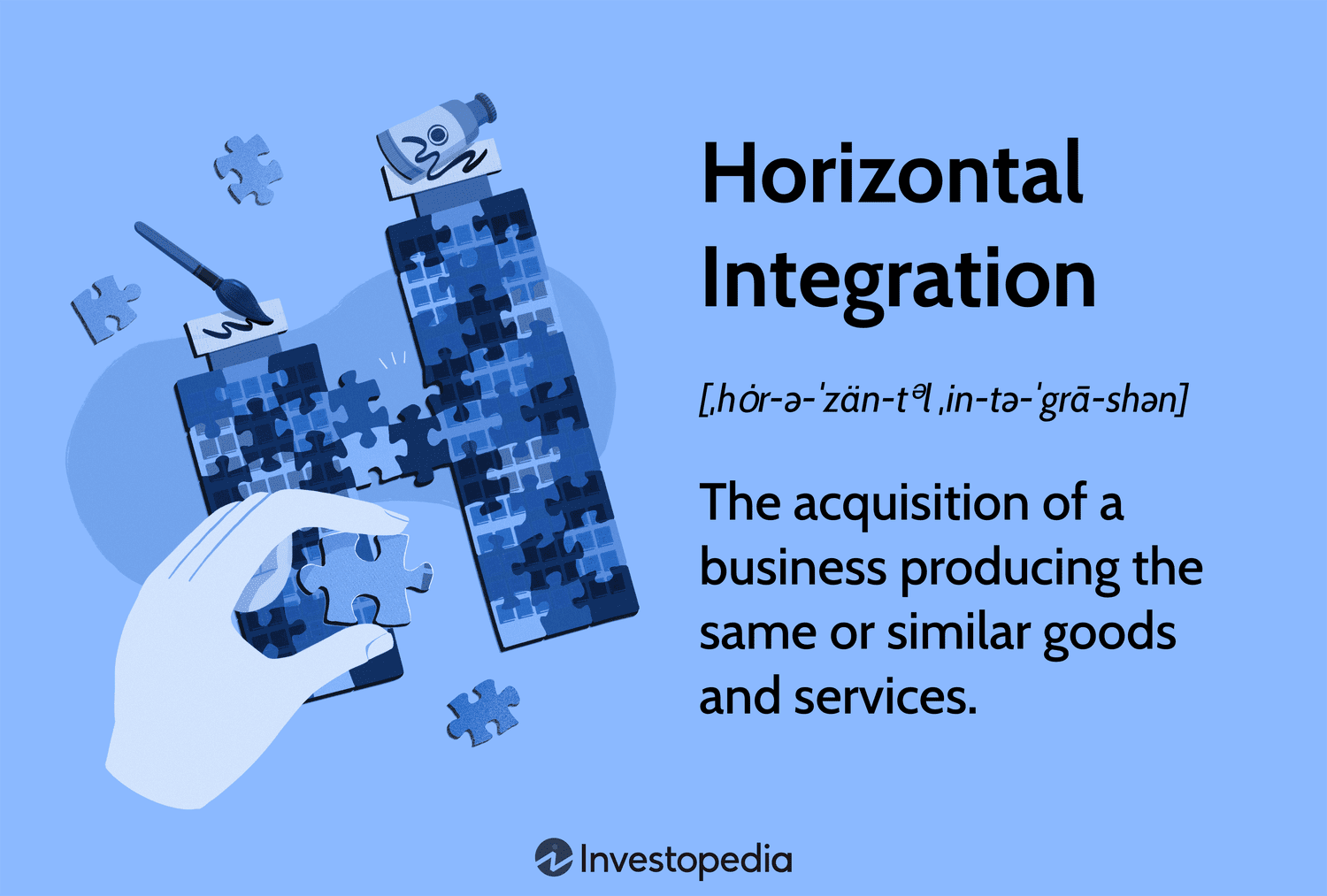
Horizontal integration involves acquiring or merging with businesses at the same level within an industry, strengthening a firm’s market presence. Unlike vertical integration, which involves expansion into different stages of the production process, horizontal integration focuses on increasing market power and reducing competition. This strategy can boost revenues, create economies of scale, and present new market opportunities.
Investopedia / Julie Bang
How Horizontal Integration Works
Horizontal integration is a competitive strategy that can create economies of scale, increase market power over distributors and suppliers, improve product differentiation and help businesses expand their market or enter new markets. By merging, two businesses may be able to produce more revenue than they would have been able to do independently.
However, when horizontal mergers succeed, it is often at the expense of consumers, especially if the merger reduces competition. For this reason, horizontal mergers are heavily scrutinized by regulators, to see if they violate antitrust laws.
Indeed, the real motive behind a lot of horizontal mergers is that companies want to reduce competition—either from potential new entrants, established rivals, or firms offering substitute or alternative goods.
Important
These are three of the five competitive forces that shape every industry, as identified in Porter’s Five Forces model. The other two forces, the power of suppliers and of customers, drive vertical integration.
Forms of Horizontal Integration: Mergers, Acquisitions, and Expansions
There are three primary forms of horizontal integration: mergers, acquisitions, and internal expansions.
Merger
When two companies merge, two separate entities create a new, joint organization. The brand of one of those two companies is usually retained, though the composition of operations and personnel is shared between both of the former individual companies. In addition, the product line of both companies is often similar and equally competitive in the market.
In a merger, both companies are striving to become a larger presence in their existing market. Most mergers are of similar firms, where integration of the two companies may be seamless due to the similarities between what the two former companies used to do.
Acquisition
Similar to a merger, an acquisition occurs when one company outright takes over the operations of another company. Though the two companies technically join together, one company remains in control. The acquiring company’s staff, executives, and operations often remain in place, while the acquired company’s resources are integrated as management sees fit.
Companies often pursue acquisitions in an attempt to get something specific. For example, Microsoft specifically wanted to enhance its presence in the video game market. Therefore, it acquired Activision Blizzard in January 2022. This example of an acquisition shows an often deliberate strategy for a specific sector in which a company wants to achieve a very specific goal.
Internal Expansion
Companies can also embark on horizontal integration by making more conscious allocations of internal capital. Through internal expansion, a company simply chooses to strategically change course and apply more resources in a different way. For example, a restaurant can expand to offer catering companies, or a beverage manufacturer may branch off to make food products.
In these examples, a company continues to operate how it use to. However, instead of committing capital to acquire an external company or transition with a merging firm, it decides to deploy those resources in-house to train staff, buy equipment, make capital investments, and grow a new branch of operations on its own.
Fast Fact
The M&A market was as hot as ever in 2021. According to McKinsey, the total value of larger deals (valued greater than $25 million) for the year peaked at $5.9 trillion, up 37% from 2020.
Pros and Cons of Horizontal Integration
Advantages
Companies pursue horizontal integration for synergies like economies of scale or cost savings in marketing, R&D, production, and distribution. This can make manufacturing multiple products more cost-effective.
Procter & Gamble’s 2005 acquisition of Gillette is a good example of a horizontal merger that realized economies of scope. Because both companies produced hundreds of hygiene-related products from razors to toothpaste, the merger reduced the marketing and product development costs per product.
Synergies can also be realized by combining products or markets. Horizontal integration is often driven by marketing imperatives. Diversifying product offerings may provide cross-selling opportunities and increase each business’ market. A retail business that sells clothes may decide to also offer accessories or it might merge with a similar business in another country to gain a foothold there and avoid having to build a distribution network from scratch.
Disadvantages
Like any merger, horizontal integration might not yield expected synergies and can sometimes reduce value. This happens if the larger firm becomes hard to manage or if merged firms have clashing leadership styles and cultures.
There are regulatory issues as well. If horizontal mergers within the same industry concentrate market share among a small number of companies, it creates an oligopoly. If one company ends up with a dominant market share, it has a monopoly. If a merger threatens competitors or seems to drastically restrict the market and reduce consumer choices, it could attract the attention of the Federal Trade Commission.
Horizontal Integration
Advantages
-
May result in efficiencies, economies of scale, or synergies not otherwise possible
-
May reduce company risk through product and market diversification
-
May increase profitability through new cross-selling opportunities
-
May result in decreased costs due to better processes and greater expertise
Disadvantages
-
May reduce value or synergy if merger is not performed successfully
-
May expose inflexibilities that won’t be resolved by the merger
-
May result in a clash of management styles with multiple leadership teams coming together
-
May result in regulatory issues if a dominant market share is formed
Comparing Horizontal and Vertical Integration
Horizontal and vertical integrations both involve expanding operations but have different goals. Horizontal integration aims to strengthen a company’s position within its current supply chain segment, often to improve products or increase market share.
Vertical integration means expanding into new supply chain stages to control more processes. For example, a manufacturer might acquire a raw materials supplier to control quantity, pricing, and timing of deliveries, performing backward integration.
Vertical integration is often undertaken to have better control over a long process, while horizontal integration is more suitable for a company wanting to become more niche for something specific. Horizontal integration often entails similar companies coming together, while vertical integration often entails different companies related to a similar product coming together.
The ultimate goal of vertical integration is to become independent of suppliers and control more aspects of the supply chain. On the other hand, horizontal integration strives to eliminate competitors, grow in market size, and create economies of scale.
Real-World Examples of Horizontal Integration
Many headline-grabbing mergers are examples of horizontal integration, especially when companies in similar industries combine. Specific examples include:
- JetBlue’s 2022 merger with Spirit Airlines
- Marriott’s 2016 acquisition of Starwood Hotel & Resorts
- Anheuser-Busch InBev’s 2016 acquisition of SABMiller (brewers)
- AstraZeneca’s 2015 acquisition of ZS Pharma (biotech)
- Volkswagen’s 2012 acquisition of Porsche (automobiles)
- Facebook Inc.’s (now Meta Inc.’s) 2012 acquisition of Instagram (social media)
- Disney’s 2006 acquisition of Pixar (entertainment media)
- Mittal Steel’s 2006 acquisition of Arcelor (steel)
What Is the Difference Between Horizontal Integration and Vertical Integration?
Horizontal integration is the strategy of acquiring other companies that reside along a similar area of the supply chain. For example, a manufacturer may acquiring a competing manufacturing firm to better enhance its process, labor force, and equipment.
Vertical integration occurs when a company acquires a company outside of their current position along the supply chain. For example, a manufacturer may acquire a retail company so that the manufacturer can not only control the process of making the good but also selling the good as well.
What Is the Main Advantage of Horizontal Integration?
The main advantage of horizontal integration is the strategically focused decision to penetrate a specific section of a supply chain. Horizontal integration allows a company to potentially acquire a competitor, gain greater insight into the market, expand its product line, or create economies of scale. Horizontal integration is a way for a company to simply do better at what it was doing before.
Why Is Horizontal Integration Important?
Horizontal integration is important because it allows a company to grow, expand, diversify, and gather a larger market presence. Horizontal integration further enhances a company’s current position in the market and, instead of transitioning to widely different aspects of the supply chain, it allows a company to become more competitive in the space it was already operating in.
The Bottom Line
The Bottom Line: Horizontal integration enables companies to expand their market share, create synergies, and enhance competitiveness by merging with or acquiring similar businesses in the same industry. This approach consolidates a company’s position within its current stage of the supply chain and can lead to growth and diversification without shifting stages in production.
However, businesses must be aware of potential regulatory challenges and operational risks when adopting this strategy, as they seek to maximize efficiencies and reduce competition. Properly executed, horizontal integration reinforces a company’s market stance, potentially resulting in economies of scale and increased profitability.













Leave a comment