
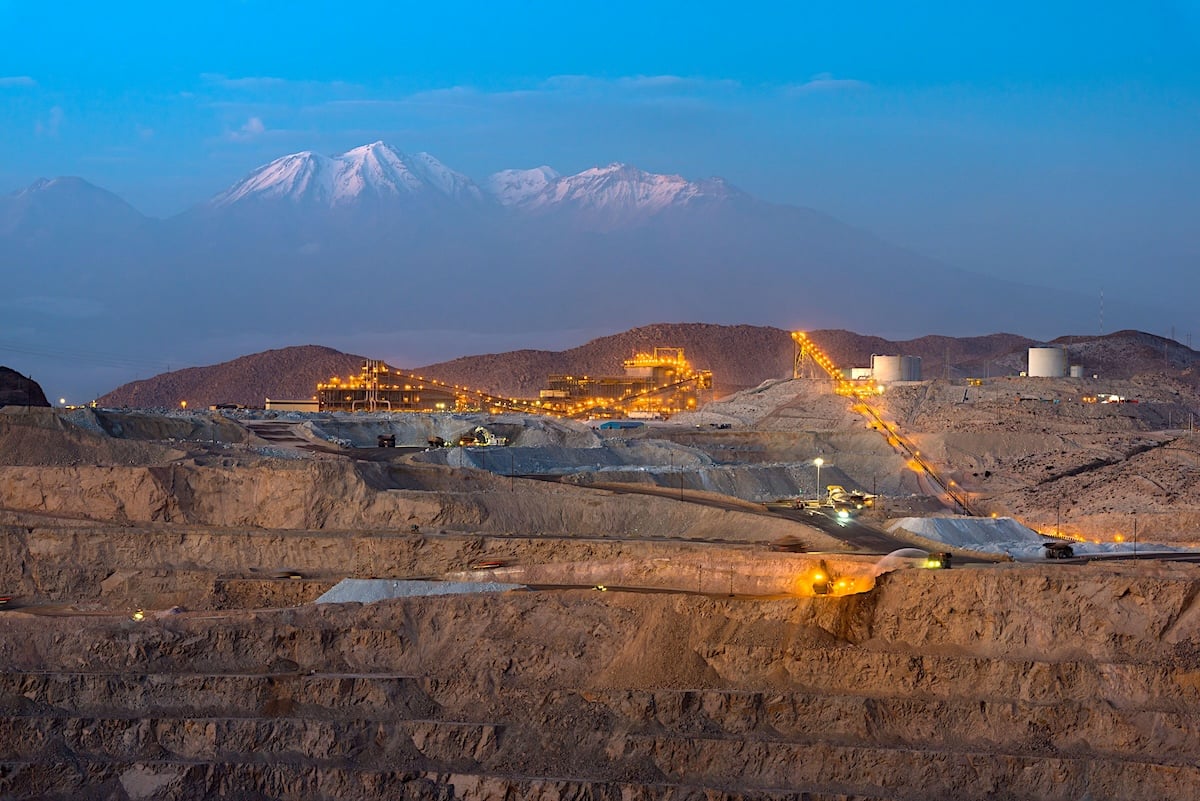
The energy transition has transformed minerals such as copper, lithium and nickel from everyday industrial inputs into vital, strategic assets. Global economies now depend on their continuous and reliable supply.
Latin America concentrates some of the world’s largest reserves of critical minerals. Chile and Peru account for around 40% of global copper, an essential mineral for the electrification of economies. Argentina, Bolivia and Chile house more than half of all known reserves of lithium, a key metal for batteries and energy storage.
In a world increasingly marked by the race between China and the US to secure transition resources, the stability of Latin American mineral supplies is ever more important.
History tells us that growth derived from natural resources does not always translate into sustainable development. Latin America has lived through multiple export boom cycles, characterised by resource abundance coexisting with weak institutions and fragmented territories. In many cases, the result was growth without sufficient institutional strengthening, leaving territories exposed to inequality, environmental pressures and recurring conflict as a boom subsided.
Is Latin America ready to take advantage this time around?
Governance – not geology – will determine outcomes
The debate should not be around how many minerals Latin America can produce. It should be about how the region is going to produce them.
The responsible, sustainable and reliable provision of minerals means having clear rules, institutions capable of enforcing them, and effective mechanisms to manage environmental and social impacts. It means economic benefits that translate into real opportunities for communities and tangible improvements in the territories.
In recent years, several countries have taken important steps in that direction. Chile has strengthened environmental standards and environmental evaluation systems; Peru has developed social dialogue mechanisms and traceability systems for strategic minerals; and Colombia has developed regulatory frameworks that seek to balance mining investment and environmental protection.

But social conflict surrounding extractive projects remains a common occurrence. In Peru, for example, this trend is especially persistent. Socio-environmental issues account for a significant share of recorded social conflicts, according to the latest available data from the national Ombudsman’s Office. Mining is the single most-cited subcategory. This reflects the political difficulty of making decisions that are legitimate and sustainable over time.
Avoiding these conflicts does not mean suppressing opposition but building institutions capable of anticipating disputes. This may ensure credible consultations and the enforcement of environmental rules. It may help to make local benefits more obvious, too, combatting the entrenchment of distrust.
Beyond domestic perspectives, the energy transition is redefining the relationship between producing countries and major powers.
The US seeks to reduce dependence on suppliers it considers strategically sensitive and to strengthen supply chains in politically reliable environments. China, for its part, has often combined financing, infrastructure investment and long-term commercial agreements as part of its own, broader strategy to secure access to raw materials.
Over the past decade, Chinese companies have increased their presence in mining projects, ports and electricity networks in countries such as Peru, Chile and Argentina. This reflects a sustained strategy to secure access to critical resources.
These dynamics have catapulted many Latin American countries into the heart of geopolitical manoeuvring. Decisions on mining, energy and infrastructure are no longer solely economic; they are strategic, and affect the position of countries within the global system. The capacity of states to oversee and regulate critical infrastructure has become a central component of economic and territorial governance.
Peru’s port of Chancay, inaugurated in November 2024, was developed with major Chinese investment. The project sparked debate over regulatory authority, exclusivity rights and the degree of state oversight when it comes to strategic infrastructure. The concern is not foreign investment as such, but whether the Peruvian state has sufficient capacity to regulate infrastructure that is becoming central to trade, logistics and geopolitical positioning. Meanwhile, the growing concentration of Lima’s electricity being distributed by an operator from another country raises questions about regulation, competition and energy security.
It is a matter of recognising that the governance of these assets has become a strategic issue.
A regional response to a global race
Another dimension that is beginning to become evident is the need to think as a region. No Latin American country, on its own, has enough weight to decisively influence global markets for critical minerals, nor the definition of international environmental standards. Even the largest producers, such as Chile and Peru in copper, or Brazil in iron and nickel, represent only a fraction of the world market. They also depend on supply chains outside the region, over which they have limited influence.
Thinking as a region is economically rational but politically difficult
However, regional coordination faces obvious limits. Latin American economies compete to attract investment, their regulatory frameworks are varied, and national priorities often prevail over any attempt at collective action. Thinking as a region is economically rational but politically difficult. Even so, it is a conversation the region can no longer postpone if it wishes to remain relevant in the new energy landscape.
Whether Latin America is ready to supply minerals to the world does not depend solely on geology or international demand but on something more fundamental: the capacity of countries to govern their resources effectively and consistently over time.
The region has the resources, experience and accumulated technical knowledge. What is lacking, in many cases, is the alignment of institutional capacities and political will to manage that wealth with stability, social legitimacy and environmental responsibility.
The challenge, therefore, is not just to produce more minerals, but to govern them better. Latin America’s role as a provider of strategic resources will only increase in the coming decades. Whether this minerals rush turns into sustainable development, or another raw material boom-bust cycle, depends on whether its countries prove to be up to the task.










Leave a comment