
Key Takeaways
- London is a top global financial hub, competing closely with New York City due to its strategic location and light regulation policies.
- The “Big Bang” deregulations in 1986 transformed London into a leading global financial center, reforming its markets significantly.
- Brexit poses potential risks to London’s financial status, affecting its access to EU markets and foreign professionals.
- London’s financial prominence is historically rooted in its early banking innovations and pivotal role in global trade.
- The competition among global financial centers is evolving, with cities like Singapore and Hong Kong gaining influence.
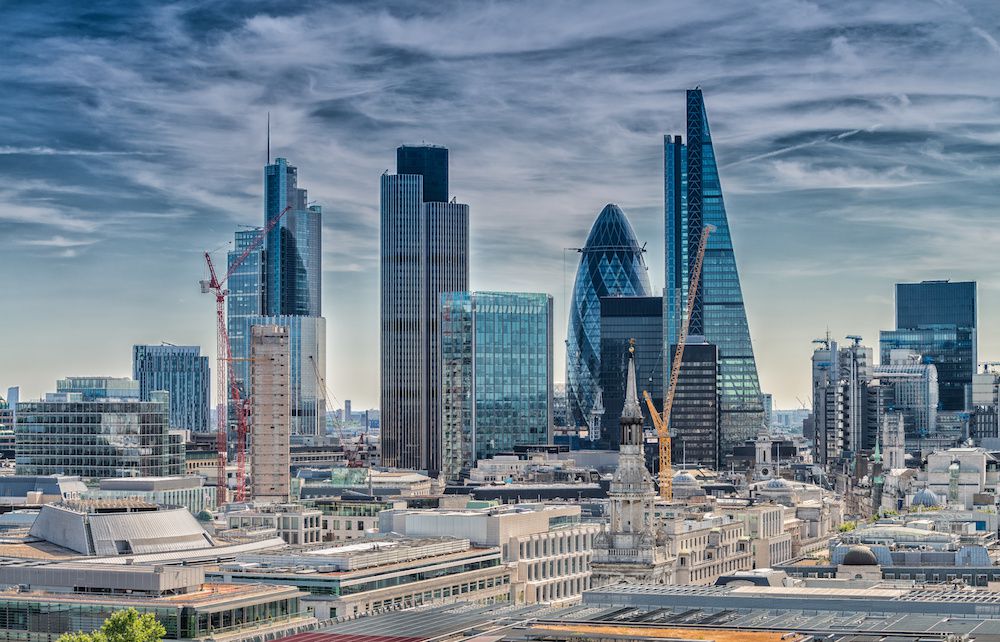
London has long been regarded as one of the world’s leading financial hubs, playing a pivotal role in the global economy. The U.K. is the world’s highest net exporter of financial services and London, with its convenient time zone and feather-light regulations, vies with New York as the world’s financial capital.
A rich history positioned London as a financial powerhouse against the challenges it faces today as Brexit reshapes the economic landscape. Learn how London’s strategic location, historic financial institutions, and progressive deregulation have contributed to its enduring status. We’ll explain the factors that established London’s financial preeminence and what the future might hold for The City in a post-Brexit world.
The City of London: The Historical Financial Core
London’s financial district is actually The City within the city of London. Known as The City of London, it was established a few years after the Roman invasion in AD 50 on the north bank of the River Thames. It has its own mayor and governing body, called the City of London Corporation.
From its early years, commerce flourished in the City, and its ports drew merchants and entrepreneurs from many nations. Historian Peter Borsay says London’s population went from about 50,000 to 60,000 in the 1520s to a million by the end of the 18th century.
Between 1650 and 1750, it saw the arrival of 8,000 immigrants a year, according to historical demographer Tony Wrigley. They included craftsmen and merchants who joined or established guilds and wielded great influence and power in The City. They secured freedoms and rights for their members that businesses enjoy to this day.
The Bank of England: Catalyst in London’s Financial Ascent
Some of those merchants went into banking and developed the sector. The Bank of England, which stands in the middle of the City, began as a private corporation started by merchants in 1694, and it stayed private until the close of World War II. Its first task was to fund the government’s military efforts in the Nine Years’ War with France. It received various long-term privileges and became a monopoly.
Coffee houses, which were enormously popular within the City’s walls around this time, were used as makeshift offices that evolved into financial institutions. The London Stock Exchange was started by stockbrokers who had conducted business in Jonathan’s Coffee House in Change Alley. The insurance market Lloyd’s of London is named after a coffee house on Tower Street that was frequented by marine underwriters.
Harvard Library
There was little question as to which U.K. city would be its financial and trade center. “An ancient banking tradition, a major port, the capital seat, the hub of the railroad network built after 1830, all forces were brought to bear on the single locality, itself with a minor ambivalence between the City and the West End. The Irish and Scottish different banking systems reached across their boundaries and linked up with London,” wrote economic historian Charles P. Kindleberger in The Formation of Financial Centers.
International Rivalries Shaping London’s Financial Leadership
London borrowed financial innovations from Amsterdam, the world’s trading and financial center in the 17th century, and improved on them. It developed a market-centered system as opposed to the bank-centered of its Dutch rival city and grew more dominant in the 18th century as the Netherlands began an economic and political decline.
London then competed with Paris to be the biggest global financial hub until the mid-19th century. Paris lost out in 1848 when the Bank of France ran into trouble after France lost a war with Prussia. The French bank was forced to halt specie payments, meaning it could no longer exchange paper money for gold. France, and its bank, were running short on gold.
London’s Rise to Financial Dominance
“Since the suspension of specie payments by the Bank of France, its use as a reservoir of specie is at an end. No one can draw a cheque on it and be sure of getting gold or silver for that cheque. Accordingly the whole liability for such international payments in cash is thrown on the Bank of England,” wrote Walter Bagehot in his famous 1873 book Lombard Street: A Description of the Money Market. “London has become the sole great settling-house of exchange transactions in Europe, instead of being formerly one of two. And this pre-eminence London will probably maintain, for it is a natural pre-eminence. The number of mercantile bills drawn upon London incalculably surpasses those drawn on any other European city; London is the place which receives more than any other place, and pays more than any other place, and therefore it is the natural ‘clearing house.’ The pre-eminence of Paris partly arose from a distribution of political power, which is already disturbed.”
London held supreme until the start of the First World War. During that devastating conflict, Kindleberger says, The City began to have “difficulty in maintaining its role as a center for foreign reserves and a source of short- and long-term credit.”
New York Overtakes London: A Shift in Financial Power
This period coincided with the emergence of the U.S. as a global financial force. The New York Stock Exchange overtook the London Stock Exchange.
New York was briefly the financial center of the world after the Second World War until the eurodollar market developed in the 1950s and London took a lion’s share of it, according to Kindleberger. English common law meant that the Bank of England could allow lightly regulated, offshore markets to flourish. Hundreds of foreign banks set up branches in London.
Regulatory Differences between London and New York
The U.S. had its own version of common law and could have adopted and developed a parallel market in New York, but its government chose to stay with a stricter standard of financial regulations.
Economist Ronen Palan explained that the U.S. was then a rising hegemonic power focused on developing its manufacturing and commercial sector, while the British Empire was a declining state with a weak manufacturing and commercial sector and a relatively powerful financial sector.
“The City of London developed at the heart of the British Empire, somewhat divorced from the U.K.’s mainland economic needs, to finance trading and manufacturing throughout the formal and informal British Empire,” he wrote. “Although nationalized in 1948, the Bank of England remained effectively under the control of the City’s commercial banks. The Bank of England consistently pursued policies that favored the City’s position as a world financial center, even when such policies were seen as harmful to the UK’s mainland manufacturing needs. The pound was consistently overvalued, interest rates relatively high, in a country that saw a declining manufacturing sector.”
But the Square Mile hadn’t definitively beaten Wall Street yet.
From the Big Bang to Brexit: London’s Financial Evolution
In October 1979, Britain removed controls on foreign exchange that had been in place from the Second World War. Nicholas Goodison, chair of the London Stock Exchange at the time, told the New York Times the restrictions had “done a lot of harm to London as one of the leading financial centers.”
Seven years later, the city’s financial markets were deregulated in a move so tremendous that it was dubbed the “Big Bang.” The removal of fixed rate commissions, the entry of foreign companies, and a switch to electronic trading kicked off a financial revolution that would cement London’s place as the global financial capital.
The average daily turnover of the London Stock Exchange rose from 500 million pounds in 1986 to more than $2 billion in 1995. Small British firms were bought up by international players. The culture of the country’s financial sector changed forever. The city also became a hub for the multitrillion-dollar global derivatives market in the 1990s.
The Brexit Challenge: Risks to London’s Financial Hub
London has enjoyed a good run, but Brexit is a cloud that hangs over its skyscrapers.
Consultancy firm EY said assets worth nearly 800 billion pounds were being moved from Britain to other European financial centers in the run-up to the finalization of the nation’s departure from the European Union.
Brexit also threatens the city’s access to foreign talent, which it has relied on for centuries. In 2017, 18% of the workforce in the City was born in Europe, versus 7% for the country as a whole.
Vying for London’s position in Europe are Dublin, Luxembourg, Frankfurt, and Paris. After being toppled from the top spot in the eighteenth century, Amsterdam may regain some of its former glory, too. After the Brexit vote, Reuters reported that 20 financial firms were applying for licenses to operate in the city.
New York has already replaced London as the financial center of the world, according to a survey by London-based think-tank Z/Yen. A new chapter begins.
New York Reclaims Financial Center Leadership
In 2023, New York City had regained its top spot as the financial center of the world while London was second on the list, according to an index compiled by Z/Yen Partners and the China Development Center.
But the rest of the top 10 on the list would come as a shock to an 18th-century financier in either city. The list includes Singapore, Hong Kong, San Francisco, Los Angeles, Shanghai, Chicago, Boston, and Seoul.
What City Is the World’s Top Financial Center?
In 2023, most sources choose New York, for its sheer size and volume and its strategic location as a place to do business. London is usually in second place.
Not all agree. For example, the International Financial Centers Index reverses the order, putting London on top of New York. Its findings are compiled by CEOWorld magazine based on a survey of financial services professionals plus no fewer than 50 other analyses of cities for their global competitiveness. It takes into account not just size but factors such as regulatory and political environment, tax policies, and infrastructure.
What Cities Rank Highest as Global Financial Centers?
A city gains its status as a global financial hub when it has a strategic location, a reputable stock exchange, and a concentration of major financial institutions, To keep that status, it needs a stable government, good infrastructure, and a sound regulatory system.
Today’s top global financial centers, in addition to London and New York, include Singapore, Zurich, Hong Kong, Chicago, Tokyo, Frankfurt, and Shanghai.
How Does Brexit Jeopardize London’s Financial Dominance?
The markets hate uncertainty, and Brexit raises colossal uncertainty.
Some financial institutions are poised to move to other hubs such as Frankfurt in order to stay competitive in European Union nations.
Some foreign nationals (and there are many of them working in The City) are wondering whether they can continue to stay in Britain. Recruitment of foreign nationals has become more complicated.
These are early days for Brexit. The next few years will determine its real impact on The City.
The Bottom Line
London is the world’s foremost financial center, or maybe New York is. The two cities regularly swap places on the list depending in part on the criteria used.
But another factor is the political environment. Brexit has added an element of uncertainty to the continuing status of London as a global financial hub.












Leave a comment