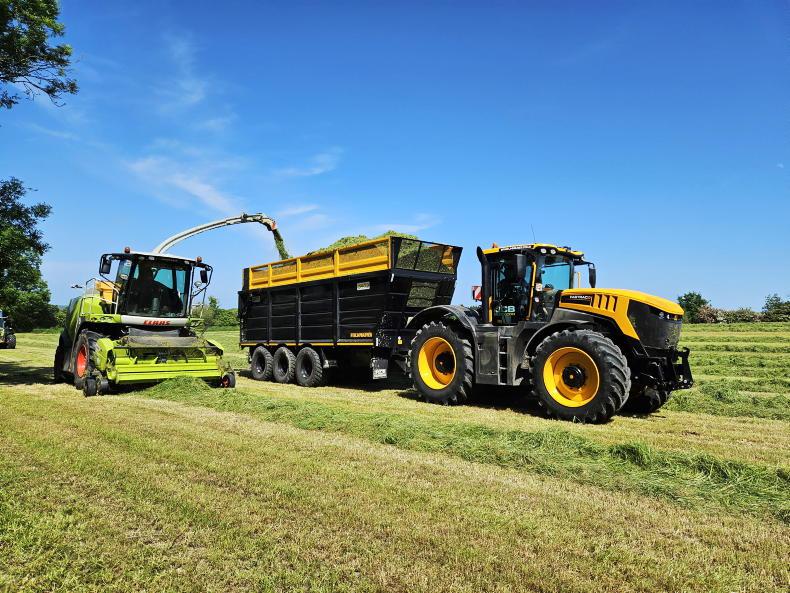
When we look at the scale of machinery, in particular silage equipment, today, we need to assess the threat to soil structure – something that could have long-lasting impacts on our soils. While the tyre sizes on tractors and machinery have increased, is this increase enough to protect our soils?
Scale increase
The pursuit of scale is driven by labour efficiency. Labour is a cost, and difficult to secure. The output of modern silage systems has greatly helped labour efficiency. Today, a six- to seven-person SPFH team is able to ensile double what that team would have done 20 years ago and maybe six or more times what a five-person trailed-harvester team would have harvested in the 1990s. But there are downsides:
It requires a tremendous investment in machinery; much of which has a relatively short working season, making financial management challenging.
These outfits must harvest more area to be economic, leading to extreme competition and more time moving between jobs (as job size changes little).
The equipment may be unsuited to smaller farmyards.
Heavy machine weights, particularly loaded silage trailers, may damage soil structure.
Trafficability v compaction
Trafficability issues are visible and are extreme in wetter conditions; deep ruts are caused and machine movement is threatened. A wet season results in huge trafficability problems for silage equipment. Good wheels/tyres, etc, can help, but in very wet conditions, harvesting is delayed.
Compaction is where the soil structure is damaged, and can be caused without any obvious surface rutting. The weight of machinery, through the tyre, packs the soil aggregates together. This restricts root penetration, water and air movement and impacts on grass growth. In the absence of any wheel ruts, compaction causes yield loss: Teagasc has measured from 9% to over 30% reductions in grass yields caused by silage traffic ( Figure 1). The effects of compaction can persist for years.
What causes compaction?
The key factors in determining compaction risk are:
Soil moisture: the biggest factor; wet or moist soils are easily damaged.
Machine weight: specifically axle load is very important.
Tyre sizes, types and inflation pressure will determine ground pressure.
Traffic patterns will have some influence on where compaction may occur.
Soil types, drainage and the type of crop (grass or other) also matter.
How do we reduce compaction risk?
Our ability to manage or work around soil moisture is limited. Some soils may be improved by drainage, but this must be economic. Repairing/managing existing drains is important, however. Delaying machinery operations to drier periods is often essential when conditions are extreme, but in busy harvest periods, the capacity to delay is limited, once the machines can travel without trafficability risk. Very heavy machines with poor tyre equipment should be delayed more than lighter machines with good tyres.
The factors we have most control over are machinery weight and wheels/tyres.
Machinery weight reduction?
The system we use has an impact. Bulk forage systems that use trailers and wagons to haul silage will have greater axle loads. Baled silage systems have much smaller unit loads, with smaller machine and axle loads which make them more suitable for wetter land.
The biggest challenge has been the increase in machinery weight. While we are all aware of weight changes from older trailed harvester systems of the 1980s, over the last 20 years, the change in SPFH and baled systems has been dramatic (Table 1). The forager weight increase of 50% is substantial, but trailer sizes and capacities have practically doubled along with a similar increase in the tractor pulling it. A fully loaded silage trailer and tractor can be 35t today compared to 17t 25 years ago (and perhaps 9t in the 1970s). Even baled silage machinery has increased with the arrival of combi-balers and bale chaser trailers.
Trailer size and weight
Have we the correct size silage trailers? On longer haulage or ‘draw’ distance larger trailers reduce labour requirement and cost.
On short draws, transport labour is a smaller part of the total cost. Interestingly, larger trailers may not be any more fuel efficient than smaller ones if all are properly matched with tractors. Modern large trailers with tyres big enough for the field, hauled at 50kmh on the road, may use more diesel per tonne of silage than smaller units of 25 years ago traveling at 30kmh.
The durability of today’s Irish-built trailers is second to none, and many have bodies that can handle all sorts of bulk loads, and can even withstand a field turnover on occasions, but they are often very heavy.
For the soil, trailers should be as light as possible, with good design focusing on reducing weight, while also having the necessary strength. It is good to see some manufacturers, particularly in the northern part of the country, offering silage trailers designed with lower weight.
Big tyres to reduce soil pressures
Wheel and tyre size has increased on all silage machines; much of this in the wetter areas of the country was initiated in response to Teagasc research in the 1990s. This research clearly showed the benefit of lower ground pressure. But what were ‘big’ tyres then are often ‘small’ now because of increase in machine weight. We need to look at the issues of tyre size again.
Ground pressure is reduced by having bigger tyres that can run at lower inflation pressures to produce a large soil/ground contact area, to carry the load on the wheel. The required inflation pressure for the tyre for a particular load is a good guide to ground pressure and can be used to rate and select tyres.
VF tyres
VF tyres can reduce ground pressure. They have a more flexible carcase allowing them to be run at 40% lower pressures for a given load increasing contact area (length) and reducing ground pressure. But they must be worked at the correct pressure to benefit the soil.
Tyres for hauling silage
Today’s move to heavier, high-capacity trailers poses huge challenges and expense for tyre choice. A couple of examples are given in Table 2 for a 190hp tractor and either 6.0m (20ft) or 6.7m (22ft) trailers. Depending on silage dry matter and fill level these trailers will have loads of from 8t to 12t on each axle and from 3t to 4t on the tractor’s hitch. The ‘pressure’ column in Table 2 is critical and is the inflation pressure required to carry the load, which broadly equates to ground pressure.
The pressure we need to target depends on the conditions, with 0.8 bar needed to prevent damage on wet ground, but unattainable in conventional silage machinery. As a compromise, we should target pressures less than 1.2 bar for tractor tyres ( exerting traction forces which exacerbate compaction) and < 2.0 bar for trailers. In the past we aimed for <1.5 bars for trailers in wetter conditions.
Table 2 shows how difficult it is to achieve the trailer figures with wider and taller (>1.2m diameter) VF tyres needed. These are expensive and need trailers with suitable wheel clearance. Also high-sided trailers with these tyres may be less stable on slopes when the correct pressures are used.
Key points
Machinery weight has increased dramatically and demands that action is taken to protect our soils.
Kiting out larger trailers with suitable tyres to protect the soil is very expensive.
Lower weight trailers should be considered where field work dominates.
Reducing ground pressure on heavier machines requires very large tyres using VF carcase technologies.
Farmers should value lower ground pressure equipment, provided by contractors, whether achieved by bigger tyres, lower weights or a combination of both.
When we look at the scale of machinery, in particular silage equipment, today, we need to assess the threat to soil structure – something that could have long-lasting impacts on our soils. While the tyre sizes on tractors and machinery have increased, is this increase enough to protect our soils?
Scale increase
The pursuit of scale is driven by labour efficiency. Labour is a cost, and difficult to secure. The output of modern silage systems has greatly helped labour efficiency. Today, a six- to seven-person SPFH team is able to ensile double what that team would have done 20 years ago and maybe six or more times what a five-person trailed-harvester team would have harvested in the 1990s. But there are downsides:
It requires a tremendous investment in machinery; much of which has a relatively short working season, making financial management challenging.
These outfits must harvest more area to be economic, leading to extreme competition and more time moving between jobs (as job size changes little).
The equipment may be unsuited to smaller farmyards.
Heavy machine weights, particularly loaded silage trailers, may damage soil structure.
Trafficability v compaction
Trafficability issues are visible and are extreme in wetter conditions; deep ruts are caused and machine movement is threatened. A wet season results in huge trafficability problems for silage equipment. Good wheels/tyres, etc, can help, but in very wet conditions, harvesting is delayed.
Compaction is where the soil structure is damaged, and can be caused without any obvious surface rutting. The weight of machinery, through the tyre, packs the soil aggregates together. This restricts root penetration, water and air movement and impacts on grass growth. In the absence of any wheel ruts, compaction causes yield loss: Teagasc has measured from 9% to over 30% reductions in grass yields caused by silage traffic ( Figure 1). The effects of compaction can persist for years.
What causes compaction?
The key factors in determining compaction risk are:
Soil moisture: the biggest factor; wet or moist soils are easily damaged.
Machine weight: specifically axle load is very important.
Tyre sizes, types and inflation pressure will determine ground pressure.
Traffic patterns will have some influence on where compaction may occur.
Soil types, drainage and the type of crop (grass or other) also matter.
How do we reduce compaction risk?
Our ability to manage or work around soil moisture is limited. Some soils may be improved by drainage, but this must be economic. Repairing/managing existing drains is important, however. Delaying machinery operations to drier periods is often essential when conditions are extreme, but in busy harvest periods, the capacity to delay is limited, once the machines can travel without trafficability risk. Very heavy machines with poor tyre equipment should be delayed more than lighter machines with good tyres.
The factors we have most control over are machinery weight and wheels/tyres.
Machinery weight reduction?
The system we use has an impact. Bulk forage systems that use trailers and wagons to haul silage will have greater axle loads. Baled silage systems have much smaller unit loads, with smaller machine and axle loads which make them more suitable for wetter land.
The biggest challenge has been the increase in machinery weight. While we are all aware of weight changes from older trailed harvester systems of the 1980s, over the last 20 years, the change in SPFH and baled systems has been dramatic (Table 1). The forager weight increase of 50% is substantial, but trailer sizes and capacities have practically doubled along with a similar increase in the tractor pulling it. A fully loaded silage trailer and tractor can be 35t today compared to 17t 25 years ago (and perhaps 9t in the 1970s). Even baled silage machinery has increased with the arrival of combi-balers and bale chaser trailers.
Trailer size and weight
Have we the correct size silage trailers? On longer haulage or ‘draw’ distance larger trailers reduce labour requirement and cost.
On short draws, transport labour is a smaller part of the total cost. Interestingly, larger trailers may not be any more fuel efficient than smaller ones if all are properly matched with tractors. Modern large trailers with tyres big enough for the field, hauled at 50kmh on the road, may use more diesel per tonne of silage than smaller units of 25 years ago traveling at 30kmh.
The durability of today’s Irish-built trailers is second to none, and many have bodies that can handle all sorts of bulk loads, and can even withstand a field turnover on occasions, but they are often very heavy.
For the soil, trailers should be as light as possible, with good design focusing on reducing weight, while also having the necessary strength. It is good to see some manufacturers, particularly in the northern part of the country, offering silage trailers designed with lower weight.
Big tyres to reduce soil pressures
Wheel and tyre size has increased on all silage machines; much of this in the wetter areas of the country was initiated in response to Teagasc research in the 1990s. This research clearly showed the benefit of lower ground pressure. But what were ‘big’ tyres then are often ‘small’ now because of increase in machine weight. We need to look at the issues of tyre size again.
Ground pressure is reduced by having bigger tyres that can run at lower inflation pressures to produce a large soil/ground contact area, to carry the load on the wheel. The required inflation pressure for the tyre for a particular load is a good guide to ground pressure and can be used to rate and select tyres.
VF tyres
VF tyres can reduce ground pressure. They have a more flexible carcase allowing them to be run at 40% lower pressures for a given load increasing contact area (length) and reducing ground pressure. But they must be worked at the correct pressure to benefit the soil.
Tyres for hauling silage
Today’s move to heavier, high-capacity trailers poses huge challenges and expense for tyre choice. A couple of examples are given in Table 2 for a 190hp tractor and either 6.0m (20ft) or 6.7m (22ft) trailers. Depending on silage dry matter and fill level these trailers will have loads of from 8t to 12t on each axle and from 3t to 4t on the tractor’s hitch. The ‘pressure’ column in Table 2 is critical and is the inflation pressure required to carry the load, which broadly equates to ground pressure.
The pressure we need to target depends on the conditions, with 0.8 bar needed to prevent damage on wet ground, but unattainable in conventional silage machinery. As a compromise, we should target pressures less than 1.2 bar for tractor tyres ( exerting traction forces which exacerbate compaction) and < 2.0 bar for trailers. In the past we aimed for <1.5 bars for trailers in wetter conditions.
Table 2 shows how difficult it is to achieve the trailer figures with wider and taller (>1.2m diameter) VF tyres needed. These are expensive and need trailers with suitable wheel clearance. Also high-sided trailers with these tyres may be less stable on slopes when the correct pressures are used.
Key points
Machinery weight has increased dramatically and demands that action is taken to protect our soils.
Kiting out larger trailers with suitable tyres to protect the soil is very expensive.
Lower weight trailers should be considered where field work dominates.
Reducing ground pressure on heavier machines requires very large tyres using VF carcase technologies.
Farmers should value lower ground pressure equipment, provided by contractors, whether achieved by bigger tyres, lower weights or a combination of both.















Leave a comment