
Ambidextrous search
Search behavior, referring to firms’ learning process of acquiring, integrating, and absorbing heterogeneous knowledge from various sources, can be classified into technology search and market search based on the type of knowledge, and the two types of search are also called ambidextrous search (Rosenkopf & Nerkar, 2001; Vissa et al., 2010; Zhang et al., 2019). Search in a technology domain (technology search) is related to the search of technological knowledge for a firm’s innovation improvement and is reflected by R&D investment activities, whereas search behavior in a market domain (market search) refers to efforts devoted to discovering more potential customers for a deeper market penetration or to add products for gaining a wider market position (Vissa et al., 2010; Zhang et al., 2019). However, technology search and market search activities are both interdependent and contradictory. In terms of interdependence, technological knowledge and market knowledge are complementary and have positive synergistic effects on innovation (Su et al., 2013). As for contradictions, two kinds of knowledge search behaviors will compete for resources commitment and managers’ attention (Zhang et al., 2019). Therefore, in the management literature, the pair of market search and technology search can be considered as a paradox based on their interdependent and contradictive relations (Schad et al., 2016).
The paradox is more evident in high-tech SMEs. On the one hand, ambidextrous search requires high-quality resources investment and managers’ attention (Su et al., 2013; Zhang et al., 2019), but SMEs are constrained by resources and well-trained management talents (Parida et al., 2012; Zhou & Park, 2020), which exacerbates the tension. On the other hand, due to the characteristics of high-tech industries, such as faster technology updating, shorter product life cycles (Boh et al., 2020), the higher demand for the novelty of products and more common radical innovation (Simms & Frishammar, 2024), thereby increasing the frequency of the balance or tradeoff. However, recent studies on search-related literature have neglected to explore the technology-market search paradox in high-tech SMEs.
In addition, from a resource-based view, resource allocation and utilization are critical to the success and performance of firms (Carnes, Xu, Sirmon, & Karadag, 2019; Greve, 2021). Organizational slack can foster innovation and competitive action, while it can also cause inefficient resource utilization (Carnes et al., 2019; Teirlinck, 2020). In this sense, it is important to explore or test the effects of slack on high-tech SMEs’ ambidextrous search, so that these firms can adjust their search strategies to improve the efficiency of slack utilization. Therefore, we study the direct impact of organizational slack on ambidextrous search, and then take the ambidextrous search behavior as a paradox, and further explore the influence of the paradox on high-tech SMEs’ performance.
Growth-oriented and profit-oriented strategies
Strategy literature pays more attention to Porter’s three business strategies, including low-cost, differentiation, and focused strategies, or imitation strategy and innovation strategy, and explores how these strategies contribute to firms’ competitive advantages (Ali, 2021; Lee et al., 2021). Growth and profit are two significant goals for firms’ development (Nunes et al., 2012; Zhou & Park, 2020). The majority of researchers consider growth and profit as outcomes or performance measurements, but few researchers view them as strategy choices (Pe’er et al., 2016; Zhou & Park, 2020). Indeed, two different strategic orientations (profit or growth) can be adopted by firms to reinforce their competitive advantages (Pe’er et al., 2016; Zhou & Park, 2020), since these strategies influence firms’ search directions and areas. The growth-oriented strategy is defined as the firm pursuing high growth at expense of its profit, while a profit-oriented strategy emphasizes more on profit than growth (Zhou & Park, 2020). Some high-tech SMEs adopt the growth-oriented strategy to strengthen their core competitiveness and to expand market shares (Nunes et al., 2012), but some firms utilize the profit-oriented strategy of creative imitation to leading firms in order to achieve high returns with lower cost (Wu et al., 2019).
Zhou and Park (2020) have proposed that growth-oriented and profit-oriented strategic orientations in emerging markets deserve separate exploration and investigation because these markets are experiencing economic transition and numerous opportunities urge firms to balance or tradeoff between growth and profit. However, these studies mainly link growth-oriented or profit-oriented strategic orientations with firms’ survival (Pe’er et al., 2016; Zhou & Park, 2020), but ignore the interaction effects between these strategies and search behaviors. Enterprises’ strategic choice could influence their resource allocation, and then affect firms’ search behaviors (Lee et al., 2021; Leiponen & Helfat, 2010). Therefore, we incorporate growth-oriented and profit-oriented strategic orientations and explore how these strategies moderate the relationship between slack and high-tech SMEs’ ambidextrous search.
Organizational slack and ambidextrous search
Organizational slack is defined as a firm’s stock of disposable resources (Carnes et al., 2019). We predict that organizational slack could provide flexible resources and buffers for high-tech SMEs’ ambidextrous search activities. From a resource-based view, organizational slack, as substantial uncommitted resources, can support firms’ technological investment activities to explore new ideas or technologies (Carnes et al., 2019). Technology search, reflected by R&D investment activities, is characterized by large investment and a long return cycle (Coad & Rao, 2008; Yu, Minniti, & Nason, 2019; Zhang et al., 2019), while the available slack allows firms to engage in more technology search. Meanwhile, slack can provide a cushion or buffer for firms to experiment for technology since technological search activities are associated with risk and uncertainty (Carnes et al., 2019; Zhang et al., 2019). Thus, technology search activities can be promoted by organizational slack.
However, a curved or negative correlation may exist between organizational slack and technology search because slack can decrease efficiency (Carnes et al., 2019; Teirlinck, 2020). For high-tech SMEs, these kinds of relations may not exist. On the one hand, due to the constraints of scale and resources, SMEs have fewer opportunities to enter the external capital market for financing, so they are inclined to efficiently make full use of their slack or resources (Guo et al., 2020b; Kim & Hemmert, 2016; Nunes et al., 2012). On the other hand, high-tech industries operating in a relatively competitive environment, the speed of technological updating and obsolescence are much faster, which requires continuous R&D investment and technological innovation to maintain advantages (Boh et al., 2020; Guo et al., 2020b). Therefore, we propose the following hypothesis:
H1: Organizational slack is positively related to high-tech SMEs’ technology search
Organizational slack is also closely related to the market search. Market search refers to adding products to gain a wider market position or attracting more customers for deeper market penetration (Vissa et al., 2010). Similarly, organizational slack, as uncommitted resources, could provide abundant discretionary resources and opportunities for high-tech SMEs to establish deep relations with customers (Vissa et al., 2010; Zhang et al., 2019), thereby promoting high-tech SMEs’ market search. In addition, since the availability of organizational slack could help enterprises improve the controllability of uncertainty and risky behaviors, managers of resource-rich high-tech SMEs are more inclined to frame environment issues as potential opportunities and then actively exploit promising opportunities to open new product markets or to find new customer groups (Voss, Sirdeshmukh, & Voss, 2008; Zhang et al., 2019). In this vein, high-tech SMEs’ market search is promoted by organizational slack. Therefore, we hypothesize:
H2: Organizational slack is positively related to high-tech SMEs’ market search
Moderating effects of growth-oriented and profit-oriented strategies
The growth-oriented strategy emphasizes more on establishment and improvement of the core competencies to achieve long-term growth and it will improve the utilization efficiency of enterprises’ resources (Pe’er et al., 2016; Zhou & Park, 2020). We predict that firms with growth-oriented strategies have more motivation and possibilities to utilize slack efficiently in both technology search and market search. Technology search, reflected in R&D investment activities, is regarded as the fundamental factor for the success and growth of high-tech SMEs because such technological search activities enable firms to create new technologies or products, enhance their absorptive capability, and promote innovation capabilities (Nunes et al., 2012). In the context of a growth-oriented strategy, in order to achieve growth goal and build core competencies, SMEs are likely to improve the efficiency of slack utilization in R&D investment activities to explore or seize more potential growth opportunities (Nunes et al., 2012; Zhou & Park, 2020), thereby enhancing the impact of organizational slack on technology search. In addition, high-tech SMEs’ pursuit of growth strategy implies their preference for risk and exploration (Nunes et al., 2012; Zhou & Park, 2020), so that these SMEs may engage in technology search more frequently with the support of slack resources. Thus, a growth-oriented strategy reinforces the effect of organizational slack on technology search. Accordingly, we hypothesize:
H3: The growth-oriented strategy strengthens the positive relationship between organizational slack and high-tech SMEs’ technology search.
The growth-oriented strategy also influences the impacts of organizational slack on high-tech SMEs’ market search. High-tech SMEs with growth-oriented strategies are embodied in the pursuit of market knowledge to gain more new markets and market power (Buxton & Davidson, 1996; Zhou & Park, 2020). As such, it is necessary to establish relationships with more new customers or suppliers to enhance market penetration and position, which further require the firm to improve efficiency utilization of slack into more market search. In addition, firms with growth-oriented strategies are inclined to improve growth rates by developing new technologies or products (Buxton & Davidson, 1996; Liu et al., 2024a). These new technologies and products need to be marketed to attract more customers and to increase firms’ market share, which reflects that firms are likely to allocate financial slack to more market search. Thus, the positive effect of organizational slack on high-tech SMEs’ market search is reinforced. Therefore, we hypothesize:
H4: The growth-oriented strategy strengthens the positive relationship between organizational slack and high-tech SMEs’ market search.
Firms with profit-oriented strategy prioritize high profits rather than growth. These firms tend to adopt strategies of low-cost or imitation and to pursue quick market return (Vissa et al., 2010; Wu et al., 2019; Zhou & Park, 2020), so we predict that these SMEs are more willing to utilize their slack efficiently to more market search than to technology search. These profit-oriented SMEs are willing to adopt an incremental innovation strategy by exploiting existing knowledge and resources, or an imitation strategy by following first-movers’ technologies, rather than engaging in risky activities of exploration (Wu et al., 2019; Zhou & Park, 2020). In the context of a profit-oriented strategy, SMEs do not have much willingness and motivation to apply organizational slack to explore new ideas or opportunities through technology search due to the legitimacy of technology has been verified (Barreto & Baden-Fuller, 2006; Zhou & Park, 2020). In addition, profit-oriented firms have characteristics of risk aversion, but technology search activities require large long-term investment without certainty payoff (Blagoeva, Mom, Jansen, & George, 2020; Shaikh, O’Brien, & Peters, 2018). In this sense, these firms are unlikely to utilize organizational slack to conduct more technology search and the positive effect of organizational slack on technology search is reduced. Therefore, we propose the following hypothesis:
H5: The profit-oriented strategy weakens the positive relationship between organizational slack and high-tech SMEs’ technology search.
Previous studies have demonstrated that profit-oriented firms in emerging markets would strengthen their competitive advantages through strategies of low-cost or imitation (Porter, 1980; Zhou & Park, 2020). Imitation of first-movers enables firms to predict customers’ response or acceptance to new products (Wu et al., 2019; Zhou & Park, 2020), which further increases firms’ certainty to market search behaviors; in this context, high-tech SMEs have more willingness and motivation to allocate organizational slack to initiate more market search. In addition, a profit-oriented strategy focuses more on short and quick returns (Vissa et al., 2010; Zhou & Park, 2020); in this situation, the firm will focus on applying organizational slack to engage in market search more frequently due to the effects or returns of market search is much quicker. Therefore, a profit-oriented strategy intensifies the positive effect of organizational slack on market search. Accordingly, we hypothesize:
H6: The profit-oriented strategy strengthens the positive relationship between organizational slack and high-tech SMEs’ market search.
Ambidextrous search and high-tech SMEs’ performance
Ambidextrous search is closely related to high-tech SMEs’ performance. The searched technology and market knowledge could enrich firms’ knowledge base and bring more heterogeneous knowledge combinations, which further contribute to technological and product innovation (Leiponen & Helfat, 2010). More specifically, technology search activities could improve high-tech SMEs’ absorptive capabilities, innovation speed, and quality, and help firms to keep up with technology updating, thereby further enhancing their performance (Davcik, Cardinali, Sharma, & Cedrola, 2021; Guo et al., 2020a). Market search activities could not only facilitate imitation successes of competing products or leading products, but also enable firms to accurately capture or satisfy customers’ needs and preferences and further promote customer relationships building (Kohler, Sofka, & Grimpe, 2012; Zhang et al., 2019), which is beneficial to firms’ performance. Thus, we hypothesize:
H7: Technology search is positively related to high-tech SMEs’ performance.
H8: Market search is positively related to high-tech SMEs’ performance.
As mentioned in the above hypotheses, technology search and market search could respectively enhance SMEs’ performance. However, high-tech SMEs are unlikely to balance the tradeoff between technology and market search because of their resources and capacities constraints (Zhang & Li, 2023). First, synergistic effects require substantive financial and human resources support, but the resources that can be redeployed to search activities are often limited and more resources for technology search mean fewer resources are left for the firm’s market search, and vice versa (Zhang et al., 2019). For high-tech SMEs, the paradox is more obvious, because SMEs are constrained by their scale and complementary assets (Barrett, Dooley, & Bogue, 2021; Nunes et al., 2012), and these high-tech firms, operating in a highly competitive environment with characteristics of rapid technology upgrading and frequent emergence of market trends (Boh et al., 2020), needs more resource investment (Xie, Wu, & Martínez, 2023). Besides, the successful balance between technology and market search needs managerial attention and a different managerial mindset to both market and technological changes (Lee, Wu, & Pao, 2014; Zhang et al., 2019), as market search emphasizes more the speed of a product to market, while technology search focuses more on the quality of the technology or product (Mardani, Nikoosokhan, Moradi, & Doustar, 2018). However, in emerging markets, most firms suffer from a lack of well-trained qualified management talents (Zhou & Park, 2020), thereby intensifying the tension. Second, different characteristics and logic of market and technology knowledge increase difficulties of integration and absorption (Li, Zhang, & Lyles, 2013; Zhang et al., 2019), and SMEs lack absorptive capabilities compared with large firms (Ahokangas et al., 2021), which increases the difficulties of the tradeoff. Third, firms’ technology or market search activities are consciously self-reinforcing, reflecting that they would engage in their technology search along the same trajectory, namely path dependency, and the same applies to market search, thereby increasing firms’ tension between technology and market search (Zhang et al., 2019). Therefore, we put forward the following hypothesis:
H9: The interaction of technology search and market search is negatively related to high-tech SMEs’ performance.
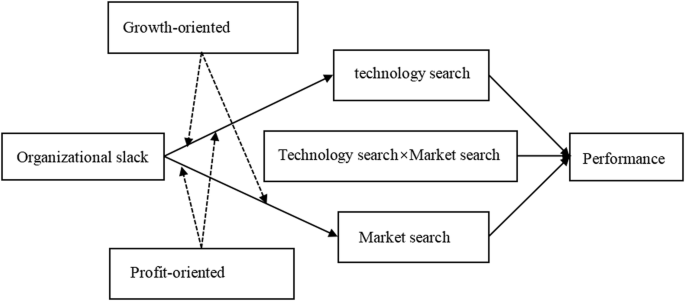
The research model is displayed in Fig. 1.
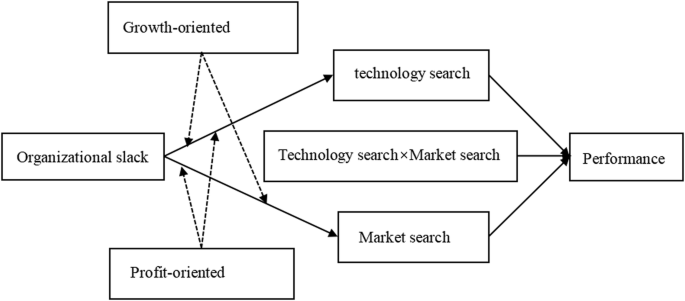
Each box represents the key variable and the arrows represent the paths of influence.












Leave a comment