
Tesla‘s (NASDAQ: TSLA) market cap is currently hovering around $1.2 trillion. Over the last three years, shares have soared by more than 50%.
What many investors may not realize, however, is that Tesla’s auto sales are actually declining. Last year, Tesla’s auto sales fell by 8%. In 2024, auto sales were down by around 1%.
Missed Nvidia in 2009? This Rare Signal Is Flashing Again.In 2009, a “Double Down” signal flashed for a little-known chipmaker called Nvidia. For the first time in years, that same “Total Conviction” signal is flashing for a company 1/100th the size of Nvidia. Continue »
Tesla’s core auto manufacturing business is by no means cratering. But it does raise the question: Why are shares doing so well despite declining sales in its biggest business segment?
The answer to this question is undoubtedly artificial intelligence. Autonomous driving is increasingly made possible by rapid advancements in AI. This is allowing Tesla to target new growth opportunities with higher growth rates and superior margins than conventional auto sales. Some experts believe that the robotaxi market, for example, will grow into a $10 trillion industry worldwide over the long term.
“We think $8 trillion to $10 trillion for the entire autonomous taxi opportunity throughout the world, from almost nothing,” predicts Cathie Wood, the CEO of Ark Invest, a major Tesla shareholder. “That’s how quickly AI is going to cause these things to happen.”
Tesla’s pivot from carmaker to AI company has already been rewarded heavily by the market. But one EV stock isn’t getting the same premium despite its new focus on AI. Growth investors could be getting a bargain.
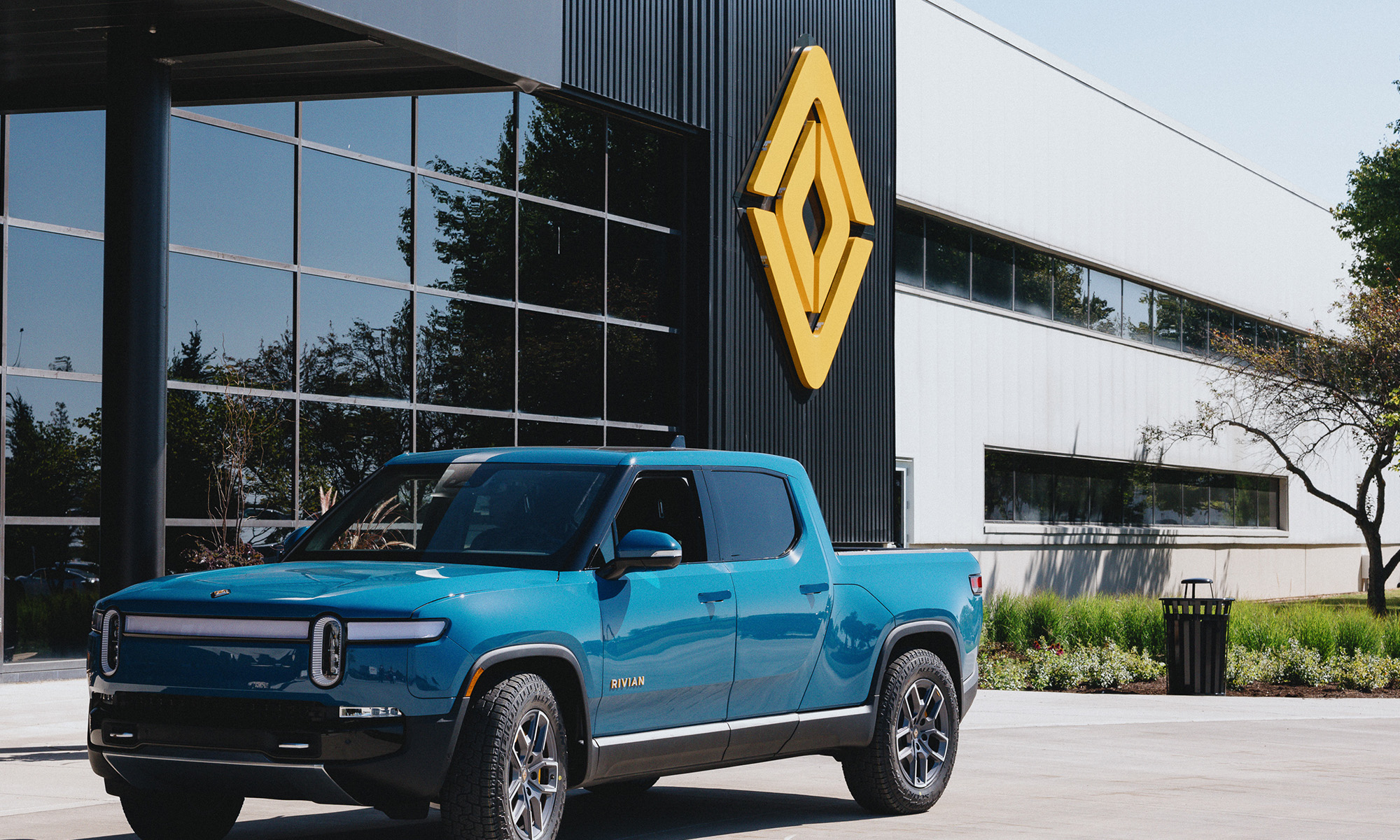
Image source: Rivian.
This Tesla competitor looks way too cheap
Rivian‘s (NASDAQ: RIVN) $19 billion market cap pales in comparison to Tesla’s $1.2 trillion valuation. But in many ways, the companies are pursuing the same growth path.
Both Tesla and Rivian are, of course, manufacturers of electric vehicles. And following the launch of Rivian’s R2 model, both companies now produce at least one vehicle with a starting price tag under $50,000.
Both companies are also going all-in on AI.
“We believe [Tesla] will aggressively bring capacity online to enable AI-driven learning cycles on product design, manufacturing processes, and software integration into products,” explains Colin Rusch, an analyst at Oppenheimer. So it’s not just self-driving robotaxis that AI will make possible for Tesla.
Rivian, meanwhile, announced a major strategic shift last December, one that will see the company significantly increase its investments in AI, to the point that Rivian no longer expects to be profitable in 2027. “We believe autonomy will be a key fundamental long-term differentiator for our business,” Claire McDonough, Rivian’s CFO, stressed in February.
Tesla enjoys many advantages that Rivian lacks. It has brand name recognition, an influential CEO in Elon Musk, and a sizable capital advantage. But Rivian’s stock price arguably reflects those disadvantages more than it should. Shares trade at just 3.3 times sales, versus Tesla’s 13.8 times sales. Plus, experts expect Rivian to grow its sales by 31% this year, with another 64% growth expected in 2027. Tesla’s sales, meanwhile, are projected to grow by just 8% this year, with 16% growth expected in 2027.
To be fair, there are also differences in each company’s approach to AI and autonomy. Tesla has already established its own robotaxi service in several metro areas of Texas. Musk has teased rapid expansion, but some reports suggest that Tesla’s robotaxi fleet is actually shrinking. Rivian, meanwhile, has positioned itself as a supplier to the robotaxi versus a direct competitor. Earlier this year, it agreed to sell up to 50,000 R2 SUVs to Uber Technologies in a $1.25 billion deal. Uber is expected to use the vehicles for its own robotaxi fleet.
I previously speculated that as the robotaxi market heats up, more robotaxi operators will seek supply deals from Rivian. That’s because many robotaxi competitors, while backed by big-tech budgets, don’t produce their own vehicles. Therefore, these operators need to source vehicles from third-party suppliers to grow.
It’s unclear when the market will wise up to Rivian’s potential. It may take a few years for actual underlying growth to buoy the stock’s struggling valuation. But for patient investors, few growth stocks look as attractive as Rivian right now.
Should you buy stock in Rivian Automotive right now?
Before you buy stock in Rivian Automotive, consider this:
The Motley Fool Stock Advisor analyst team just identified what they believe are the 10 best stocks for investors to buy now… and Rivian Automotive wasn’t one of them. The 10 stocks that made the cut could produce monster returns in the coming years.
Consider when Netflix made this list on December 17, 2004… if you invested $1,000 at the time of our recommendation, you’d have $387,428!* Or when Nvidia made this list on April 15, 2005… if you invested $1,000 at the time of our recommendation, you’d have $1,221,398!*
Now, it’s worth noting Stock Advisor’s total average return is 895% — a market-crushing outperformance compared to 205% for the S&P 500. Don’t miss the latest top 10 list, available with Stock Advisor, and join an investing community built by individual investors for individual investors.
*Stock Advisor returns as of June 25, 2026.
Ryan Vanzo has no position in any of the stocks mentioned. The Motley Fool has positions in and recommends Tesla and Uber Technologies. The Motley Fool has a disclosure policy.











Leave a comment