

- Kang Byung-ha, an executive at Meritz Securities, said the digital-asset market will grow around institutions, the regulated financial sector and real financial demand.
- Meritz Securities said it plans to gradually expand its tokenized securities (STO) business, with blockchain-based distribution and payment infrastructure and tokenized securities as core pillars.
- Kang said financial infrastructure will be reshaped to reduce payment and settlement costs and processing times through the combination of blockchain and AI agents.
Forecast Trend Report by Period


Interview with Kang Byung-ha, Executive Director of Strategic Planning at Meritz Securities
Digital-asset market shifts toward institutions and real demand
STOs, RWAs and stablecoins to drive growth
“Blockchain and AI to reshape payments and settlement”
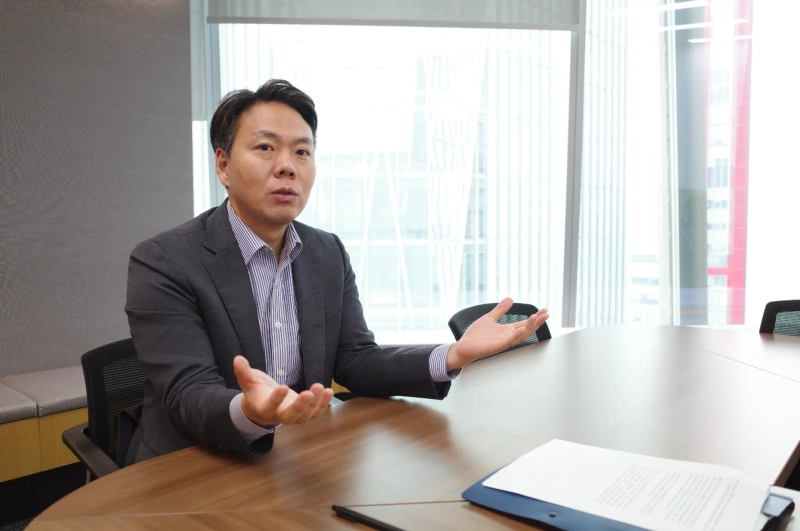
“The digital-asset market will be led increasingly by institutions and the regulated financial sector, growing on real financial demand rather than speculative appetite. Digital assets should now be viewed not simply as investment targets, but as part of a broader ecosystem that includes tokenized financial products and blockchain-based distribution and payment infrastructure.”
Traditional financial assets are moving on-chain in earnest, pushing the digital-asset market into a new inflection point, Kang Byung-ha, executive director of strategic planning at Meritz Securities, told Bloomingbit in an Aug. 20 interview. In the past, the market was driven by price gains and speculative demand. Going forward, he said, institutions and real demand will drive growth through tokenized securities, real-world asset tokenization and stablecoins.
“In the early stages of the market, there was excessive focus on prices and strong speculative demand,” Kang said. “Now the market is maturing as attention shifts to technology and practical use cases. Over time, institutions and the regulated sector will take center stage, and the market will grow on the basis of real financial demand.”
Institutions reshape the market, from speculation to real demand
Kang said the boundary between traditional finance and digital assets is breaking down quickly. Firms such as BlackRock are expanding into blockchain-based products. At the same time, companies that started in Web3, such as Ondo Finance, are widening their ties with regulated finance.
“Traditional financial firms are bringing digital assets into their existing business lines, while digital-asset companies are trying to extend their reach into regulated finance,” he said. “Markets that allow institutions to participate in a stable way, such as tokenized securities and stablecoins, are also beginning to take shape.”
As tokenization spreads across financial products, securities firms will be able to handle a broader range of products and reach a wider investor base, he said. That could improve access to overseas assets and make global capital flows more seamless.
Kang said tokenized assets could expand liquidity, lower transaction costs and shorten settlement cycles. They can be traded without being constrained by the operating hours of traditional exchanges. Greater liquidity could also help cut trading costs and speed settlement.
For financial firms, the ability to respond to the shift on-chain will become a key determinant of competitiveness, Kang said. Investment costs and trial and error will be unavoidable as firms adopt new financial infrastructure. But if the market structure is reshaped, the gap between early movers and laggards could widen.
Meritz to gradually expand tokenized securities business
Meritz Securities has set up a dedicated digital-assets team and is preparing new investment products such as tokenized securities, along with blockchain-based distribution and payment infrastructure.
“Digital assets need to be viewed through two lenses at once: investment products and the blockchain infrastructure that supports them,” Kang said. “Banks are likely to expand into stablecoin businesses based on their payment capabilities, while securities firms are likely to broaden their tokenized securities businesses based on their experience handling stocks and bonds.” He added that Meritz Securities also sees tokenized securities as an important business area.
Kang said the strengths securities firms have built in product sourcing, capital matching and distribution could also translate into an edge in on-chain finance. Financial firms are well positioned to identify investment opportunities that require large pools of capital and trust, and to offer them at scale to institutional and retail clients. Participation by regulated financial institutions could also reduce counterparty risk in decentralized markets and improve investor protection, he said.
Meritz Securities plans to expand the scope of its tokenized securities business in stages as regulations evolve. It is first preparing to focus on non-standardized securities. If tokenization of standardized securities such as stocks and bonds is later allowed, the firm is considering expanding into related brokerage businesses.
“The industry has made substantial preparations in both technology and business and is now waiting for a regulatory framework to be put in place,” Kang said. “Once the regulatory environment becomes clearer, financial companies will be able to move ahead in earnest.”
Kang also said the next three to five years will be a hybrid phase in which traditional finance and digital-asset markets continue to grow separately while increasing their points of contact. Rather than being integrated immediately onto a single platform, the two markets will develop independently and gradually converge, he said.
“Tokenization is only the tip of the iceberg” as AI reshapes payments and settlement
Kang said the combination of blockchain and artificial intelligence will improve efficiency across financial infrastructure. Blockchain would provide the base layer for processing transactions and payments. AI agents operating on top of that could automate trade execution, error verification and know-your-customer procedures.
“The combination of blockchain and AI agents could have an especially large impact in payments and settlement,” he said. “The expansion of tokenized investment products may be only the tip of the iceberg in terms of what financial consumers will actually feel.”
That shift could reduce the time needed for asset transfers and cash settlement after a trade is executed. If AI automates related procedures, both costs and processing times across financial infrastructure could fall.
Kang also expressed expectations for EastPoint: Seoul 2026, a private global conference on Web3, digital assets and AI scheduled for Sept. 28.
“Through EastPoint, financial firms can embrace innovation and new experiments from the digital-asset industry, while digital-asset companies can learn stability, compliance and consumer-protection frameworks from financial institutions,” he said. “I hope EastPoint becomes a venue where both industries learn from each other’s strengths and make up for what they lack.”
Kang Min-seung, Bloomingbit reporter minriver@bloomingbit.io













Leave a comment