
Increasingly advanced IP infringement of Korean companies
Beyond follow-up measures, the Ministry of Land, Infrastructure and Transport introduced K-government certified trademarks, and expanded and reorganized to four departments responding to technology crimes
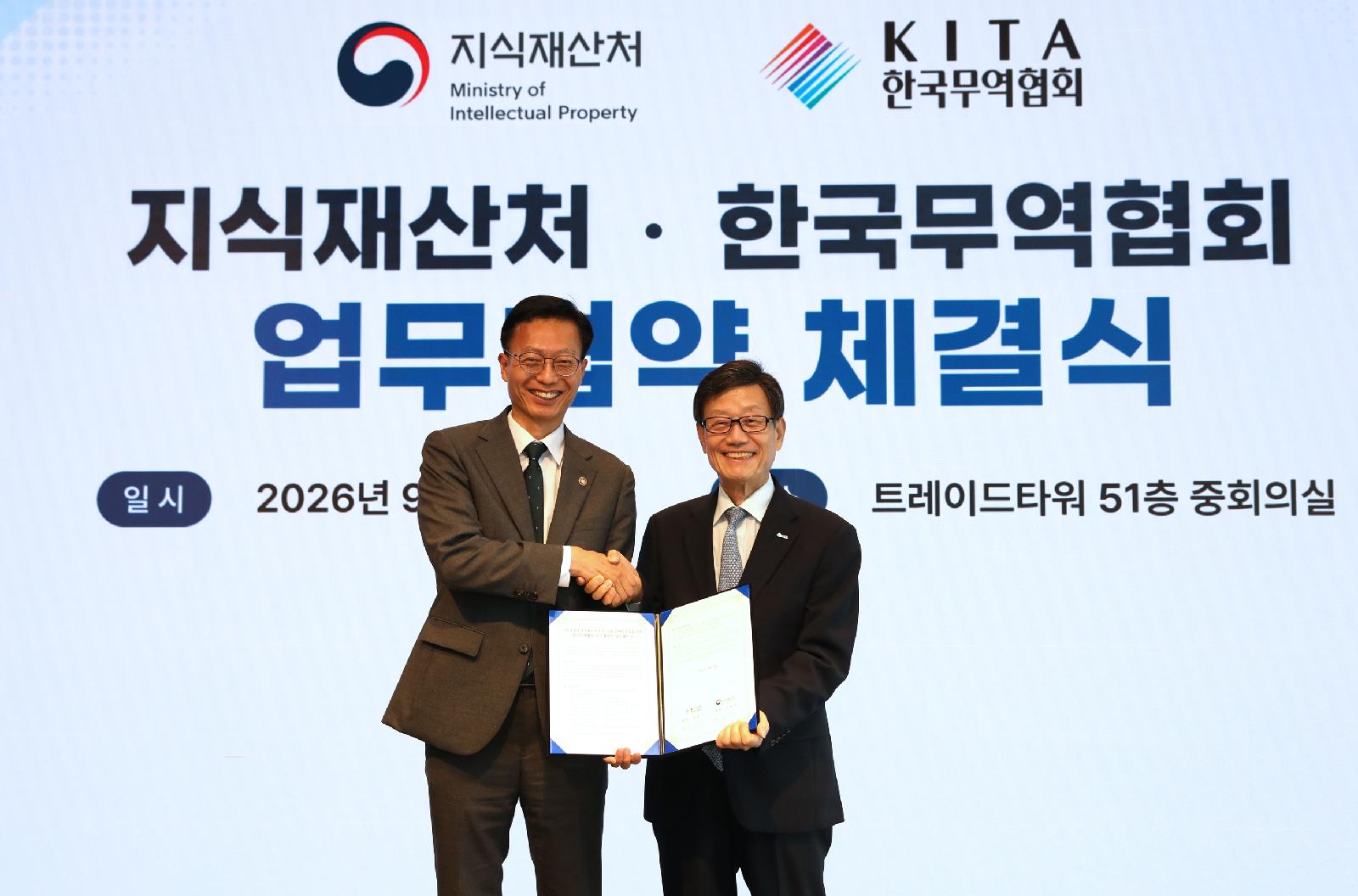
![Director of Intellectual Property Kim Yong-sun (left) is taking a commemorative photo with Yoon Jin-sik, chairman of the Korea International Trade Association, after signing a "business agreement to strengthen export competitiveness and protect intellectual property of exporting companies" at the Korea International Trade Association in Gangnam-gu, Seoul on the 3rd. [Intellectual Property Office]](https://wimg.mk.co.kr/news/cms/202609/03/rcv.YNA.20260903.PYH2026090320190001300_P1.jpg)
The battlefield of the global economy is shifting from tangible to intangible. Beyond tangible assets such as factories and equipment, intangible assets such as patents, trademarks, copyrights, and trade secrets have emerged as the core of national competitiveness.
Technology hijackers have also shifted their activities. In particular, Korean intellectual property (IP), which has recently been in the spotlight in the global market, has emerged as a major target of attack. From cutting-edge technologies such as semiconductors and secondary batteries to K-pop, K-beauty, K-food, webtoons, and games, we are looking at opportunities to steal.
Infringement methods are also being advanced. Distribution of counterfeit goods abroad through online platforms, technology leaks targeting key personnel and trade secrets, and illegal copying of K contents based on overseas servers are now threatening national economic security beyond corporate damage.
The government’s paradigm in responding to the IP war has also taken a turning point. It is typical to speed up the establishment of a “preemptive IP protection system” that detects risks in advance and quickly blocks the spread, away from post-mortem measures that rescued rights after infringement.
Ministry of Land, Infrastructure and Transport Blocks Overseas Fake Distribution
In proportion to the popularity of K brand, the size of the overseas counterfeit goods market has also soared. According to the Organization for Economic Cooperation and Development (OECD), counterfeit products distributed worldwide are worth $9.7 billion (about 11 trillion won), accounting for 1.5% of Korea’s total exports.
As a result, domestic companies are estimated to lose 7 trillion won in sales, 14,000 job losses, and 1.8 trillion won in tax revenue. The industry believes that the damage, which has not been officially counted, will be much greater.
Due to the local authorities’ non-cooperation in the investigation and the low amount of damages, the response of individual companies was clear. In particular, small and medium-sized enterprises were burdened with securing overseas trademark rights and reporting procedures for local platforms.

Accordingly, the Ministry of Intellectual Property introduces the ‘K brand government certification system’. It plans to directly register state-certified trademarks to 73 major exporting countries with high risk of distribution of counterfeit goods. It is to attach a certification trademark to export products so that consumers can immediately check whether they are genuine with a smartphone.
The Ministry of Intellectual Property has secured 9.5 billion won in related budgets through this year’s supplementary budget, and is currently recruiting first participating companies through the website of the Korea Intellectual Property Protection Agency. The deadline for applications is the 11th.
The government will also reorganize its response system in the event of detecting counterfeit products. Instead of having companies respond individually, the government operates a pan-governmental response network that directly requests local related agencies to investigate, crack down, and hold customs clearance.
It has also strengthened its artificial intelligence (AI)-based online counterfeit product surveillance network. The number of monitored countries has been expanded from 8 to 115, and 480,000 online counterfeit products were blocked last year alone.
Advanced technology leaks, dedicated organizations respond
Believing that the leakage of high-tech technologies is directly related to national interests, the government has taken measures to prevent the leakage itself. This is because core national technologies such as semiconductors, secondary batteries, and AI are almost impossible to recover when they are leaked overseas.
“In the past, the key to IP protection was ‘how many infringers are caught’, but now it is becoming more important to ‘how quickly to detect and block risks before infringement occurs,’ said Kim Yong-sun, head of the Intellectual Property Office. “Technology, brands, and content are no longer just assets of companies.” It is a key strategic asset of a country that influences exports and industrial competitiveness, national image and economic security, he stressed.
Accordingly, the Ministry of Intellectual Property expanded the technical crime response organization from 1 department to 4 departments in June, and increased the number of technical police personnel from 27 to 61. The reorganization is meaningful in that it has established a comprehensive technology protection system that leads to “analysis, detection, investigation, and countermeasures” beyond simple scale expansion.
The newly established “Intellectual Property Protection Analysis Division” analyzes patent information and technology trends to detect the risk of leakage in advance. The “Special Judicial Police Department of Technology Leakage” is in charge of cases of leakage of key national technologies and trade secrets, while the “Special Judicial Police Department of Technology Design” is in charge of investigating patent and design infringement.
In August, an “Experts Advisory Committee on Technology Leakage and Extortion,” consisting of experts in criminal law and digital forensics, was also launched to enhance the expertise of the investigation.
In response, the Ministry of Intellectual Property sent a total of 347 criminals who violated intellectual property, including technology leakage, exploitation, and counterfeit products, to the prosecution in the first half of the year. This is a 32% increase compared to the same period last year (262 people). In addition, 186 people were sent to the prosecution for counterfeit goods crimes, up 32% from the same period last year (141 people).
![President Lee Chun-moo, head of the National Intellectual Property Committee's Intellectual Property Strategy Planning Team, gives an opening speech at the 2026 National Intellectual Property Network (KIPnet) conference held on the 3rd at El Tower in Seocho-gu, Seoul, under the theme of realizing the value of intellectual property (IP) and global protection strategies. [Intellectual Property Office]](https://wimg.mk.co.kr/news/cms/202609/03/rcv.NEWSIS.NEWSIS.20260903.NISI20260903_0021422021_P1.jpg)
Block illegal sites as soon as they are detected
Illegal digital content distribution takes on a speed war pattern. This is because webtoons and videos are copied as soon as they are released and spread through overseas servers and variable domains. As a result, the Ministry of Culture, Sports and Tourism also accelerated its response. Through the “emergency blocking system” implemented in May, more than 1,000 illegal sites with obvious copyright infringement were immediately blocked.
The investigation infrastructure has also been strengthened. The “Copyrights Special Judicial Police Department,” which was newly established in June, uses digital forensics to track operators of illegal sites hidden behind overseas servers. It will also be more active in international cooperation with Interpol and overseas investigative agencies. In fact, in recent years, operators of illegal sharing sites naturalized in Japan have been repatriated to Korea and closed illegal sites based in Vietnam and North Africa.
The level of institutional punishment has also been significantly raised. The revised copyright law, which took effect in August, applied up to five times punitive damages for intentional infringement, strengthening the standard of criminal punishment to a maximum of seven years in prison or a fine of 100 million won. Intermediary platforms that only provide original links have also been included in the punishment list to eliminate legal blind spots.











Leave a comment