
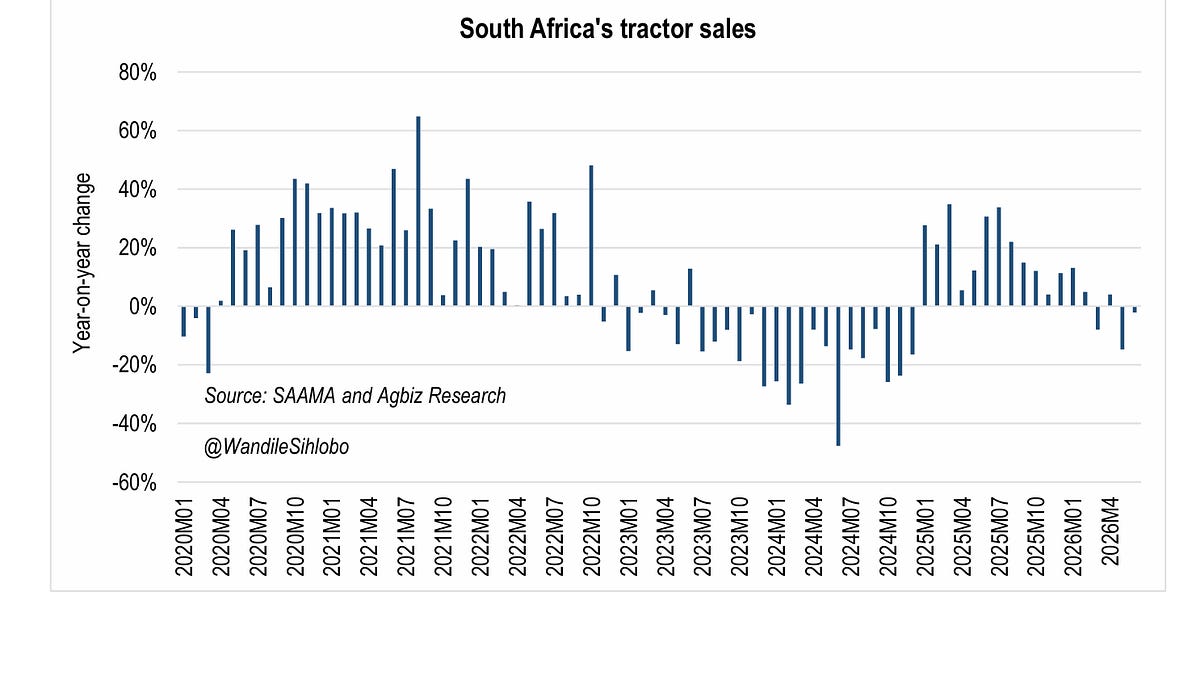
South Africa’s tractors and combine harvester sales fell in June due to a combination of factors. These include the delayed summer crop harvest in the 2025-26 season, uncertainty about the weather outlook heading into the 2026-27 season and relatively higher input costs driven by the war in the Middle East.
Indeed, Iran and the U.S. are currently negotiating a peace deal, and we are seeing the benefits of a likely peace in the easing of input costs from recent levels. Still, costs remain higher than a year ago, and uncertainty lingers.
The data released on July 7, 2026, by the South African Agricultural Machinery Association shows that tractor sales fell by 2% year-on-year in June 2026, with 623 units sold, and combine harvester sales declined by 15%, with 11 units sold.
This decline is unsurprising and marks the change in sales direction for the coming months. South Africa has had a good run, with strong tractor sales for much of 2025 and into the early months of 2026. There was always going to be some normalisation.
The robust sales in recent months were driven by the ample harvest in the 2024-25 production season, particularly of grains and oilseeds, which supported farmers’ incomes.
The horticulture industry also performed well in that period, supporting farmers’ incomes. The fact that the interest rates were also relatively low was another important boost to sales.
In the current 2025-26 production season, South Africa still has an ample harvest, with an expected record summer grain and oilseed harvest of 21.49 million tonnes, up 5% year-on-year. This production figure comprises maize, sunflower seed, soybean, groundnuts, sorghum, and dry beans.
But this ample summer grain harvest is unlikely to support future sales. The forecast for an El Niño in the season ahead will likely place additional strain on the farming sector, as farmers face lower commodity prices for harvested crops, particularly grains, oilseeds, and sugarcane, at a time when input costs are somewhat higher than in recent past seasons.












Leave a comment