
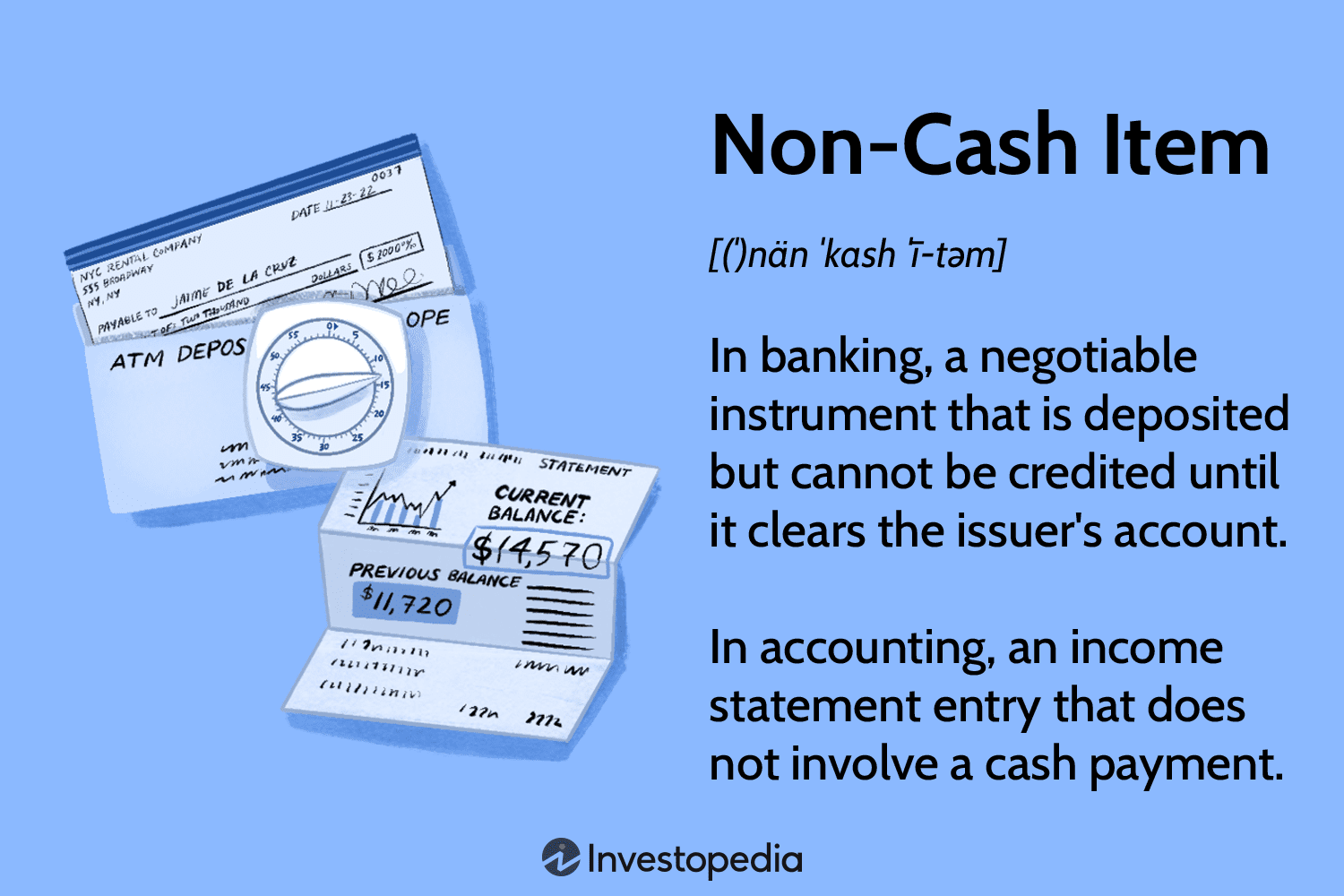
What Is a Non-Cash Item?
A non-cash item can mean different things. In banking, it refers to things like checks or bank drafts that are deposited but not credited until they clear. These items are treated differently in each field. In accounting, a non-cash item is an expense on an income statement that doesn’t involve cash, like depreciation or investment gains.
Non-cash items have an impact on financial statements and cash flow.
Key Takeaways
- A non-cash item in banking is a negotiable instrument, like a check, that requires clearing before being credited.
- In accounting, non-cash items appear on financial statements but do not impact cash flow.
- Examples of non-cash items include depreciation, amortization, and stock-based compensation.
- Non-cash items are often based on estimates, posing a risk of inaccuracies.
- Depreciation and amortization reduce taxable income without involving actual cash transactions.
Get personalized, AI-powered answers built on 27+ years of trusted expertise.
Exploring the Role of Non-Cash Items in Financial Statements
Accounting
Income statements show how much money companies earn or lose. They include items that affect earnings but not cash flow. That’s because in accrual accounting, companies measure their income by also including transactions that do not involve a cash payment to give a more accurate picture of their current financial condition.
Non-cash items examples include deferred taxes, company write-downs, employee stock compensation, depreciation, and amortization.
Banking
Banks may hold a large check for several days, depending on account history and the payor’s financial stability.
The float is the short time when both banks have access to funds before the check clears.
Depreciation and Amortization Example
Depreciation and amortization are perhaps the two most common examples of expenses that reduce taxable income without impacting cash flow. Companies factor in the deteriorating value of their assets over time in a process known as depreciation for tangibles and amortization for intangibles.
For example, say a manufacturing business called company A forks out $200,000 for a new piece of high-tech equipment to help boost production. The new machinery is expected to last 10 years, so company A’s accountants advise spreading the cost over the entire period of its useful life, rather than expensing it all in one big hit. They also factor in that the equipment has a salvage value, the amount it will be worth after 10 years, of $30,000.
Depreciation seeks to match up revenue with its associated expenses. Dividing $170,000 by 10 means that the equipment purchased will be shown as a non-cash item expense of $17,000 per year over the next decade. However, no money was actually paid out when these annual expenses were recorded, so they appear on income statements as a non-cash charge.
Key Considerations for Non-Cash Items in Accounting
Non-cash items often appear in financial statements but are sometimes overlooked by investors. It’s important to approach them with some skepticism.
A major risk with non-cash items is they are often based on estimates influenced by past experiences. Accrual accounting users sometimes fail to accurately estimate revenues and expenses, whether intentionally or not.
For example, company A’s equipment might be written off before 10 years or last longer. Its salvage value could also be incorrect. Eventually, businesses must update and report actual expenses, which can cause surprises.
The Bottom Line
A non-cash item pertains to both banking and accounting. They’re items that do not impact immediate cash flow. Non-cash items in banking, like checks or bank drafts, require a clearing period before they can be credited to the account. Non-cash items in accounting are expenses recorded on financial statements, such as depreciation or amortization, that do not involve cash movements.
Understanding non-cash items is important for both businesses and investors, as they significantly affect financial reporting and the perception of a company’s financial health. They have potential risks due to estimates and assumptions that may not always hold true over time. Thorough analysis and skepticism are crucial when evaluating non-cash entries on financial statements.











Leave a comment