
Key Takeaways
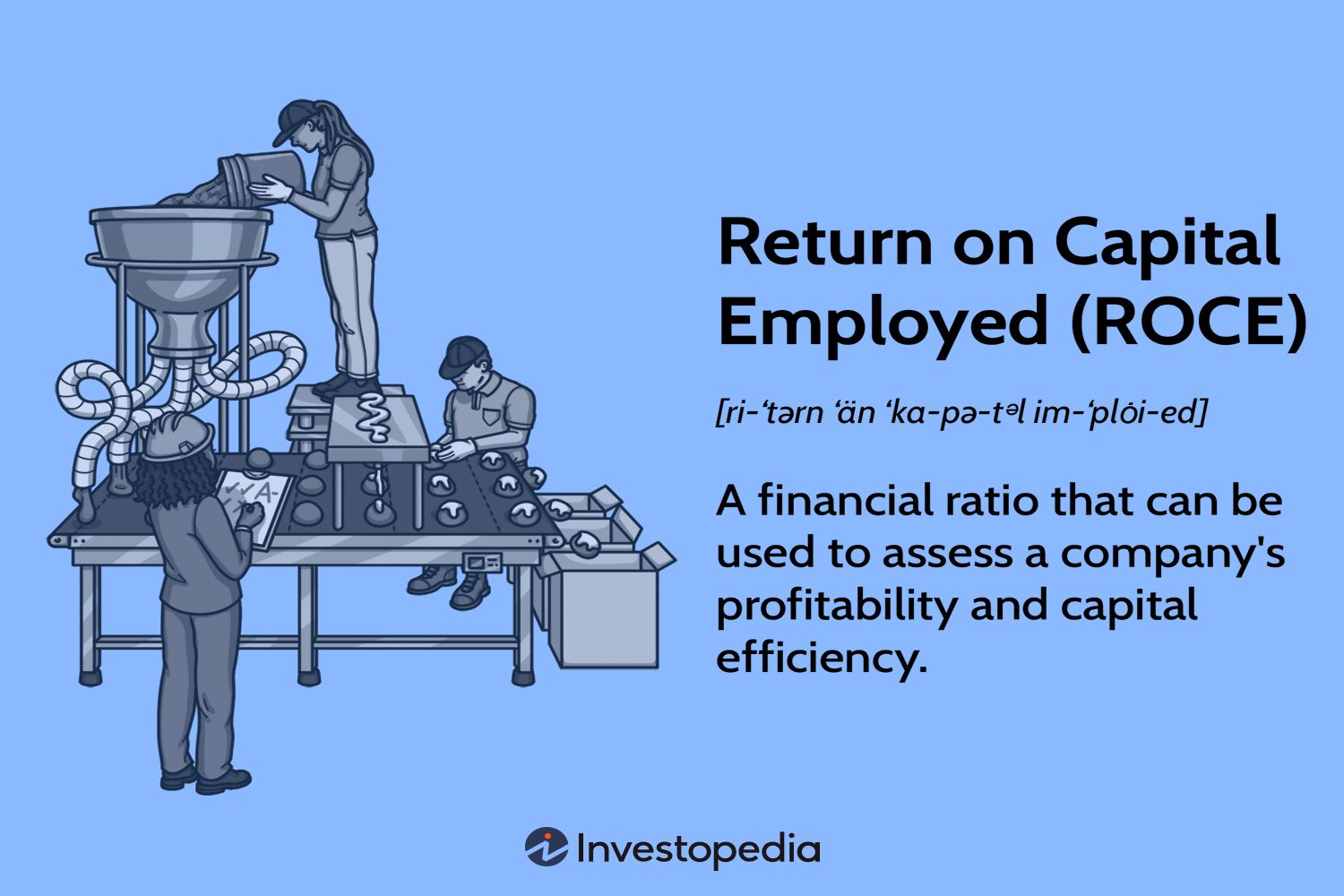
- Return on capital employed is a financial ratio that measures a company’s profitability in terms of all of its capital.
- It’s a ratio: earnings before interest and tax (a.k.a. operating income) per capital employed.
- The higher the ratio, the greater the profits generated from capital.
- ROCE includes debt and equity.
- It’s always a good idea to compare the ROCE of companies in the same industry because those from differing industries usually vary.
What Is Return on Capital Employed (ROCE)?
Return on capital employed (ROCE) is a financial metric that shows how well a company is generating profits from its capital. It’s a measure of profitability. It is one of several different financial metrics that help analysts and investors review the financial health and well-being of different companies.
Formula and Calculation of Return on Capital Employed (ROCE)
The formula for ROCE is as follows:
ROCE=Capital EmployedEBITwhere:EBIT=Earnings before interest and taxCapital Employed=Total assets − Current liabilities
ROCE is a metric for analyzing profitability and comparing profitability levels across companies in terms of capital utilization. Two components are required to calculate ROCE. These are earnings before interest and tax (EBIT) and capital employed.
Also known as operating income, EBIT shows how much a company earns from its operations alone without interest on debt or taxes. It is calculated by subtracting the cost of goods sold (COGS) and operating expenses from revenues.
Capital employed is found by subtracting current liabilities from total assets, which ultimately yields shareholders’ equity plus long-term debts.
Instead of using capital employed at an arbitrary point in time, some analysts and investors may choose to calculate ROCE based on the average capital employed, which takes the average of opening and closing capital employed for the time period under analysis.
What Return on Capital Employed (ROCE) Can Tell You
ROCE can be especially useful when comparing the performance of companies in capital-intensive sectors, such as utilities and telecoms.
This is because, unlike other fundamentals such as return on equity (ROE), which only analyzes profitability related to a company’s shareholders’ equity, ROCE considers debt and equity. This can help neutralize financial performance analysis for companies with significant debt.
The calculation of ROCE ultimately tells you how much profit a company generates per $1 of capital employed. The more profit per $1 a company can generate, the better. Thus, a higher ROCE indicates stronger profitability across company comparisons.
For a company, the ROCE trend over the years can also be an important indicator of performance. Investors tend to favor companies with stable and rising ROCE levels over companies where ROCE is volatile or trending lower.
Advantages and Disadvantages of ROCE
Advantages
ROCE provides a comprehensive measure of a company’s overall performance by considering both profitability and capital efficiency. It helps assess the effectiveness of capital allocation decisions and the ability to generate returns on invested capital.
ROCE sometimes allows for meaningful comparisons between companies operating in different industries and highlights a company’s ability to generate profits from the capital it uses.
It is an important metric for investors, as it reflects the company’s ability to generate returns on its investment. A consistently high ROCE indicates that the company is generating attractive returns, which can instill confidence in investors and potentially attract more capital.
ROCE also serves as a useful management tool for assessing the performance of different business units or projects within a company. It helps identify areas where capital may be tied up inefficiently and allows for better decision-making regarding resource allocation and investment strategies.
More specifically, ROCE provides a long-term perspective on a company’s profitability and efficiency. It considers the profitability generated over an extended period and relates it to the capital used.
Disadvantages
Because industries vary in capital needs and business models, ROCE isn’t always comparable across sectors. It also focuses on efficiency and profitability, but it doesn’t capture factors like revenue growth, margins, cash flow, or return on equity.
Since ROCE is based on past financial data, it cannot accurately reflect current market circumstances or growth possibilities. It’s a reflection of previous capital investments’ success and may not be a reliable predictor of future profitability or the potential effects of new investments.
ROCE can be manipulated via financial engineering and accounting techniques, just like any other financial indicator. It also may not take into account changes in the industry as a whole, changes in the economy, or other variables that may influence a company’s performance.
Relying entirely on ROCE might result in a limited viewpoint and an inadequate evaluation of a company’s current situation and prospects.
Pros
-
Performance evaluation combining profitability and efficiency
-
Helps identify inefficient capital utilization
-
Boosts investor confidence in returns
-
Measures capital efficiency and allocation
-
Comparability across some industries
Cons
-
Limited comparability across diverse industries
-
Historical focus may not reflect future prospects
-
Does not capture complete financial performance
-
Susceptible to manipulation
How Companies Can Improve ROCE
Improving ROCE requires a strategic approach that focuses on enhancing profitability and capital efficiency. Companies can achieve this by streamlining operations, optimizing capital allocation, and continuously monitoring and evaluating.
Operational efficiency involves streamlining and optimizing operations to reduce costs, improve productivity, and increase profitability. Companies often do this by enacting lean practices, automation, and process improvements. These solutions can eliminate waste and enhance efficiency.
Effective capital allocation also involves evaluating and prioritizing capital investment decisions. Companies can focus on projects with high potential returns and align investments with the company’s strategic objectives.
This also means prioritizing working capital management towards inventory, receivables, and payables, reducing inventory carrying costs, and shortening receivables collection periods related to the most profitable projects.
Important
Return on capital employed is also commonly referred to as the primary ratio because it indicates the profits earned on corporate resources.
Asset optimization also involves optimizing asset utilization to generate maximum returns. For example, companies can renegotiate leases and contracts, sell underutilized or non-performing assets, and explore shared asset models.
ROCE is improved when less capital is deployed. By avoiding unnecessary carrying costs or long-term investment expenses, companies can improve the returns they generate. Pricing and margins should also be reviewed. Sales and revenue growth strategies should expand market share, develop innovative products, and strengthen customer relationships.
Talent and skills development should be invested in employee training and development programs, while risk management should be mitigated to minimize negative impacts on ROCE. All of these solutions focus more on scaling the return aspect of ROCE.
Continuous monitoring and evaluation should be conducted to track progress and identify areas for improvement.
Companies should tailor their strategies to their specific industry, competitive landscape, and internal capabilities to achieve sustainable improvements in ROCE. As companies enact strategies to improve ROCE, they must be aware of unrelated repercussions that may have negative impacts elsewhere.
ROCE and Business Cycles
In many ways, ROCE is tied to changes during different economic cycles:
- Expansionary phase: During an economic expansion, demand and sales usually rise, helping companies earn more and use capital more efficiently. This can boost ROCE, especially as firms benefit from operating leverage and economies of scale.
- Peak phase: As an economic cycle peaks, growth often slows and competition increases. Companies may still be profitable, but ROCE can level off or decline because it’s harder to maintain high efficiency and returns.
- Contraction phase: During a downturn or recession, demand and sales often fall while costs rise, squeezing profits. As companies struggle to stay efficient, ROCE typically declines.
- Recovery phase: As the economy recovers, demand and sales gradually rise. Companies that manage costs well can improve profits, and ROCE often begins to recover as conditions strengthen.
- Early growth phase: Companies may invest to grow and pursue new opportunities early during the recovery period. ROCE can vary at first and may be lower due to higher capital spending, but it can rise if those investments succeed.
Return on Capital Employed (ROCE) vs. Return on Invested Capital (ROIC)
When analyzing profitability efficiency in terms of capital, both ROIC and ROCE can be used. These metrics are similar in that they provide a measure of profitability per total capital of the firm.
In general, both the ROIC and ROCE should be higher than a company’s weighted average cost of capital (WACC) for the company to be profitable in the long term. ROIC is generally based on the same concept as ROCE, but its components are slightly different. The calculation for ROIC is as follows:
Net Operating Profit After Tax ÷ Invested Capital
Net operating profit after tax is a measure of EBIT x (1 – tax rate).
So ROIC considers a company’s tax obligations, whereas ROCE does not. Invested capital in the ROIC calculation is slightly more complex than the simple calculation for capital employed used in ROCE. Invested capital may be either:
Net Working Capital + Property Plant and Equipment (PP&E) + Goodwill and Intangibles
or
Total Debt and Leases + Total Equity and Equity Equivalents – Non-Operating Cash and Investments
The invested capital is generally a more detailed analysis of a firm’s overall capital.
Example of How to Use ROCE
Consider two companies that operate in the same industry: ACE Corp. and Sam & Co. The table below shows a hypothetical ROCE analysis of both companies.
| (in millions) | ACE Corp. | Sam & Co. | |
| Sales | $15,195 | $65,058 | |
| EBIT | $3,837 | $13,955 | |
| Total Assets | $12,123 | $120,406 | |
| Current Liabilities | $3,305 | $30,210 | |
| Capital Employed | $8,818 | $90,196 | TA – CL |
| Return on Capital Employed | 0.4351 | 0.1547 | EBIT/Capital Employed |
As you can see, Sam & Co. is a much larger business than ACE Corp., with higher revenue, EBIT, and total assets. However, when using the ROCE metric, you can see that ACE Corp. is more efficiently generating profit from its capital than Sam & Co. ACE’s ROCE is 44 cents per capital dollar or 43.51% versus 15 cents per capital dollar for Sam & Co., or 15.47%.
What Does It Mean for Capital to Be Employed?
Businesses use their capital to conduct day-to-day operations, invest in new opportunities, and grow. Capital employed refers to a company’s total assets less its current liabilities. Looking at capital employed is helpful since it’s used with other financial metrics to determine the return on a company’s assets and how effective management is at employing capital.
Why Is ROCE Useful If There Are Already ROE and ROA Measures?
Some analysts prefer ROCE over ROA and ROE because the return on capital considers both debt and equity financing. These investors believe the return on capital is a better gauge of the performance or profitability of a company over a longer period.
How Is Return on Capital Employed Calculated?
Return on capital employed is calculated by dividing net operating profit, or earnings before interest and taxes, by capital employed. Another way to calculate it is by dividing earnings before interest and taxes by the difference between total assets and current liabilities.
What Is a Good ROCE Value?
While there is no industry standard, a higher return on capital employed suggests a more efficient company, at least in terms of capital employment. A ROCE of at least 20% is usually a good sign that the company is in a good financial position.
However, a lower number may also be indicative of a company with a lot of cash on hand since cash is included in total assets. As a result, high levels of cash can sometimes skew this metric.
And keep in mind that you shouldn’t compare the ROCE ratios of companies in different industries. As with any financial metric, it’s best to do an apples-to-apples comparison.
The Bottom Line
You can use a company’s return on capital employed to determine how profitable it is and how efficiently it uses its capital. You can easily calculate it using figures from corporate financial statements.
But be sure to compare the ROCE of companies within the same industry, as those from different sectors tend to have varying ratios. Having a ratio of 20% or more generally means that a company is doing well.













Leave a comment