
Key Takeaways
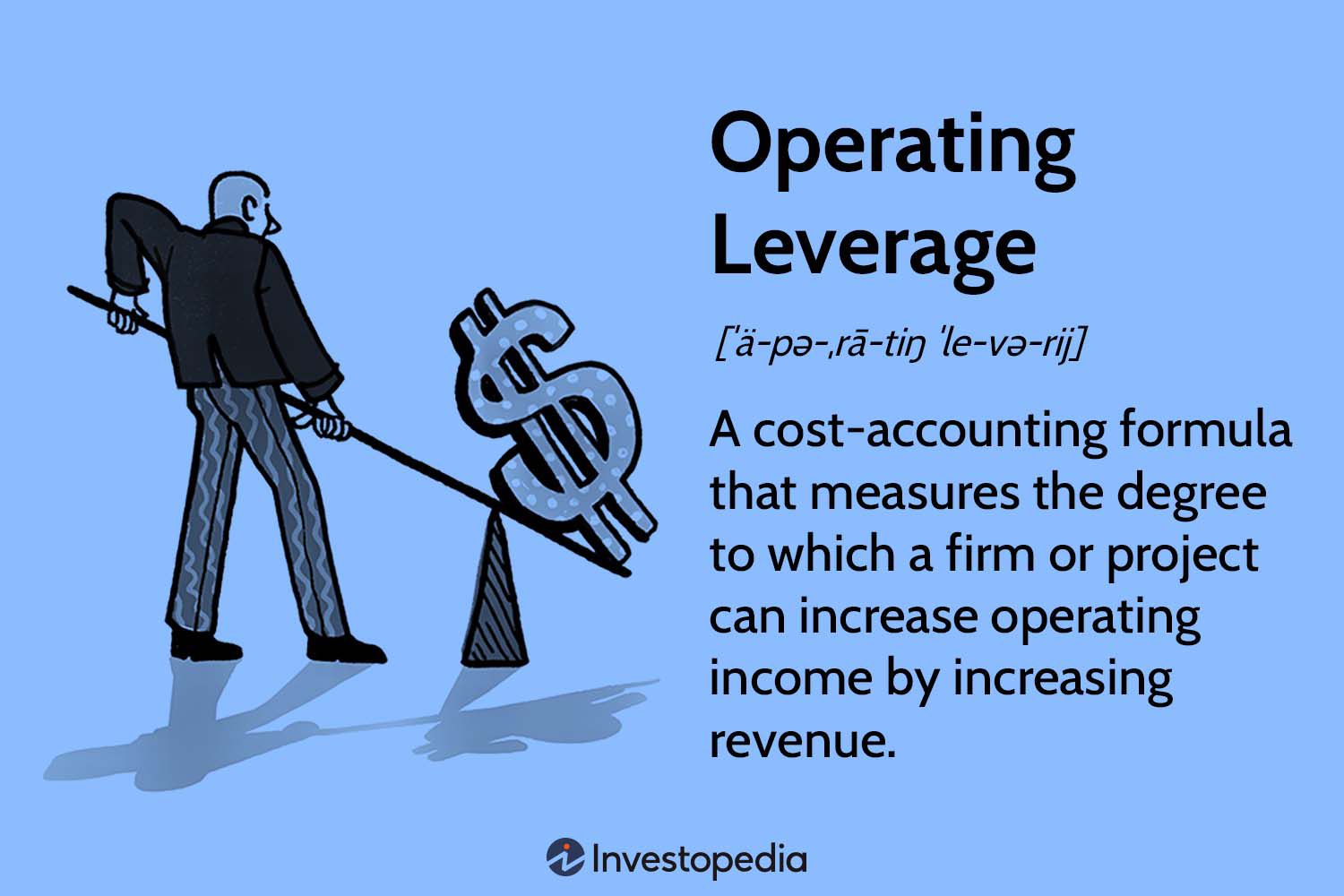
- Operating leverage measures how much a company can increase its operating income by increasing revenue. Companies with high operating leverage benefit more from sales increases but also face greater risks if sales forecasts are inaccurate.
- The degree of operating leverage (DOL) is calculated using the formula \(\frac{Q \times CM}{Q \times CM – \text{Fixed operating costs}}\), where Q is the unit quantity, and CM is the contribution margin per unit. This formula helps businesses determine their break-even point and set pricing strategies.
- Businesses with high fixed costs often have high operating leverage, which means that once they cover their fixed costs, their profits can rise significantly with sales. Conversely, businesses with high variable costs tend to have lower operating leverage.
- Operating leverage varies by industry, with certain sectors naturally having higher fixed costs. Comparing companies within the same industry offers a better understanding of their operating leverage.
- Companies like Microsoft, with high fixed costs for development and marketing, exhibit high operating leverage, while retail stores with high variable costs, such as Walmart, show low operating leverage.
Investopedia / NoNo Flores
What Is Operating Leverage?
Operating leverage is a pivotal financial ratio that measures the impact of sales on operating income. It’s used to calculate a company’s break-even point and help set appropriate selling prices that cover all costs and generate a profit. A business with a high gross margin and low variable costs has high operating leverage. Companies with high operating leverage must cover large fixed costs each month, regardless of sales. Low-operating-leverage companies may have high costs that vary directly with their sales, but they also have lower fixed costs to cover each month.
How Operating Leverage Impacts Business Strategy
The higher the degree of operating leverage, the greater the potential danger from forecasting risk, in which a relatively small error in forecasting sales can be magnified into large errors in cash flow projections.
Calculating Operating Leverage: The Formula Explained
Degree of operating leverage=ProfitContribution margin
This can be restated as:
Degree of operating leverage=Q∗CM−Fixed operating costsQ∗CMwhere:Q=unit quantityCM=contribution margin (price – variable cost per unit)
The operating leverage formula helps calculate a company’s break-even point and set selling prices to cover costs and earn profits. The formula can reveal how well a company uses its fixed-cost items, such as its warehouse, machinery, and equipment, to generate profits. The more profit a company can squeeze out of the same amount of fixed assets, the higher its operating leverage.
Companies can learn that minimizing fixed costs boosts profits without changing selling price, contribution margin, or sales volume.
Example of Operating Leverage
For example, Company A sells 500,000 products for a unit price of $6 each. The company’s fixed costs are $800,000. It costs $0.05 in variable costs per unit to make each product.
Calculate company A’s degree of operating leverage as follows:
500,000∗($6.00−$0.05)−$800,000500,000∗($6.00−$0.05)=$2,175,000$2,975,000=1.37 or 137%.
A 10% revenue increase should result in a 13.7% increase in operating income (10% x 1.37 = 13.7%).
Comparing High vs. Low Operating Leverage in Industries
Comparing operating leverage between companies in the same industry is key, as fixed costs differ by industry. The concept of a high or low ratio is then more clearly defined.
Most of a company’s costs are fixed costs that recur each month, such as rent, regardless of sales volume. As long as a business earns a substantial profit on each sale and sustains adequate sales volume, fixed costs are covered, and profits are earned.
Variable costs arise only with sales and include labor for assembly and raw material costs. Some companies earn less profit on each sale but can have a lower sales volume and still generate enough to cover fixed costs.
Important
One concept positively linked to operating leverage is capacity utilization, which is how much the company uses its resources to generate revenues. Increasing utilization infers increased production and sales; thus, variable costs should rise. If fixed costs remain the same, a firm will have high operating leverage while operating at a higher capacity.
For example, a software company has high fixed costs for developers’ salaries and low variable costs. Hence, such companies typically have high operating leverage. In contrast, a computer consulting firm charges its clients hourly and doesn’t need expensive office space because its consultants work in clients’ offices. This results in variable consultant wages and low fixed operating costs. The business thus has low operating leverage.
Most of Microsoft’s costs are fixed, such as expenses for upfront development and marketing. With each dollar in sales earned beyond the break-even point, the company makes a profit, but Microsoft has high operating leverage.
Conversely, Walmart has low fixed costs but high variable costs, especially for merchandise. Because Walmart sells a huge volume of items and pays upfront for each unit it sells, its cost of goods sold increases as sales increase. Because of this, Walmart stores have low operating leverage.
What Does Operating Leverage Tell You?
The operating leverage formula is used to calculate a company’s break-even point and help set appropriate selling prices to cover all costs and generate a profit. This can reveal how well a company uses its fixed-cost items, such as its warehouse, machinery, and equipment, to generate profits. The more profit a company can squeeze out of the same amount of fixed assets, the higher its operating leverage.
One conclusion companies can learn from examining operating leverage is that firms that minimize fixed costs can increase their profits without making any changes to the selling price, contribution margin, or the number of units they sell.
What Is the Degree of Operating Leverage (DOL)?
The degree of operating leverage (DOL) is a multiple that measures how much the operating income of a company will change in response to a change in sales. Companies with a large proportion of fixed costs (or costs that don’t change with production) to variable costs (costs that change with production volume) have higher levels of operating leverage. The DOL ratio assists analysts in determining the impact of any change in sales on company earnings or profit.
What Are Examples of High and Low Operating Leverage?
Companies with high fixed costs tend to have high operating leverage, such as those with a great deal of research & development and marketing. With each dollar in sales earned beyond the break-even point, the company makes a profit. Conversely, retail stores tend to have low fixed costs and large variable costs, especially for merchandise. Because retailers sell a large volume of items and pay upfront for each unit sold, COGS increases as sales increase. Because of this, such stores often have low operating leverage.
The Bottom Line
Operating leverage is the ratio of a business’s fixed costs to its variable costs. This ratio is often used to forecast sales and determine appropriate prices. Operating leverage is used by companies to increase operating income by adjusting revenue. It helps them set appropriate pricing strategies that can cover their costs and generate profits. Companies that minimize fixed costs can effectively increase profits without altering their sales price or contribution margin.










Leave a comment