
The Compounding Logic Behind Long-Life Gold Portfolios
Most conversations about gold mining companies begin and end with the gold price. Yet for investors with a multi-year horizon, the more consequential variable is rarely the spot price of the metal itself. It is the depth and quality of the mineable inventory sitting beneath the surface of a company’s operating assets. A miner with shallow reserves depleting faster than they are replaced is effectively a shrinking business dressed in commodity price momentum. A miner systematically converting exploration success into economically mineable inventory over successive years is compounding its intrinsic value underground, sometimes quietly, before the market fully prices it in.
Evolution Mining Ltd (ASX: EVN) released its Annual Mineral Resources and Ore Reserves Statement for the year ended 31 December 2025, and the results reinforce a trajectory the company has been building since 2011. Understanding what those figures mean, how they were achieved, and what they imply for production visibility requires looking beyond the headline numbers into the core logic of Evolution Mining resource and reserves growth.
When big ASX news breaks, our subscribers know first
Understanding the Language of Resource Statements Before Reading the Data
Before examining asset-level movements, it helps to understand the classification framework that governs how these figures are compiled. Australian mining companies reporting under the JORC Code (Joint Ore Reserves Committee) must classify mineral inventory according to geological confidence and economic viability, two distinct but related assessments. Understanding mining project fundamentals is therefore essential before diving into the data.
The key terms investors encounter in annual resource statements are:
- Mineral Resource: A concentration of mineralised material with reasonable prospects for eventual economic extraction, subdivided into Inferred (lowest confidence), Indicated (moderate confidence), and Measured (highest confidence) categories based on drilling density and geological continuity.
- Ore Reserve: The economically mineable subset of a Mineral Resource, derived after applying mining, processing, dilution, and cost assumptions. Only Measured and Indicated Resources can be converted to Reserves.
- AISC (All-In Sustaining Cost): A standardised cost metric covering all operating and sustaining capital expenditures per ounce of gold produced. It provides a more complete picture of mining economics than cash cost alone.
- Resource-to-Reserve Conversion: The process through which geological drilling upgrades confidence and modelling incorporates economic parameters to move material from the resource category into the bankable reserve category.
“A common investor misconception is treating all resource announcements as equivalent. A 1 Moz increase in Inferred Resources carries fundamentally different implications than a 1 Moz increase in Ore Reserves. The latter has been tested against real economic assumptions and represents genuinely mineable inventory.”
Furthermore, interpreting drill results correctly is critical to understanding how resource confidence builds over time, particularly when evaluating year-on-year inventory movements.
Group-Level Evolution Mining Resource and Reserves Growth: The 2025 Snapshot
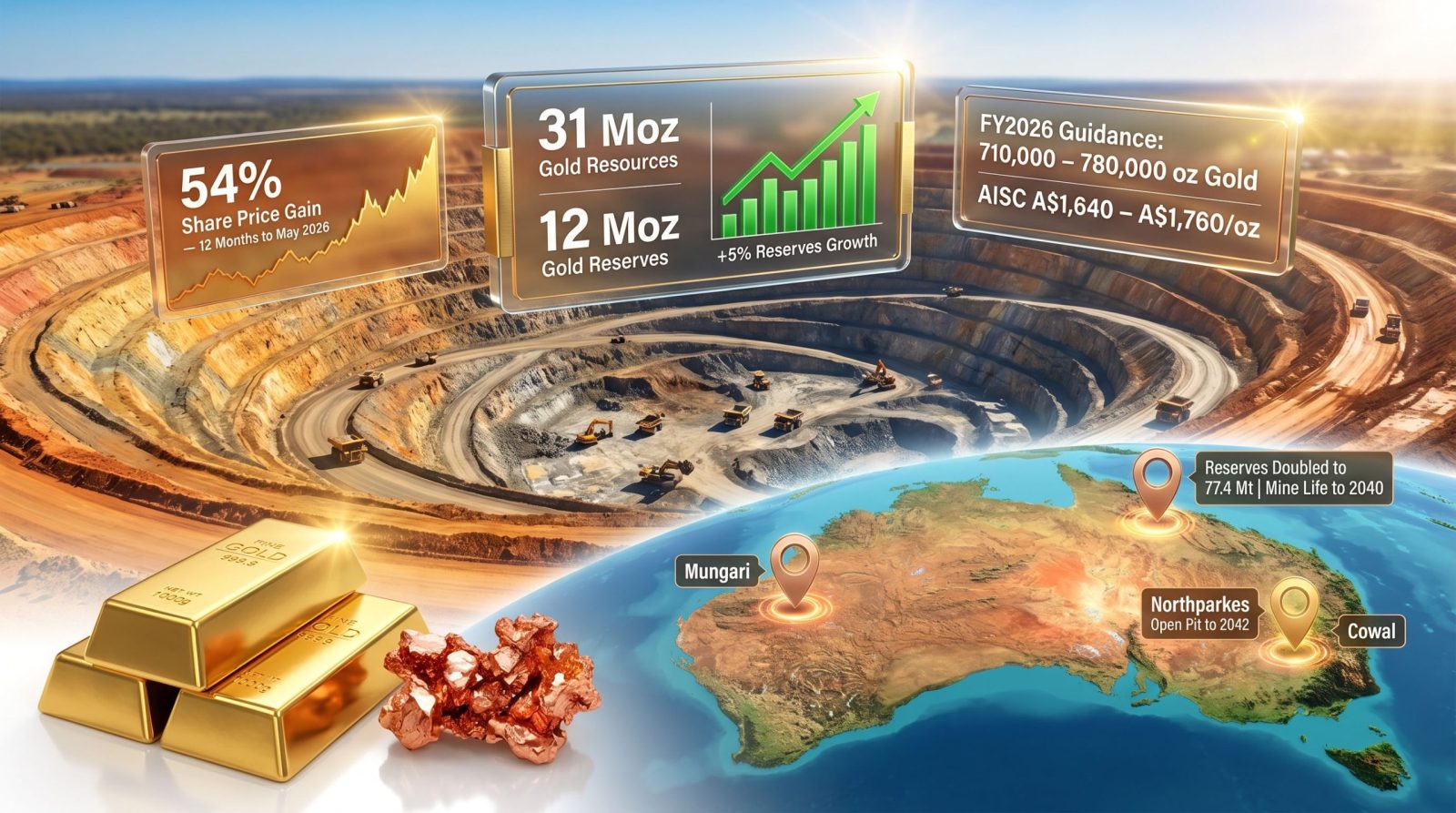
As at 31 December 2025, Evolution Mining reported Group Mineral Resources of 31 million ounces (Moz) of gold and 4.2 million tonnes (Mt) of copper, alongside Ore Reserves of 12 Moz of gold and 1.3 Mt of copper.
The year-on-year movements tell a nuanced story:
| Metric | Prior Year (Approx.) | December 2025 | Change |
|---|---|---|---|
| Group Gold Resources | ~30.1 Moz | 31.0 Moz | +0.9 Moz (+3%) |
| Group Copper Resources | ~4.4 Mt | 4.2 Mt | -0.2 Mt (-4%) |
| Group Gold Reserves | ~11.5 Moz | 12.0 Moz | +0.5 Moz (+5%) |
| Group Copper Reserves | ~1.35 Mt | 1.3 Mt | Slight decline |
The 3% uplift in contained gold represents organic growth driven by drilling success, while the 5% reserve growth is particularly meaningful because it reflects material that has cleared the economic viability hurdle. Gold reserve growth outpacing resource growth is a positive signal; it suggests the company is not only discovering mineralisation but converting it efficiently into mineable inventory.
Managing Director and CEO Lawrie Conway noted that the December 2025 statement reflects the scale and longevity of a high-quality, long-life portfolio, complemented by expansion studies that offer further upside. Conway also highlighted the potential to grow copper resources beyond the current 4.2 Mt base, with targeted exploration activities accelerating around Ernest Henry and Northparkes over the following twelve months. You can review the full details in Evolution Mining’s official resources and reserves disclosures.
Asset-Level Breakdown: Where Evolution Mining Resource and Reserves Growth Was Generated
Cowal (NSW): The Portfolio’s Standout Contributor
Cowal in central New South Wales delivered the most significant single-asset contribution to the group’s resource growth, with Mineral Resources increasing by +1.2 Moz of contained gold. Ore Reserves at the asset expanded by +0.67 Moz, underpinned by extension drilling at the Dalwhinnie South zone and deeper drilling programs targeting the Regal deposit.
The reserve growth at Cowal is analytically distinct from a simple discovery announcement. The drilling has increased geological confidence in existing mineralised zones, advancing material from Inferred to Indicated and ultimately into Reserve classification. This resource-to-reserve conversion process, as distinct from finding new deposits, reflects disciplined mine planning and is a more reliable indicator of near-term production support.
Cowal’s operational horizon was extended to 2042 following Open Pit Continuation approval in April 2025, giving the asset more than 17 years of permitted mine life from the current date. That longevity provides multi-year production planning certainty and reduces the permit renewal risk that can weigh on shorter-life assets.
Northparkes (NSW): Copper-Gold Expansion Study in Progress
Northparkes contributed an open pit Mineral Resource increase of +0.17 Moz of contained gold. While modest relative to Cowal, Northparkes carries strategic importance as one of Evolution’s two primary copper growth vectors.
The Northparkes expansion study, expected to be completed by the end of FY2027, is evaluating further Mineral Resource and Ore Reserve growth with a particular emphasis on the copper inventory. The E48 sub-level cave development continues to support near-term production scheduling, while an elevated exploration budget for FY2026 specifically targets copper resource expansion.
Sub-level caving (SLC) is a bulk underground mining method that allows high-volume extraction from large, low-grade deposits by systematically collapsing ore from above and drawing it through production drifts below. For copper-gold porphyry systems like those at Northparkes, SLC enables cost-effective large-scale extraction that would be uneconomic through conventional open stoping.
Mungari (WA): High-Grade Extensions Adding Runway to 2038
Mungari in Western Australia has delivered historical resource additions of +1.3 Moz from successive drilling campaigns, and recent drilling continues to confirm extensions to high-grade gold mineralisation. The mine life has been extended to 2038, providing more than a decade of operational runway beyond the current date.
Importantly, recent high-grade intercepts at Mungari have not yet been incorporated into current reserve figures. These results represent exploration upside that sits outside the current economic inventory, meaning they could contribute to future reserve upgrades if continued drilling supports geological confidence upgrades and economic evaluation confirms viability.
Ernest Henry (QLD): Ore Reserves Doubled, Mine Life Extended to 2040
Ernest Henry represents one of the most significant reserve growth stories in the portfolio over recent years. Ore Reserves at the asset approximately doubled to around 77.4 million tonnes, containing approximately 589,000 tonnes of copper and 1.109 Moz of gold. Targeted drilling programs delivered historical resource additions of approximately +400,000 oz of gold.
The mine life extension to 2040 cements Ernest Henry as a cornerstone asset within the group. As an underground copper-gold operation with high throughput, Ernest Henry is also the primary driver of the group’s copper production. Active mining depletion at the asset was the main contributor to the year-on-year decline in copper Mineral Resources at group level, a distinction that matters for accurate operational assessment.
“Mining depletion is the consumption of reserves through productive extraction. When depletion is the primary driver of a resource decline, as it was at Ernest Henry for copper, it reflects successful high-throughput operations rather than geological disappointment.”
Red Lake Tailings (Canada): A Reserve Addition Offsetting Depletion Elsewhere
The Red Lake Tailings project in Ontario contributed +0.2 Moz to group Ore Reserves, partially offsetting depletion across the broader portfolio. This reserve addition from a non-traditional source — reprocessing of historical tailings material — illustrates how established gold operations can generate incremental reserve inventory from previously treated material as processing economics evolve.
It is worth noting that Red Lake’s broader Mineral Resource base was previously revised downward by approximately 4.5 Moz as a result of updated geological modelling. That revision, aimed at improving resource confidence and operational stability, represents a recalibration toward higher-quality inventory rather than a fundamental change in asset value.
What the Copper Decline Actually Signals
The 200 kt (4%) decline in copper Mineral Resources across the group is worth unpacking separately, as it could be misread as an operational concern. Two distinct mechanisms drove the reduction:
- Mining depletion at Ernest Henry: Active extraction at one of the group’s highest-throughput copper operations. Depletion is a natural outcome of production and is expected to continue at a similar rate as the operation progresses toward its 2040 mine life endpoint.
- Marsden resource revisions: Updated geological modelling at the Marsden deposit resulted in resource adjustments reflecting improved understanding of grade distribution and geological continuity. This type of revision typically improves economic reliability of the remaining resource even when total contained metal is reduced.
The copper reserve decline was slight and partially offset by contributions from Northparkes and Ernest Henry. In addition, with the Northparkes expansion study targeting material copper resource upside and FY2026 exploration budgets directed toward copper growth, the near-term trajectory is oriented toward recovery rather than continued contraction. Broader copper supply trends also support a favourable environment for operators expanding their copper inventory at this point in the cycle.
Production Outlook and Reserve Coverage: Translating Inventory Into Guidance
Evolution Mining’s FY2026 production guidance provides a concrete framework for evaluating how the reserve base translates into near-term output:
| Metric | FY2026 Guidance Range |
|---|---|
| Gold Production | 710,000 to 780,000 oz |
| Copper Production | 70,000 to 80,000 t |
| All-In Sustaining Cost (AISC) | A$1,640 to A$1,760 per oz |
Against a 12 Moz gold reserve base and annual production guidance midpoint of approximately 745,000 oz, the implied reserve coverage is approximately 16 years, broadly consistent with the company’s stated average mine life of approximately 15 years across the portfolio.
For context, an average mine life of 15 years is generally considered a significant competitive advantage in the gold mining sector. Shorter-reserve-life operators face constant pressure to replace reserves through acquisition or aggressive exploration spending, both of which carry capital allocation risk. A 15-year average mine life underpins multi-year production planning, simplifies capital budgeting, and reduces the risk premium that investors typically assign to operators facing near-term depletion.
The long-life asset base is anchored by:
- Cowal (NSW): Operational to 2042
- Ernest Henry (QLD): Operational to 2040
- Mungari (WA): Operational to 2038
Evolution’s Ore Reserves have more than doubled since 2011, a trajectory that reflects consistent organic growth through near-mine exploration and resource conversion rather than dependence on large-scale acquisitions.
The next major ASX story will hit our subscribers first
Exploration Strategy: Near-Mine Discovery as a Capital-Efficient Growth Model
The company’s exploration philosophy centres on extending the mineral inventory immediately adjacent to existing operations, a near-mine discovery approach that leverages established surface infrastructure, processing facilities, and workforce to reduce the marginal cost of adding each new ounce to the reserve base.
This contrasts with greenfield exploration, which requires establishing infrastructure from scratch and typically involves significantly longer lead times before resources are converted to production. Consequently, cut-off grade economics play a central role in determining which near-mine zones are economic to drill and ultimately convert to reserves.
FY2026 exploration is concentrated on:
- Ernest Henry: Targeting extensions to the copper-gold orebody and expanding the resource base surrounding the existing underground workings
- Northparkes: Supporting the ongoing expansion study and adding to the copper inventory ahead of the FY2027 study completion
- Cowal: Continued drilling at Dalwhinnie South and Regal to convert additional Inferred Resources and test new mineralised zones
- Mungari: Building on recent high-grade intercepts to advance mineralisation extensions toward Reserve classification
The Northparkes expansion study represents a potentially significant catalyst. If the study delivers material copper resource growth by end of FY2027, it could trigger a re-rating of Evolution’s copper exposure at a time when new copper supply from conventional sources is increasingly constrained globally.
Gold and Copper: Why the Dual-Commodity Mix Matters to Investors
Evolution’s portfolio generates revenue from both gold and copper, a combination that provides structural differentiation from pure-play gold producers on the ASX. The gold miners outlook for 2025 and beyond continues to support sustained investment interest in high-quality producers with long reserve lives.
Gold provides monetary appeal and safe-haven demand characteristics. Copper’s demand profile is increasingly tied to electrification infrastructure, power grid expansion, and the broader energy transition — themes that carry long-duration structural support independent of near-term economic cycles.
The group’s copper resource base of 4.2 Mt and copper reserves of 1.3 Mt represent meaningful commodity exposure at a point in the cycle when new copper supply from undeveloped projects faces significant timeline and capital challenges globally.
| Company | Primary Exposure | Copper Presence | Approximate Reserve Life |
|---|---|---|---|
| Evolution Mining (ASX: EVN) | Gold | Significant (Ernest Henry, Northparkes) | ~15 years |
| Northern Star Resources (ASX: NST) | Gold | Minimal | Shorter |
| BHP Group (ASX: BHP) | Diversified | Major (Olympic Dam, Escondida) | Multi-decade |
| Rio Tinto (ASX: RIO) | Diversified | Significant (Oyu Tolgoi, Kennecott) | Multi-decade |
Note: This table is provided for educational context only and does not constitute financial advice. Reserve life estimates are approximate and sourced from publicly available company disclosures.
Share Price Performance and the Re-Rating Question
Evolution Mining shares appreciated approximately 54% over the 12 months to May 2026, compared to a return of approximately 6% for the S&P/ASX 200 Index (ASX: XJO) over the same period. That differential reflects a combination of rising gold prices, improved operational execution, and growing market recognition of the company’s reserve growth trajectory. For a detailed review of the financial results underpinning this performance, the Evolution Mining 2025 annual statement provides comprehensive context.
A forward-looking question for investors is whether the current reserve base is already priced into the stock, or whether exploration upside provides a credible pathway to further re-rating. Several factors could support additional valuation uplift:
- Northparkes expansion study results by end of FY2027 potentially delivering material copper resource growth
- Continued high-grade drilling success at Cowal and Mungari converting exploration results into future reserves
- Sustained gold price strength improving the economics of converting marginal Inferred Resources into the reserve category
- Ernest Henry exploration acceleration targeting resource extensions beyond the current 2040 mine life endpoint
This article contains general information only and does not constitute financial advice. Past share price performance is not indicative of future returns. Investors should consider their personal circumstances and seek independent advice before making investment decisions.
Frequently Asked Questions: Evolution Mining Resources and Reserves
What Are Evolution Mining’s Total Mineral Resources as at December 2025?
As at 31 December 2025, Evolution Mining’s Group Mineral Resources stand at 31 Moz of gold and 4.2 Mt of copper, representing increases of 0.9 Moz and a slight decline of 0.2 Mt respectively compared to the prior year.
What Drove the Increase in Gold Ore Reserves?
Gold Ore Reserves grew by 0.5 Moz (5%) year-on-year to reach 12 Moz. Cowal contributed the largest single-asset addition at +0.67 Moz, supported by successful extension drilling at Dalwhinnie South and the Regal zone. Red Lake Tailings added a further +0.2 Moz to offset depletion elsewhere in the portfolio.
Why Did Copper Resources Fall Despite Reserve Doubling at Ernest Henry?
The 200 kt copper resource decline occurred primarily because active high-throughput mining at Ernest Henry consumed inventory faster than new drilling replaced it in the resource category. Geological remodelling at Marsden contributed secondarily. These are mechanistic outcomes of productive extraction and improved geological modelling rather than signals of exploration failure.
When Will the Northparkes Expansion Study Be Completed?
The Northparkes expansion study is expected to be completed by the end of FY2027. It is focused on growing the Mineral Resource and Ore Reserve base, with a particular emphasis on expanding the copper inventory.
What Is the Significance of a 15-Year Average Mine Life?
A 15-year average mine life provides investors with multi-year production visibility, reduces reinvestment risk associated with depletion, and lowers the risk premium typically assigned to gold miners facing near-term reserve exhaustion. It enables disciplined long-range capital planning and supports a more stable production cost profile. The Evolution Mining annual report outlines in further detail how the company approaches long-term capital allocation across its portfolio.
What Is Evolution Mining’s FY2026 Production and Cost Guidance?
Evolution Mining has guided for production of 710,000 to 780,000 ounces of gold and 70,000 to 80,000 tonnes of copper in FY2026, at an AISC of A$1,640 to A$1,760 per ounce. These figures reflect the underlying strength of Evolution Mining resource and reserves growth as the company continues to convert exploration success into long-term production certainty.
Want to Identify the Next Major ASX Mineral Discovery Before the Market Does?
Discovery Alert’s proprietary Discovery IQ model scans ASX announcements in real time, delivering instant alerts on significant mineral discoveries — turning complex geological data into clear, actionable investment insights for both short-term traders and long-term investors. Explore how historic discoveries have generated substantial returns on Discovery Alert’s dedicated discoveries page, and begin your 14-day free trial today to position yourself ahead of the market.








Leave a comment