
Key Takeaways
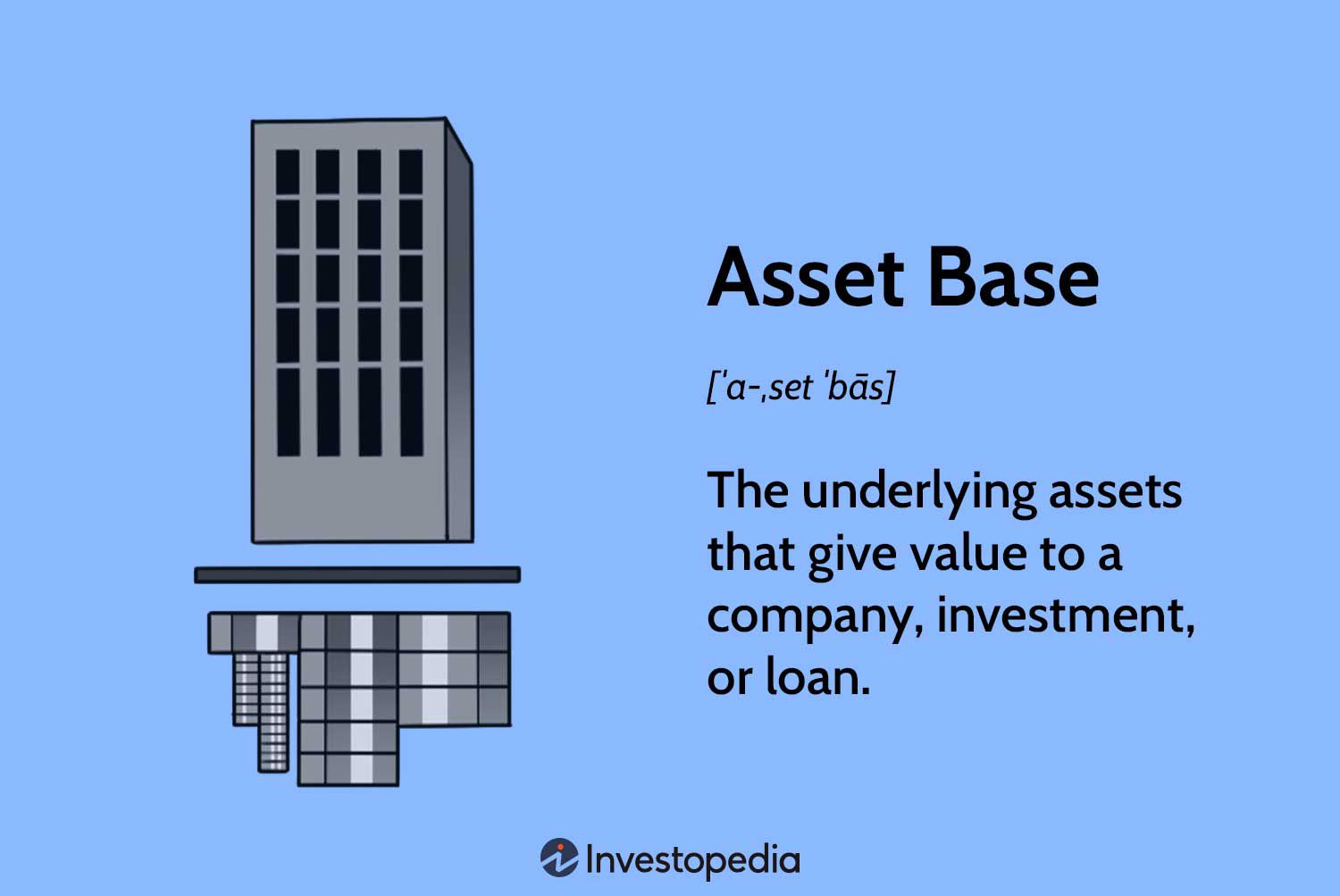
- An asset base is the value of a company’s tangible and financial assets.
- The book value of a company is its total assets minus total liabilities.
- Lenders use physical assets as collateral to secure loans.
- Market value surpasses asset base due to intangibles and future growth expectations.
- Asset base changes from buying or selling assets affect company valuation.
What Is an Asset Base?
An asset base refers to the assets that constitute the basis for the valuation of a firm, loan, or derivative security. For a firm, the asset base is its book value. For a loan, it is the collateral backing the loan. For a derivative, it is the underlying asset. The asset base isn’t static; it can increase or decrease in value. In fact, often, the market value of something backed by assets will exceed the implied value of the asset base.
Deep Dive into Asset Bases
A company’s asset base is included in its valuation and includes tangible, hard assets such as property, plant, equipment, and inventory. It also includes financial assets such as cash, cash equivalents, and securities. Typically, a company’s market value will exceed its asset base since market value also includes intangibles as well as expected future growth from cash flows and profits.
With an investment in a futures contract, as an example, the price of the underlying asset used as the asset base of such a derivative contract can increase or decrease rapidly, changing the price that investors are willing to pay for it.
With a loan, the value of a home might increase or decrease over time, affecting the underlying collateral in a mortgage. Margin loans are particularly sensitive to the underlying value of the collateral, as pledged securities whose value fluctuates with the market are often used for this purpose.
The Importance of Book Value in Asset Base
A company’s asset base is often construed as its book value. The book value of a company literally means the value of a business according to its books (accounts) that are reflected in its financial statements. Theoretically, book value represents the total amount a company is worth if all its assets are sold and all the liabilities are paid back. This is the amount that the company’s creditors and investors can expect to receive if the company is liquidated.
Mathematically, book value is calculated as the difference between a company’s total assets and total liabilities.
Book value of a company=Total assets−Total liabilities
For example, if Company XYZ has total assets of $100 million and total liabilities of $80 million, the book value of the company is $20 million. In a broad sense, this means that if the company sold off its assets and paid down its liabilities, the equity value or net worth of the business would be $20 million.
Total assets include all kinds of assets, such as cash and short term investments, total accounts receivable, inventories, net property, plant and equipment (PP&E), investments and advances, intangible assets like goodwill, and tangible assets.
Total liabilities include items like short and long term debt obligations, accounts payable, and deferred taxes.
The Bottom Line
An asset base is the collection of underlying assets that give value to a company, investment, or loan. The asset base can fluctuate due to market forces and business activities. This in turn can impact a company’s valuation. Book value is a representation of the asset base minus liabilities and is crucial in determining a company’s worth if liquidated. Lenders use physical assets as collateral to secure loans. Analysts view large changes in the asset base as red flags.













Leave a comment