
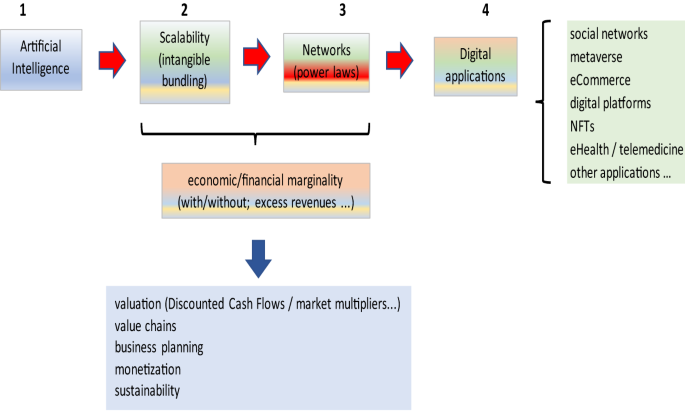
The results are consistent with the research question and the model illustrated in the section “The model”.
Section “From standard to AI-driven business planning: a sensitivity simulation” contains a sensitivity simulation, incorporating the impact on a hypothetical business plan of AI adoption.
Section “A with-or-without simulation using network theory” is dedicated to a network theory without-or-with simulation that examines the same issues from a complementary side, showing how AI can increase the number of nodes and the intensity (internet traffic, monetary transactions, and, consequently, improved EBITDA) within the ecosystem.
From standard to AI-driven business planning: a sensitivity simulation
This empirical setting provides a theoretical background of the main accounting and financial indicators underlying sustainability issues and the interrelations among stakeholders, along with the potential impact of AI-driven savings. The AI-driven sensitivity analysis shows the potential effect of savings on the life-long parameters of the investment, consistently with the “without or with (AI-driven) approach” illustrated in the comparison between Figs. 3 and 4, and indicated in the methods.

Effect of AI-driven sales and AI-reduced OPEX on Operating Cash Flows (OCF).

Relationships in a supply chain with traditional firms.
The income statement is a fundamental financial statement that serves as the “engine” behind profitability considerations and plays a crucial role in determining the overall financial health and sustainability of a company.
The hypothetical impact on operating revenues and costs is the following:
-
1.
A scenario with +10% revenues/−10% costs;
-
2.
A scenario with +5% revenues/−5% costs.
When conducting sensitivity analysis to estimate the impact of AI on financial performance, it is indeed reasonable to consider the potential repercussions on revenues and operating costs. The sensitivity analysis allows for the assessment of the potential variability in these factors, considering the potential benefits of AI integration.
-
1.
Revenue increase: AI can enhance revenue generation through various means, such as improved customer targeting, personalized recommendations, or enhanced sales effectiveness. By leveraging AI technologies, companies can optimize their pricing strategies, identify new revenue streams, or develop innovative products or services. Sensitivity analysis considers the potential increase in revenues resulting from AI-driven improvements.
-
2.
Operating cost decrease (OpEx): AI can bring cost-saving opportunities through automation, process optimization, and resource allocation efficiencies. By streamlining operations and reducing manual efforts, companies can potentially lower their operating costs. Sensitivity analysis considers the potential decrease in operating costs resulting from AI adoption, leading to improved profitability.
The combined effect of revenue increase and operating cost decrease has a positive impact on financial and economic margins. It enhances the company’s financial performance, profitability, and value-creation potential. Sensitivity analysis helps estimate the magnitude of these improvements, allowing decision-makers to evaluate the potential benefits of AI integration and make informed choices.
Unfortunately, this variability in revenues and costs is not still backed by empirical evidence and this justifies the use of sensitivity analysis. This idea is reinforced by taking into account that the use of bundled intangibles may cause about 10% variations both in higher revenues and lower costs.
Empirical evidence shows that AI leads to EBIT or EBITDA improvements, because of both revenue increases and cost-cutting. According to McKinsey and Company (2022), “at least 5 percent of their organizations’ EBIT was attributable to AI in 2021, in line with findings from the previous two years”. The impact of AI on depreciation/amortization is presumably small, and so is EBIT ≈ EBITDA.
Other sources show similar results (Pifer, 2023; Pipeline, 2023; Appen, 2022; Oberlo, 2022; Statista, 2023; Zhang et al., 2021; Human-Centered Artificial Intelligence, 2022).
This impact somewhat underestimates the long-term effect of AI (capacity to self-ignite virtuous processes) that can be dealt with as a “real option” to expand the business, with already undertaken investments. Real options analysis is a framework that is consistent with the concept of Net Present Value of Growth Opportunities (NPVGO). NPVGO is a calculation used to estimate the net present value per share of all future cash flows associated with growth opportunities, including new projects or potential acquisitions. NPVGO is typically fueled by innovative intangibles with hidden and still underexploited potential, such as AI.
A sensitivity simulation applied to an ideal client—a company purchasing AI products—shows which is the impact on the economic and financial metrics and the corporate valuation of an increase in revenues (and decrease in OPEX).
This case represents a basic simulation of the impact of adopting AI. The comparison of a simple network without AI with a smart AI-driven network including new nodes aligns with the “with or without” differential approach commonly used to estimate the value of intangibles.
By applying the “with or without” differential approach and comparing the straightforward network without AI to the smart platform-driven network with AI integration, it is possible to quantitatively assess the impact on financial performance, value creation, and overall sustainability. This approach aligns with the traditional methodology used to estimate the value of intangibles and demonstrates the potential benefits of AI integration within the analyzed context, as illustrated in the International Valuation Standard 210 (par. 80.1).
This empirical setting is fully compliant with the research question, a theoretical story that illustrates the main accounting and financial indicators associated with AI adoption, as well as the interrelations among stakeholders. Additionally, it highlights the sensitivity analysis to evaluate the impact of AI adoption on investment parameters by using the “without or with AI adoption” approach.
The income statement of the AI-adopting company is the “engine” behind any profitability consideration.
When a company adopts AI technologies, the resulting increase in revenues or decrease in operating expenses (OPEX) can significantly improve its financial and economic margins, as represented by EBITDA. These improvements have a positive impact on value creation.
A brief comparison is illustrated in Table 4 where a sensitivity analysis applied to the base case, 5, and 10% growth in operating revenues (and a corresponding reduction in operating costs, mostly monetary OpEx) is reported in each column.
The first column shows the base case of a standardized company that consequently adopts AI solutions, with increasing economic marginality.
A with-or-without simulation using network theory
Network theory analyzes the relationships, whether symmetric or asymmetric, between discrete objects through the representation of graphs. In this context, a network is typically defined as a graph where the edges and/or nodes (vertices) possess attributes such as names or other characteristics.
A network is said to be interdependent if it consists of a system of coupled networks where the nodes in one network depend on the vertices in the other networks. This interdependence is a key characteristic of complex ecosystems and can provide an innovative perspective on the interactions among different stakeholders.
The impact of AI on the business model scalability can be explained in a complementary way, considering how AI can create additional nodes within a networked ecosystem, and how these nodes increase their connections, mainly in the form of digitized Internet traffic that hosts big data (AI-enhanced information) and monetary transactions. An example can be given by eCommerce digital platforms that exploit AI to reach new clients, with new transactions.
AI impacts business value (Enholm et al., 2022) with technological and organizational enablers that use automation and augmentation to produce:
-
First-order effects (process efficiency, improved productivity, greater precision and reduction of human errors, decision quality, organizational agility, structural redesign, process reengineering, etc.);
-
Second-order effects (operational performance with new and enhanced products and services; higher economic/financial growth and profitability, market-based performance with customer satisfaction, etc.).
New and enhanced products and services represent a cornerstone of AI that can be explained through network theory, where new products are represented by additional nodes and their enhancement by stronger links.
Multilayer networks explain dynamic networks’ intertemporal nature that evolve, incorporating AI growth factors. Temporal networks embed dynamic AI features—AI is an incremental and self-learning process that could ideally produce real options, incorporating free-of-charge expansion possibilities.
Scalability can be interpreted with network theory applications, bridging physical nodes with their digital twins. Path-dependent upgrades, ignited by AI and machine learning applications, are dynamically consistent with intertemporal multilayer networks.
As anticipated, AI is a forward-looking technology, fully consistent with the intertemporal nature of multilayer networks, where each “screenshot” represents an instant, dynamically linked to the following one.
Multilayer networks are a type of network that involves multiple kinds of relations with multiplex or multidimensional configurations. In a multiplex network, the same set of nodes is connected through more than one type of link, leading to enhanced scalability and richer representation of relationships (Bianconi, 2018).
-
1.
Multilayer networks go beyond the traditional network framework by incorporating multiple layers or dimensions of connectivity. They provide a more nuanced representation of relationships by capturing various types of relations, such as multiplex, multilayer, multilevel, and multi-relational connections. This extension allows for a more accurate and comprehensive understanding of real-world systems and their interdependencies.
-
2.
Scalability features and bridging nodes: Multilayer networks are intrinsically fit for leveraging the scalability features previously examined. They can accommodate bridging or replica nodes that exist in multiple layers simultaneously. These bridging nodes facilitate connections and interactions across different layers, enabling the study of interlayer dependencies and the flow of information, resources, or influence between layers. This capability enhances the scalability and flexibility of the network representation.
-
3.
Complex multidimensional networks: Multilayer networks, as a type of complex multidimensional network, offer valuable insights across various interdisciplinary fields. Their ability to capture multiple kinds of relations and interdependencies is particularly useful in understanding complex systems and phenomena. Whether analyzing social networks, biological networks, transportation networks, or economic networks, the multidimensional nature of multilayer networks can provide deeper insights into the dynamics, structure, and emergent properties of these systems.
-
4.
Interdisciplinary insight: Multilayer networks serve as a valuable tool for interdisciplinary research. Their application can span diverse fields, including sociology, biology, physics, computer science, economics, and more. By incorporating multiple kinds of relations and interdependencies, multilayer networks enable researchers to study complex phenomena from a holistic perspective. They provide a common language and framework for analyzing and understanding the intricate relationships among elements within complex systems.
Figures 4 and 5 back the “without-with” comparison, showing—with a simplified ecosystem’s wiring diagram—a standard company, and, respectively, an AI-driven network.

Relationships in a supply chain with traditional and AI-driven firms.
Network theory can contribute to explaining the nature of AI-driven scalability. AI adds incremental nodes to the existing ecosystem and improves the interrelation between pre-existing and new nodes.
The model compares a “without” versus “with” scenario, consistent with the IVS 210 evaluation criteria for intangible assets, where a network without AI is compared with the same network when it incorporates AI-driven additional nodes and links (edges). This comparison allows us to sort out the incremental income (and cash flows) derived from the introduction of AI in the model.
The model can be further extended in a dynamic—multilayer—dimension, where AI ignites self-driven growth. Figure 4 is described by the following points:
-
1.
Invoicing to “traditional” clients;
-
2.
Invoicing from “traditional” suppliers.
Figure 5 is described by the following points:
-
1.
Impact of AI on the target company;
-
2.
Invoicing to “traditional” clients;
-
3.
Interaction between “traditional” and AI-driven clients;
-
4.
Interaction between AI and “traditional” clients (that become “augmented” or digitized);
-
5.
AI creates new clients, increasing its revenues;
-
6.
Interaction between the company and its “traditional” suppliers;
-
7.
AI creates new suppliers;
-
8.
The company interacts with AI-driven suppliers (cutting its OPEX);
-
9.
AI interacts with “traditional” suppliers.
The comparison of Figs. 4 and 5 shows that AI acts as a bridging (intermediating) hub which increases the number of nodes (vertices) and, consequently, the overall value and consistency of the network, but especially the quality and quantity of links.
The value added to Fig. 5 (compared to Fig. 4) can be interpreted through the network theory analysis (Barabási, 2016). Network analysis involves measuring the degree of nodes, which refers to the number of links or connections a node has with other nodes in a network. The degree of a node provides insights into its connectivity and prominence within the network.
This process is shown in Tables 4 and 5. In a digital ecosystem, where AI produces its effects, information produces valuable small data that, combined, become “big”. Even transactions, using fiat money or cryptocurrencies, convey useful financial information, making the AI-enhanced ecosystem financially sustainable.
The real finite network exemplified in Fig. 5 (or even 4) is a complex system. Interconnectivity can become vulnerable as any “blackout” may give rise to severe problems for the whole ecosystem. The links of Fig. 5 (numbered from 1 to 9) are bi-directional, therefore increasing the potential flow of data and transactions.
In network theory, the relations among nodes in a network are commonly illustrated by using an adjacency matrix, represented by a square matrix that provides a concise representation of the connections or edges between nodes in a finite graph as in Figs. 4 or 5.
The adjacency matrix represents a graph as the elements of the matrix indicate whether a pair of nodes are adjacent or not. Thus, the adjacency matrix is a symmetric and (0,1)-matrix with zeros on its diagonal as each node is not linked to itself.
The degree of each node illustrates the number of links with other nodes and is mathematically expressed with a symmetric adjacency matrix that is Table 4 Fig. 4 (with 3 nodes) and Table 5 for Fig. 5 (6 nodes).
Metcalfe’s Law is often used to estimate the value or impact of a network by taking into account the number of connected users or nodes within the system. The law states that the value of a network is proportional to the square of the number of users (n2). Thus, networkFigure 4 = 9, and networkFigure 5 = 36 where, for the sake of simplicity, we have assumed that the links in both networks are equally weighted. This underrates the effective value of the links since AI improves the edging intensity between any two linked nodes.
The digital platform driven by AI has the potential to revolutionize network connectivity and efficiency. It minimizes paths and distances, operates continuously, and increases network connectedness. By leveraging AI algorithms, the platform optimizes resource utilization and enables scalability and flexibility. These advancements facilitate seamless interactions, enhance value-creation opportunities, and improve overall network performance. The platform minimizes the number of links among the other nodes and increases the network connectedness. For instance, it creates additional paths between disconnected nodes like banks and sub-contractors which are connected through the platform in Fig. 5 but not in Fig. 4).
The mathematical analysis and comparison between the AI-mastered network and the original simple network can demonstrate the superior performance of the AI network. The advancements brought by the digital platform, coupled with AI capabilities, have the potential to enhance network robustness and resilience.
The specific impact on bankability may depend on various contextual factors, industry dynamics, and the specific implementation of the AI-driven network. Nonetheless, the enhanced network performance and resilience offered by the digital platform and AI technologies provide a strong basis for positive effects on bankability.












Leave a comment