
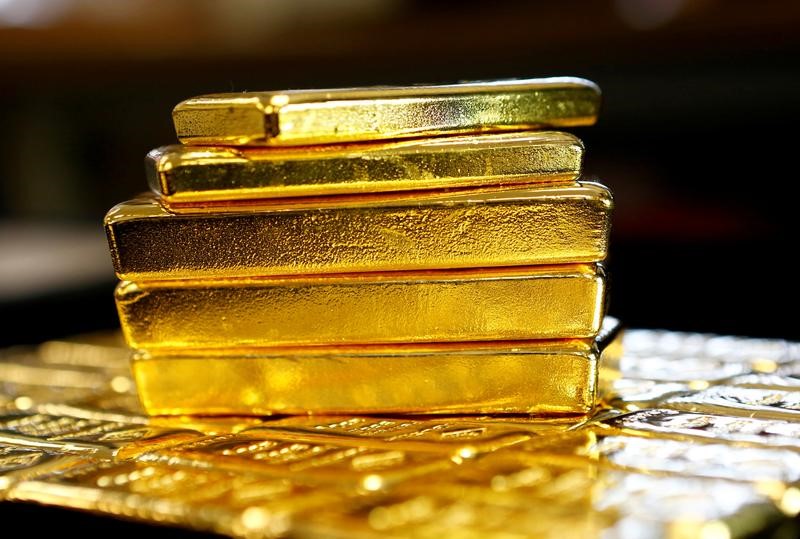
Investing.com — Gold prices dipped on Friday, but were on track for a weekly gain, as the yellow metal continues to make a comeback following deep losses in March driven by the Middle East conflict.
A shaky U.S.-Iran ceasefire has provided underlying support to bullion, though investors remained cautious ahead of crucial peace talks this weekend.
At 16:35 ET (20:35 GMT), spot gold was down 0.4% to $4,747.38/oz, while slipped 1% to $4,770.72/oz.
Spot gold was up 1.6% for the week, while gold futures were up 2%. The former was on track for a three-week win streak, while the latter a two-week one.
Get premium commodity insights with InvestingPro – now 50% off
Traders eye potential U.S.-Iran talks
President Donald Trump’s announcement of a two-week ceasefire with Iran this week has helped to stabilize sentiment across global markets, but the agreement showed has shown signs of fragility. Continued Israeli military activity in Lebanon has especially raised key questions around the longevity of the deal.
Israel carried out more strikes on Iran-aligned Hezbollah targets in Lebanon on Friday, further imperiling the outlook for potential talks between U.S. and Iranian officials in Pakistan which are anticipated to start on Saturday. American and Iranian officials have reportedly been at odds over whether Lebanon was included in the ceasefire.
Iranian media said that Tehran has denied that a delegation has arrived in Islamabad for the discussions, adding that the talks would remain suspended as long as Israeli attacks continue in Lebanon.
Meanwhile, the Strait of Hormuz, a critical artery for global oil supplies, remains largely shut. Trump criticized Iran for doing a “poor job” of allowing energy supplies to flow.
U.S. CPI accelerates
Much of the spotlight on Friday was on a key U.S. inflation print in the form of the March consumer price index (CPI) report. The data showed that the effects of surging oil prices due to the Iran war were showing up in U.S. prices.
In the twelve months to March, the CPI rose 3.3%, compared to 2.4% in February and economists’ expectations of 3.4%. It was the largest increase since June 2022, when oil prices were rocketing higher in the wake of the outbreak of the war in Ukraine.
Month-on-month, the gauge jumped 0.9%, versus 0.3% in the preceding month. The figure was seen at 1.0%.
As expected, the headline figures reflected a massive surge in energy-related prices, with that index jumping 10.9% M/M, the biggest increase since September 2005. The index for gasoline prices soared 21.2% M/M.
“The first inflation data from after the war in Iran confirmed what everyone was worried about – the oil shock contributed to an extremely high headline CPI number of 0.9% month-over-month,” Chris Zaccarelli, chief investment officer at Northlight Asset Management, said.
However, so-called “core” CPI stood at 2.6% year-on-year and 0.2% month-on-month, both slower than forecast.
“Fortunately, the core inflation number – which strips out more volatile food and energy prices – was only up 0.2% MoM. This won’t make consumers happy (as obviously they are buying groceries and filling up the tanks of their cars), but should give the economy some room to absorb the higher energy price shock,” Zaccarelli said.
The data will likely keep the Federal Reserve on hold. Gold tends to do better in lower rate environments.
Gold’s typical safe-haven status has been taken over by the dollar during the ongoing conflict, further denting bullion’s appeal by making the yellow metal more expensive for overseas buyers.
Ayushman Ojha and Scott Kanowsky contributed to this article












Leave a comment