
What Is Tier 1 Capital?
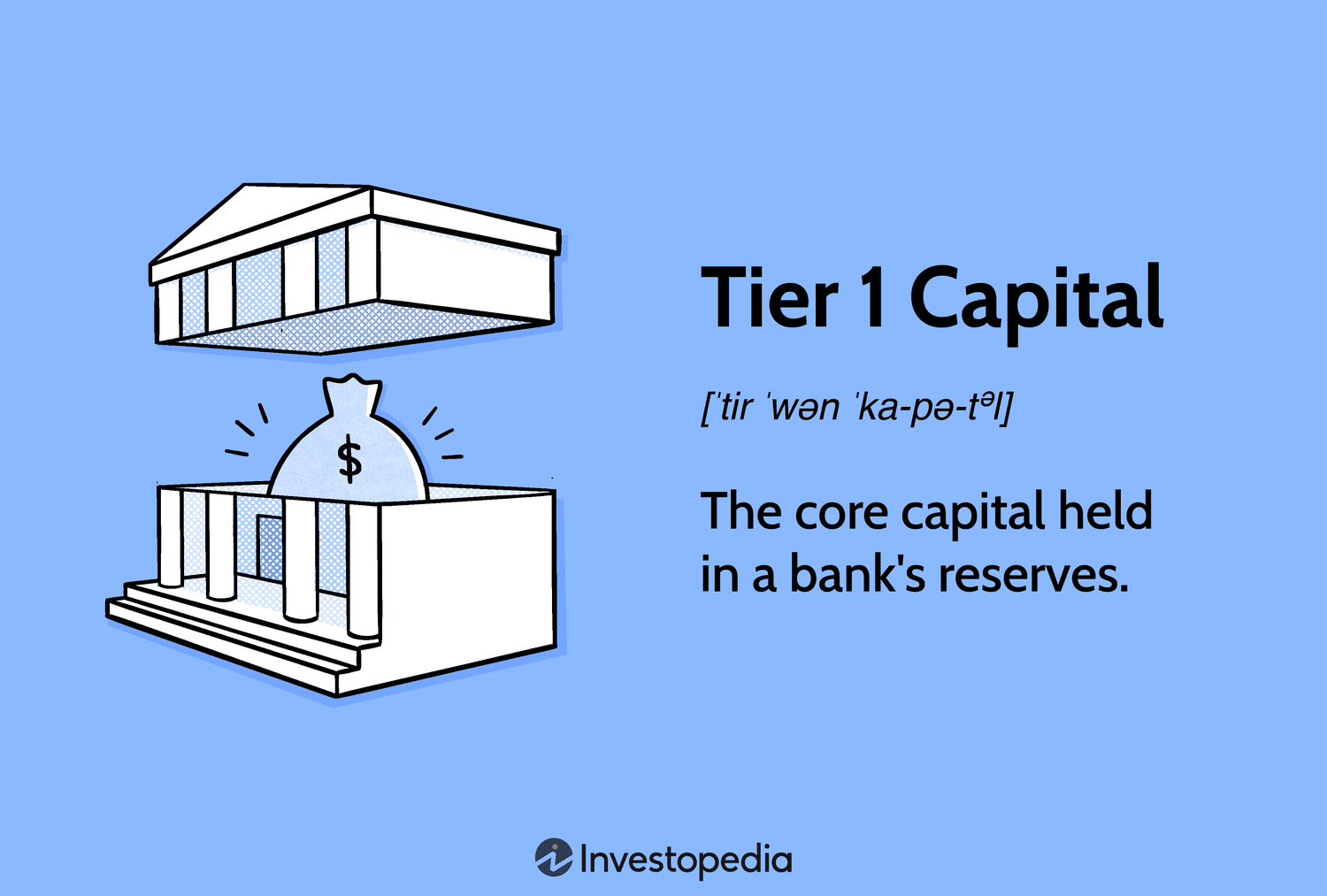
Tier 1 capital refers to the core capital held in a bank’s reserves and is used to fund business activities for the bank’s clients. It includes common stock, as well as disclosed reserves and certain other assets. Along with Tier 2 capital, the size of a bank’s Tier 1 capital reserves is used as a measure of the institution’s financial strength.
Regulators require banks to hold certain levels of Tier 1 and Tier 2 capital as reserves, in order to ensure that they can absorb large losses without threatening the stability of the institution. Under the Basel III accord, the minimum Tier 1 capital ratio was set at 6% of a bank’s risk-weighted assets.
Key Takeaways
- Tier 1 capital is a measure of a bank’s core strength, consisting mainly of equity capital and disclosed reserves.
- The Basel III accord mandates a minimum Tier 1 capital ratio of 6% of risk-weighted assets to ensure financial stability.
- Tier 1 capital comprises two components: Common Equity Tier 1 (CET1) and Additional Tier 1, both vital for absorbing losses.
- Basel IV, implemented in January 2023, introduced changes to capital requirements and risk assessments, impacting banks’ financial practices.
Get personalized, AI-powered answers built on 27+ years of trusted expertise.
Investopedia / Hilary Allison
In-Depth Look at Tier 1 Capital
Tier 1 capital represents the core equity assets of a bank or financial institution. It is largely composed of disclosed reserves (also known as retained earnings) and common stock. It can also include noncumulative, nonredeemable preferred stock.
According to the Basel III standard, Tier 1 capital includes Common Equity Tier 1 (CET1) and Additional Tier 1 (AT1). CET1 is the highest quality and absorbs losses immediately. CET1 includes common shares, retained earnings, other comprehensive income, and minority interest, with some regulatory deductions.
Additional Tier 1 Capital consists of preferred stock, related surplus, and qualifying minority interest. These instruments can also absorb losses, although they do not qualify for CET1.
The Tier 1 capital ratio compares a bank’s equity capital with its total risk-weighted assets (RWAs). RWAs are all assets held by a bank that are weighted by credit risk. Central banks follow the Basel Committee’s guidelines to set formulas for asset risk weights.
Warning
Tier 1 capital shouldn’t be confused with Common Equity Tier 1 (CET1) capital. Tier 1 includes CET1, as well as Additional Tier 1 capital.
Comparing Tier 1 and Tier 2 Capital
In the Basel Accords, the Basel Committee on Banking Supervision set the regulatory standards for Tier 1 and Tier 2 capital that must be reserved by any financial institution. Tier 2 capital has a lower standard than Tier 1, and is harder to liquidate. It includes hybrid capital instruments, loan-loss and revaluation reserves as well as undisclosed reserves.
Tier 1 and Tier 2 capital reserves differ mainly in their purpose. Tier 1 capital is described as “going concern” capital—that is, it is intended to absorb unexpected losses and allow the bank to continue operating as a going concern. Tier 2 capital is described as “gone concern” capital. In a bank failure, these assets help cover obligations before affecting depositors, lenders, and taxpayers.
Important
While the Basel agreements create a broad standard among international regulators, implementation will vary in each country.
Evolution of Tier 1 Capital Ratios
The Basel Accords, set by central banks, establish the minimum requirements for Tier 1 and Tier 2 capital. Under the original Basel I agreement, the minimum ratio of capital to risk-weighted assets was set at 8%.
Following the 2007-8 financial crisis, the Basel Committee met again to address the weaknesses that the crisis had exposed in the banking system. The Basel III agreement, published in 2010, raised the capital requirements and introduced more-stringent disclosure requirements. It also introduced the distinction between Tier 1 and Tier 2 capital. The new guidelines set the CET1 capital ratio minimum at 4.5% and the Tier 1 ratio at 6%. The total amount of reserve capital (Tier 1 and Tier 2) must be over 8%.
These standards were further amended by the Basel IV standards in 2017, which started implementation in January 2023. The revised standards’ effects depend on each bank’s business model.
How Do Banks Use Tier 1 Capital?
Tier 1 capital represents the strongest form of capital, consisting of shareholder equity, disclosed reserves, and certain other income. Under the Basel III standards, banks must maintain the equivalent of 6% of their risk-weighted assets in Tier 1 capital. This allows them to absorb unexpected losses and continue operating as a going concern.
What Is the Difference Between Tier 1 Capital and Common Equity Tier 1 (CET1) Capital?
CET1 is the main component of Tier 1 capital. It represents the strongest form of capital, which can be quickly liquidated to absorb unexpected losses. It comprises common stock and stock surplus, retained earnings, qualifying minority interest, and certain other income. Tier 1 includes CET1, as well as certain other instruments, such as preferred stock and related surplus.
What Are the Major Changes Between Basel III and Basel IV?
The Basel IV standards are a set of recommendations to financial regulators that were adopted in 2017 and started to take effect in January 2023. These recommendations fine-tune the calculations of credit risk, market risk, and operations risk. They also enhance the leverage ratio framework for certain banks, and other reforms.
Final Insights on Tier 1 Capital
Tier 1 capital, the core equity capital held in banks, includes common stock, disclosed reserves, and some preferred stock, crucial for maintaining a bank’s ability to absorb unexpected losses.
This capital, along with Tier 2 capital, is vital to assess a bank’s financial strength under the Basel Accords. According to Basel III standards, banks are required to maintain a minimum Tier 1 capital ratio of 6% of their risk-weighted assets, with Basel IV updates enhancing these guidelines from 2023 onward.












Leave a comment