
Key Takeaways
- Goodwill is an intangible asset created when a company acquires another company for more than the fair value of its net assets.
- It represents non-physical assets such as brand reputation, customer relationships, and intellectual property.
- Goodwill is not amortized but must be tested annually for impairment.
- Goodwill is calculated as the purchase price minus the fair value of identifiable net assets.
- Negative goodwill occurs when a company is purchased for less than the value of its net assets.
Get personalized, AI-powered answers built on 27+ years of trusted expertise.
What Is Goodwill?
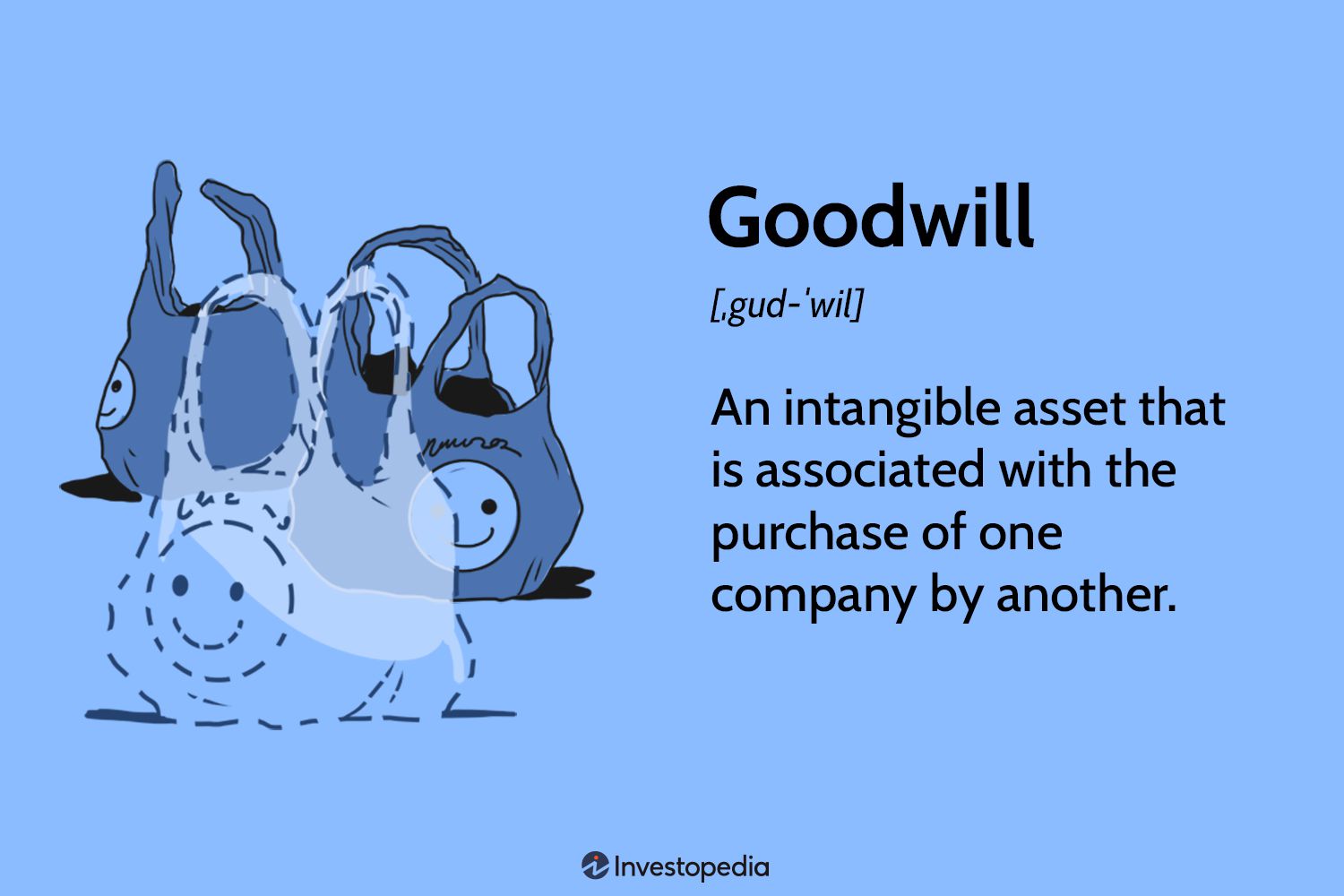
When a company purchases another, it often pays more than the net fair value of the target’s assets and liabilities. This excess is recorded as goodwill, an intangible asset reflecting brand strength, customer loyalty, and proprietary technology, among other factors. It signifies a competitive edge and justifies premiums paid during acquisitions.
Investopedia / Lara Antal
How Goodwill Is Valued in Company Acquisitions
Goodwill is important when one company buys another. Even if a company’s net assets have a fair value, the buyer might pay more for that company. This difference is usually due to the value of the target’s goodwill.
Fast Fact
A company gains negative goodwill, also known as badwill, if the acquiring company pays less than the target’s book value. It purchased the company at a bargain in a distress sale.
Goodwill is recorded as an intangible asset on the acquiring company’s balance sheet under the long-term assets account. It’s considered to be an intangible or non-current asset because it’s not a physical asset such as buildings or equipment.
Companies are required under generally accepted accounting principles (GAAP) and the International Financial Reporting Standards (IFRS) to evaluate the value of goodwill on their financial statements at least once a year and record any impairments.
Important
Goodwill isn’t the same as other intangible assets. It’s the premium paid over fair value during a transaction and it can’t be bought or sold independently. Other intangible assets such as licenses or patents can be. Goodwill has an indefinite life. Other intangibles have a finite useful life.
Identifying and Addressing Goodwill Impairments
Accounting goodwill involves the impairment of assets that occurs when the market value of an asset drops below historical cost. This happens due to events like reduced cash flow, more competition, or an economic downturn.
The company must impair or do a write-down on the value of the asset on the balance sheet if a company assesses that acquired net assets fall below the book value or if the amount of goodwill was overstated. The impairment expense is calculated as the difference between the current market value and the purchase price of the intangible asset.
Impairment reduces goodwill on the balance sheet and is recorded as a loss on the income statement, lowering the year’s net income. Earnings per share (EPS) and the company’s stock price are also negatively affected.
Methods for Conducting Goodwill Impairment Tests
Companies perform tests on intangible assets to check for impairment. The two commonly used methods for testing impairments are the income approach and the market approach.
- Income approach: Estimated future cash flows are discounted to the present value.
- Market approach: Assets and liabilities of similar companies operating in the same industry are analyzed.
How to Accurately Calculate Goodwill
Calculating goodwill is simple in theory, but can be complex in real-world situations. You can determine goodwill with a simple formula by taking the purchase price of a company and subtracting the net fair market value of identifiable assets and liabilities.
Goodwill=P−( A − L )where:P=Purchase price of the target companyA=Fair market value of assetsL=Fair market value of liabilities
Accountants use competing approaches in calculating goodwill.
Goodwill includes estimating future cash flows and other unknown factors during acquisition. This may not normally be a major issue but it can become significant when accountants look for ways to compare reported assets or net income between companies. Some of them may have acquired other firms and some may not have.
The Financial Accounting Standards Board (FASB), which sets U.S. GAAP accounting standards, considered changing how goodwill is accounted for by reintroducing goodwill amortization instead of annual impairment testing. Supporters argued that impairment testing is costly and subjective. In 2022, FASB decided not to reintroduce amortization for public companies, so goodwill is still tested annually for impairment rather than amortized. However, private companies are allowed to amortize goodwill over time instead of performing annual impairment tests.
Challenges and Limitations of Goodwill Valuation
Pricing goodwill is challenging. Negative goodwill happens when a company is bought for less than fair market value, often due to negotiation issues.
Negative goodwill is usually seen in distressed sales and is recorded as income on the acquirer’s income statement.
There’s also the risk that a previously successful company could face insolvency. The goodwill the company previously enjoyed has no resale value at the point of insolvency. Investors deduct goodwill from their determinations of residual equity when this happens.
Real-World Examples of Goodwill in Business Acquisitions
If a company buys Company ABC for $15 billion and its assets minus liabilities are worth $12 billion, the $3 billion difference is the acquisition premium. This $3 billion will be included on the acquirer’s balance sheet as goodwill.
Consider the T-Mobile and Sprint merger announced in early 2018 for a real-life example. The deal was valued at $35.85 billion as of March 31, 2018, per an S-4 filing. The fair value of the assets was $78.34 billion and the fair value of the liabilities was $45.56 billion.
The difference between the assets and liabilities is $32.78 billion so goodwill for the deal would be recognized as $3.07 billion ($35.85 billion – $32.78 billion), the amount over the difference between the fair value of the assets and liabilities.
Explain It Like I’m Five
Goodwill is the extra money a company pays when buying another company because the business is worth more than just its buildings and equipment. The extra value might come from the company’s brand name, loyal customers, or reputation. That extra value is called goodwill.
How Is Goodwill Different From Other Assets?
Goodwill is an intangible asset that’s created when one company acquires another company for a price greater than its net asset value. It’s shown on the company’s balance sheet like other assets.
But goodwill isn’t amortized or depreciated, unlike other assets that have a discernible useful life. It’s periodically tested for goodwill impairment instead. The value of goodwill must be written off, reducing the company’s earnings, if the goodwill is thought to be impaired.
How Is Goodwill Used in Investing?
Evaluating goodwill is a challenging but critical skill for many investors. It can be difficult to tell whether the goodwill claimed on a balance sheet is justified.
Investors should scrutinize what’s behind its stated goodwill when they’re analyzing a company’s balance sheet. The answer should determine whether that goodwill may have to be written off in the future.
The opposite can also occur in some cases with investors believing that the true value of a company’s goodwill is greater than what’s stated on its balance sheet.
What Is an Example of Goodwill in an Acquisition?
Amazon.com, Inc. (AMZN) bought Whole Foods Market Inc. for $13.7 billion in 2017. The current share price of Whole Foods was $35 at that time. Amazon ended up paying $42 per share. Amazon paid $9 billion more in total than the value of Whole Foods’ net assets. That amount was recorded as the intangible asset goodwill on Amazon’s books.
The Bottom Line
Goodwill is an intangible asset recorded during acquisitions, reflecting the premium paid above the fair market value of a company’s net assets. It accounts for elements like brand reputation, customer loyalty, and proprietary technology, offering the acquiring company a competitive edge. Unlike other intangible assets, goodwill has an indefinite life, but it requires annual impairment testing to ensure its value has not diminished. Impairments, caused by declining cash flows or adverse events, directly decrease goodwill on the balance sheet and result in a loss on the income statement, affecting the company’s net income and potentially its stock price.











Leave a comment