
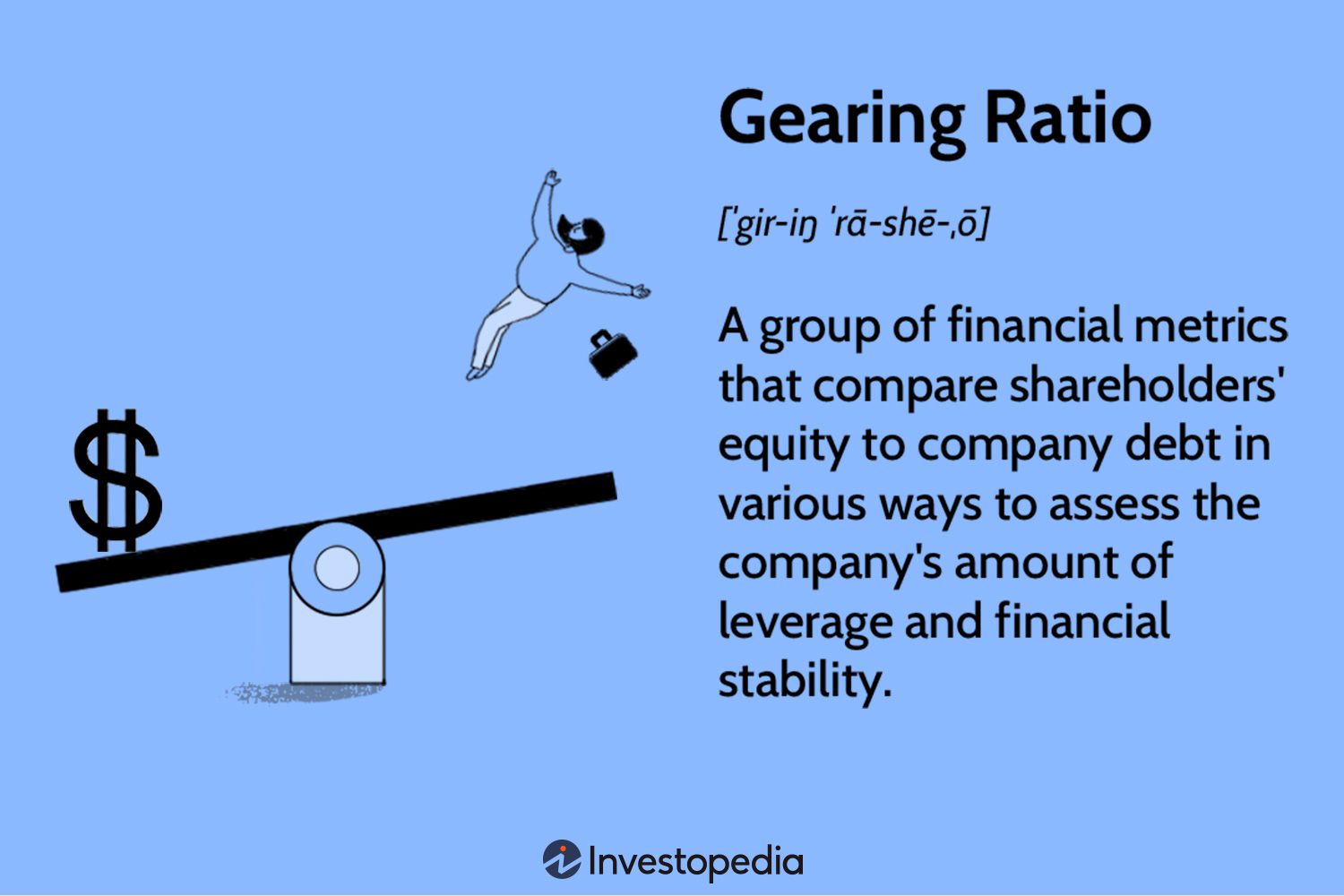
Key Takeaways:
- Gearing ratios assess a company’s leverage by comparing equity to debt.
- A higher gearing ratio means a company is more financially leveraged and at greater risk during downturns.
- Gearing ratios are most meaningful when compared to other companies in the same industry.
- Companies with high fixed assets often display higher gearing ratios due to debt financing.
- Gearing ratios guide financial institutions when deciding on loan issuances.
Get personalized, AI-powered answers built on 27+ years of trusted expertise.
Xiaojie Liu / Investopedia
What Are Gearing Ratios?
Gearing ratios compare some form of owner’s equity or capital to debt or funds borrowed by the company. They are financial ratios that are critical for assessing a business’s financial stability and leverage.
Types of gearing ratios include debt, debt-to-equity, equity, and times interest earned ratios. A gearing ratio is most meaningful when used as a benchmark against another company in the same industry.
The higher the gearing ratio, the more financial leverage a company has. The lower the gearing ratio, the more a company may turn to equity for financing.
An In-Depth Look at Gearing Ratios
The best-known examples of gearing ratios include:
Debt-to-Equity Ratio=Total EquityTotal DebtTimes Interest Earned=Total InterestEBITEquity Ratio=AssetsEquityDebt Ratio=Total AssetsTotal Debt
A higher gearing ratio means a company has more financial leverage. Such companies are more vulnerable to economic downturns because they have more debt relative to equity. Companies with high gearing ratios have more debt to manage. Companies with lower gearing ratios rely more on equity for financing.
Both internal and external parties find gearing ratios useful. Financial institutions use gearing ratios to decide whether to issue loans. Loan agreements may require companies to meet specific gearing ratio guidelines. Managers use gearing ratios to assess future cash flows and leverage.
How to Interpret Gearing Ratios Effectively
A high gearing ratio usually means high leverage, but it doesn’t always signal poor financial health. A company with a high gearing ratio has a riskier financing structure than a company with a lower gearing ratio. Regulated entities typically have higher gearing ratios because they can operate with higher levels of debt.
Companies in monopolistic situations often operate with higher gearing ratios because their strategic marketing position puts them at a lower risk of default. Industries that use expensive fixed assets typically have higher gearing ratios because these fixed assets are often financed with debt.
Important
A firm’s gearing ratio should be compared with the gearing ratios of other companies in the same industry.
Practical Examples: Applying Gearing Ratios
Assume that a company has a debt ratio of 0.6. This figure alone provides some information as to the company’s financial structure, but it’s more meaningful to benchmark it against another company in the same industry.
The company’s debt ratio might have been 0.3 last year. The industry average is 0.8, and the company’s main competitor has a debt ratio of 0.9. More information is derived by comparing gearing ratios to each other. A company with a 0.3 ratio is performing comparatively well in its industry when the industry average ratio result is 0.8, and the competition’s gearing ratio result is 0.9.
What Is Gearing?
Gearing is a measurement of the entity’s financial leverage. It demonstrates the degree to which a company’s operations are funded by debt to creditors compared to equity from shareholders.
What Is the Times Interest Earned Ratio?
A company’s times interest earned ratio is arrived at by dividing its earnings before interest and taxes (EBIT) by its interest expenses. It’s a gauge of the company’s ability to pay its debts each period.
What Is Shareholders’ Equity?
Shareholders’ equity is the portion of a company’s net assets that belongs to its investors or shareholders. It appears on the company’s balance sheet. The par value of shares, anything additional in capital, retained earnings, treasury stock, and any other accumulated comprehensive income all contribute to shareholders’ equity.
What Is Financial Leverage?
A company’s financial leverage is its total assets divided by its shareholders’ equity. The result shows a comparison between total assets owned by the company vs. shareholders’ ownership. A high ratio indicates that a good portion of the company’s assets are funded by debt.
The Bottom Line
Gearing ratios are financial metrics that compare a company’s equity to its debt in several ways. They assess a company’s leverage and financial stability. Comparing a company’s gearing ratio with that of other companies in the same industry, it provides more information and a greater understanding of the business’s financial health.
Gearing ratios are useful for both internal management and outsiders, like financial institutions. The reasons include analyzing cash flows, assessing leverage, and deciding whether to issue loans.
Four types of gearing ratios are the debt (total debt divided by total assets), debt-to-equity (total debt divided by total equity), equity (equity divided by assets), and times interest earned (earnings before interest and taxes divided by total interest) ratios. Each plays a role in assessing a company’s financial condition.
A high gearing ratio can indicate increased risk, but doesn’t necessarily indicate poor financial health. Monopolistic firms or regulated industries are examples where higher ratios might be acceptable.
To make informed financial decisions, it’s important to view gearing ratios in the context of economic conditions and industry standards.












Leave a comment