
Update: Here’s the official press release from NOAA:

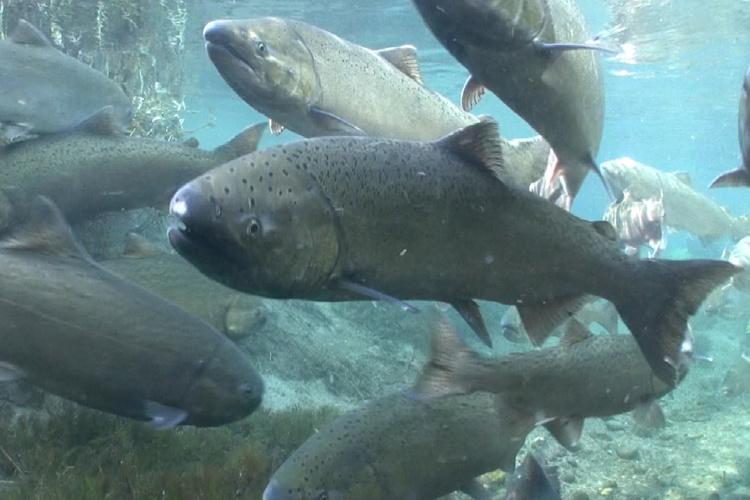
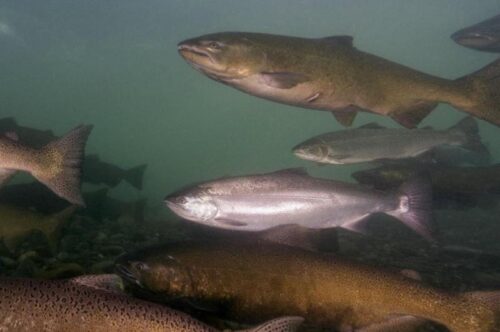
NOAA Fisheries has completed a status review and 12-month finding for Gulf of Alaska Chinook salmon in response to a January 2024 petition. The Wild Fish Conservancy petitioned to delineate and list one or more evolutionarily significant units (ESUs) of Gulf of Alaska Chinook salmon as threatened or endangered under the Endangered Species Act.
We have determined that listing any of the three ESUs of Gulf of Alaska Chinook salmon under the Endangered Species Act is not warranted. This determination is based on the best available scientific and commercial information and the findings of the status review.
Based on the best available scientific and commercial information, we identified three ESUs for Gulf of Alaska Chinook salmon:
- Southeast Gulf of Alaska – all populations in Alaska east of Cape Fairweather
- Central Gulf of Alaska – populations from Cape Fairweather through Cordova
- Northwest Gulf of Alaska – populations from Cook Inlet, the Kenai Peninsula, and the South Alaska Peninsula
The three ESUs were delineated primarily through extensive analyses of genetic differences, barriers to migration, and habitat breaks. After an analysis of each ESU, we found that all three units are at low risk of extinction.
Status Review and Findings
Following a positive 90-day finding in May 2024 indicating that the petitioned action may be warranted, we assembled a status review team of scientists to review the best available scientific and commercial information. The team worked with salmon biologists from the Alaska Department of Fish and Game, as well as a Tribal liaison, for sources of data and regional ecological and biological expertise. We also reached out to all Alaska Native Tribes and corporations in the Gulf of Alaska and consulted with those who expressed interest. Information provided by Tribal partners at these consultations contributed to the Status Review Report.
The status review team assessed the status of the species and determined the risk of extinction for each ESU based on:
- Demographic risk analysis
- Analysis of threats
- Information solicited by the 90-day finding
The demographic risk analysis considered four viable population criteria: abundance, productivity, spatial distribution, and diversity.
The analysis of threats considered the five ESA listing factors:
- Present or threatened destruction, modification, or curtailment of its habitat or range
- Over-utilization of the species for commercial, recreational, scientific, or educational purposes
- Disease or predation
- Inadequacy of existing regulatory mechanisms
- Other natural or human-made factors affecting its continued existence (including environmental variability and hatchery impacts for this review)
After considering all information, we concluded:
- Environmental variability is the most significant threat to all three ESUs
- While current run sizes are trending low for many Gulf of Alaska stocks, fluctuations in abundance and productivity are typical of salmon populations, and many Gulf of Alaska stocks remain within the scope of historical variability or are showing signs of stabilization
- Despite some declines in abundance and productivity, the ESUs exhibit large overall population sizes spread across multiple stocks, viable levels of productivity, broad spatial distributions, and high genetic and ecological diversity
- High-quality, intact habitat, as well as proactive conservation and management practices, support population viability in each ESU
After conducting both a demographic risk analysis and an analysis of threats, all three Gulf of Alaska Chinook salmon ESUs were determined to be at low risk of extinction
The not warranted 12-month finding is a final decision.
FOR MORE INFORMATION
90-Day Finding (89 FR 45815, 05/24/2024)
After a petition was filed to list Gulf of Alaska Chinook salmon as part of the Endangered Species Act, the National Marine Fisheries Service decided to deny the petition and keep the species delisted. Here’s the State of Alaska’s press release with reaction:
Chinook Not to Be Listed Under the Endangered Species Act, Alaska Agrees
May 13, 2026 (Anchorage, AK) – NMFS, the National Marine Fisheries Service, has decided that listing Gulf of Alaska (GOA) Chinook salmon under the Endangered Species Act (ESA) in not warranted. This decision follows an extensive review of data on salmon abundance, habitat quality, harvest, fishery management, and other factors.
The State emphasizes that Gulf of Alaska Chinook do not come close to meeting the definition for listing under the ESA. If the listing had occurred, oversight of Chinook management would have transferred to the federal government.
“This decision by NMFS Assistant Administrator Eugenio Piñeiro Soler indicates strong support for Alaska’s management of natural resources,” said Alaska Department of Fish and Game Commissioner Doug Vincent-Lang. “Alaska became a state, in large part, to hold authority over our own natural resources such as fisheries. Since then, the sound science and fisheries management by our department has been recognized globally.”
Commissioner Vincent-Lang emphasized that biological indicators cited in the petition were grossly inadequate to support an ESA listing. “Failing to meet an escapement goal is not evidence that a stock is at risk of extinction; rather it is a proactive management trigger to ensure stocks are not overfished,” Commissioner Vincent-Lang said. “Alaska takes the decline in Chinook abundance very seriously. That is why we have taken significant management actions to reduce harvest and have invested heavily in research to better understand the causes of reduced productivity of these stocks.”
While changing ocean conditions have reduced Chinook productivity statewide since 2007, trends vary by river system, and some stocks have recently improved.











Leave a comment