
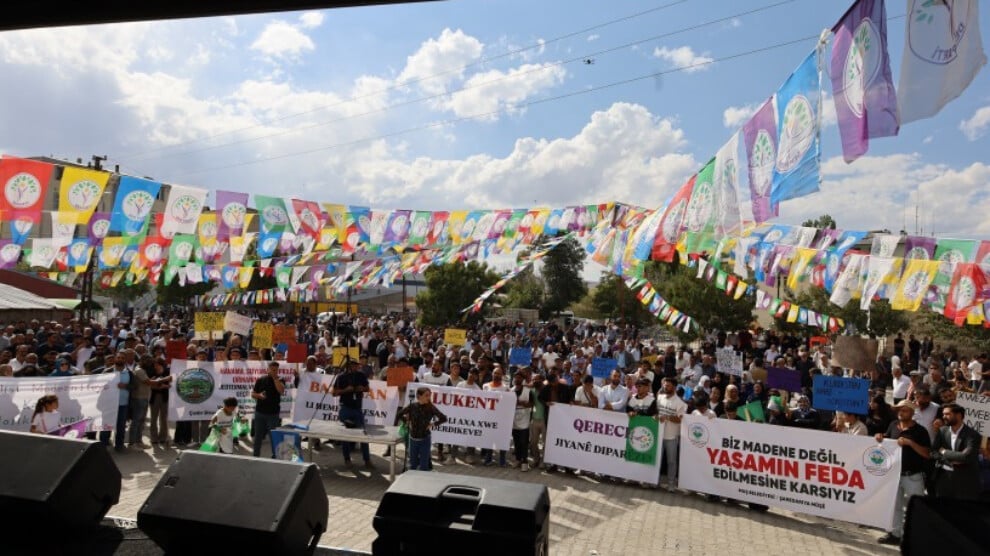
Under the slogan “We Protect Our Land,” large numbers of people demonstrated in the district of Diyadin in Ağro province against gold mining using cyanide. The environmental rally was organized by the DEM Party and the Mesopotamia Ecology Movement. The demonstrators marched from the post office on İnönü Street to the central bus terminal. Chants included “Bê ax jiyan nabe” [There is no life without land] and “Kurdistan nabe goristan” [Kurdistan will not become a graveyard.] Banners and placards carried messages including “Kurdistan is not your mining zone,” “Killing nature means killing life,” and “Hands off my air, my water, my land, and my forests.”

Participants in the rally included DBP and DEM Party co-chairs Çiğdem Kılıçgün Uçar and Tuncer Bakırhan, as well as representatives of various environmental groups. The protest was directed against a gold mining project near the village of Mollakara. Environmental organizations and municipalities in the region have warned in particular about the potential impact of cyanide use on the Murat River and its watershed.
‘We are fighting for every place that is being plundered’
Alev Yılmaz of the Varto Ecology Platform recalled the resistance against energy and resource extraction projects in Varto, which has been ongoing for more than 140 days. She stressed that the protest there was not limited to their own region: “We are waging this resistance not only for Varto, but for every place that is being plundered.”

Rojhat Özgökçe of the Mesopotamia Ecology Movement spoke of the long-standing exploitation of Kurdistan’s natural environment. At the same time, he said, the experiences in Varto and Karlıova showed that an organized ecological movement was emerging in response. “We must become stronger, organize ourselves, and develop a powerful struggle against ecocide,” Özgökçe said.

Uçar: Land is more valuable than gold
DBP (Democratic Regions Party) co-chair Çiğdem Kılıçgün Uçar linked the mining projects to poverty, migration, and the economic exploitation of the region. “Why have the people of Diyadin migrated away? Because deep poverty was left behind here,” Uçar said. She noted that attempts were now being made to bring companies into the region and exploit Diyadin. “What we must do, therefore, is protect our land. The land and the resistance of the people of Diyadin are more valuable than gold.”
She rejected claims that mining companies would bring jobs to the region: “Our people are being offered toxic employment. No one accepts the plundering of their air, water, and livelihoods. We will not accept it either.”

Uçar said that exploitation was taking place from Muş and Diyarbakır to Ağrı without regard for the people living there. “We also want to leave a dignified life for the seven-year-old children standing here in this square today.”
Uçar also called on local residents not to sell their land to mining companies: “They are trying to buy up land in the villages piece by piece. Do not sell your land.”
Ecology and peace
Referring to Abdullah Öcalan’s call of February 27, 2025, Uçar linked the protection of natural resources and ecosystems to the peace and democratic society process. “Those who do not protect their nature do not protect peace either,” the politician said. “We must begin by protecting the water and nature of this land, especially Kurdistan.” She said that companies were poised to exploit the region’s natural and social resources. “We will stand against them together in this struggle.”

Bakırhan: Kurdish population faces renewed displacement
DEM Party (Peoples’ Equality and Democracy Party) co-chair Tuncer Bakırhan drew a connection between today’s mining projects and the displacement of the Kurdish population in previous decades. He recalled that millions of Kurds were forced to leave their villages, pastures, mountains, and homes as a result of war and violence in the 1990s. “Now they are trying to displace the Kurdish population for a second time through mining companies and profiteers,” Bakırhan said.
The resistance, he said, was not limited to Diyadin. “From Lice to Varto and Karlıova, and from the Ida Mountains to Akbelen Forest, people are resisting environmental destruction and profit-driven interests. We say: Do not blast our mountains, do not pollute our plains, do not pollute our water. The people will not surrender their land to companies that want to poison it, extract a little gold, and then disappear.”

‘True peace is peace with the land’
Bakırhan also placed the struggle in the context of the ongoing peace process. Peace, he said, must mean that Kurds are able to live in dignity where they reside and on their own land. “Instead, more and more areas are being opened up to mining projects. True peace is peace with the land. It is peace with the water of the Kurds, with their mountains, with the plains from which they make their living, and with the people and other living beings that inhabit them.”
Bakırhan said that current policies were compatible neither with peace nor with its spirit: “Keep your hands off our pastures, our water, our land, and our history.”
 Ecology is one of Öcalan’s key concerns
Bakırhan also spoke about his talks with Abdullah Öcalan. During a four-hour meeting, he said, ecology was one of the central topics alongside language, identity, and equal citizenship. According to Bakırhan, Öcalan was particularly concerned with the question of how Kurds could find work and secure a livelihood in the places where they were born. He described Öcalan’s stance against the destruction of nature as very firm.
In this context, Bakırhan pointed to the increasing number of mining licenses being granted in Kurdish regions. “In Şırnak, Gabar, Besta, and Cudi, they have barely left a single tree standing. In Bitlis and Bingöl, they are trying to hand over almost every mountain, every flowing body of water, and every plain to mining companies. Hundreds of licenses have already been granted, while thousands more are awaiting approval. Why this plunder? This geography has endured enough oppression and suffering over the past hundred years.”
Bakırhan said that anyone who believed Kurdistan could now be opened up on a large scale to mining and corporate interests would face resistance: “The people of Diyadin will not allow it. The people of Patnos will not allow it. Nor will the people of Hakkari and Şırnak allow their natural environment to be destroyed for mining.”
The rally concluded after the speeches.









Leave a comment