

Investment is a key factor in increasing productivity over the long term. At the national level, investment has been weaker than in other developed countries for over a decade and it has stagnated since 2016.
Is investment the reason why London’s productivity growth has stagnated since the financial crisis?
Overall investment is broadly stable but its make up has changed
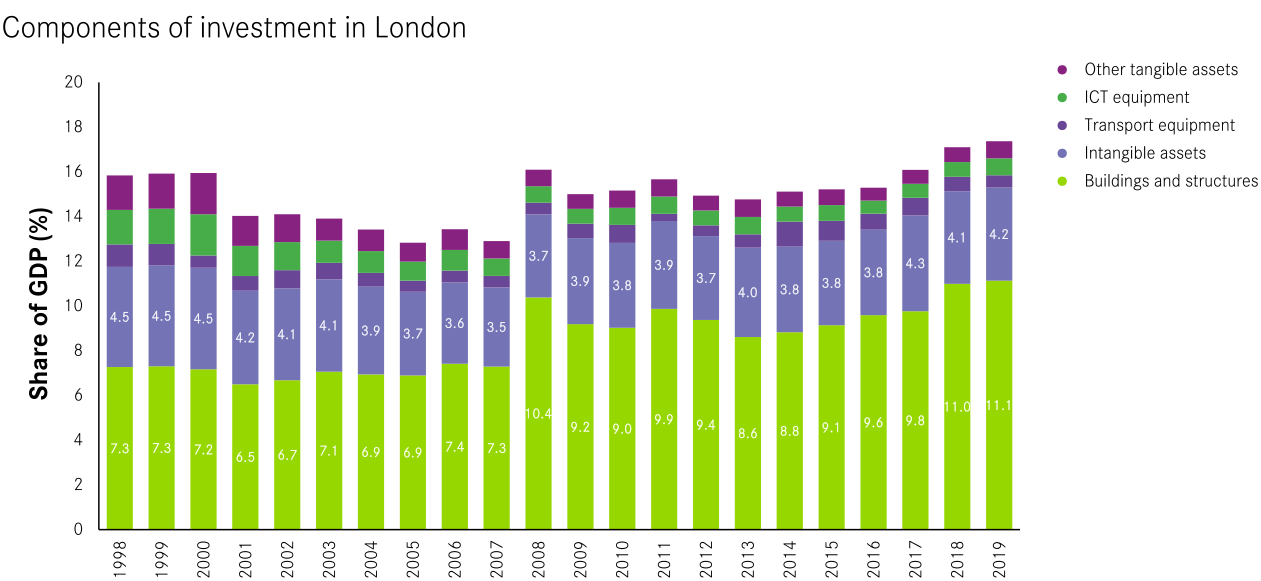
At first sight, investment does not look like a candidate to explain weak productivity growth. Investment levels, as a share of London’s GDP, have been slightly higher in the last decade than before the financial crisis. Investment in London accounted for 19 per cent of GDP in 2019, the highest level in 22 years; and it has been constantly higher in the last decade than before the financial crisis.
Figure 1: Investment in buildings and structures accounted for an increasing share of overall investment in London in the last decade
Source: ONS. Regional gross fixed capital formation (GFCF) estimates by asset type: Experimental data. Note: intangible assets are also known as intellectual property products; computer software and databases are allocated to the region where they are used and are estimated using employee location; research and development is allocated according to where the investment takes place using survey data. Geography: Greater London (ITL1).
But where this investment is channeled has changed. Figure 1 shows that the post-crisis increase in investment was driven by ‘buildings and structures’, while ‘intangible investments’ such as software, databases and R&D – the second most important source of investment – were mostly stable over the last decade. Looking at this data from a sectoral point of view rather than an asset based one (Figure 2) shows that investment in ‘exporting’ sectors such as information and communications and finance has declined as a share, while for real estate it has doubled.
Figure 2: Real estate sector became the most important sector in terms of investment

Source: ONS. Regional gross fixed capital formation (GFCF) estimates by conducting sector: Experimental data.
The result is that two decades ago, there was £0.65 invested in intangibles for each £1 in ‘buildings and structures’. In 2019, the ratio was £0.37 to £1.
Investing in buildings and structures is clearly an important part of growth for any city. But the much smaller increase in construction (both in investment and output) suggests that it was not new construction that was mostly driving this trend but the increase in the purchase price of existing buildings. Meanwhile, as the UK and other developed economies moves to an ever more intangible-based economy, it is reasonable to expect London’s intangible investment to increase, as it has elsewhere in the country. That has not happened, and it has impacted on productivity, which fits with research at the national level showing that intangible investment and intangible-intensive sectors are important drivers of the UK productivity slowdown.
Rising real estate costs may be hindering London’s innovation
A possible explanation is that capital invested in London has moved away from intangibles towards tangibles (and the real estate sector). In a decade of stagnant productivity, real estate costs (both commercial and residential) continued rising, which is likely to be driven by supply constraints.
Under these conditions, incumbent firms may need to allocate more funds to cover increasing real estate costs, which could reduce their innovation enhancing investments. Also, this could discourage new businesses from moving to London. Research from other countries supports the hypotheses.
To overcome supply constraints, central Government should introduce planning reform, making the system more rules-based so it makes development more certain. Also, the Mayor and Government should revise the London plan and relax some restrictions that could be blocking development of residential and commercial space in London.
Finally, Government should be aiming to promote investment that boosts innovation and productivity, such as intangibles, in the UK. It appears that the Chancellor may be scaling back R&D support in next week’s Budget, rather than expanding the expanding the coverage of R&D tax credits. To compete in the global economy, the UK and the Capital will need more investment and innovation. The budget should try to address that.














Leave a comment