
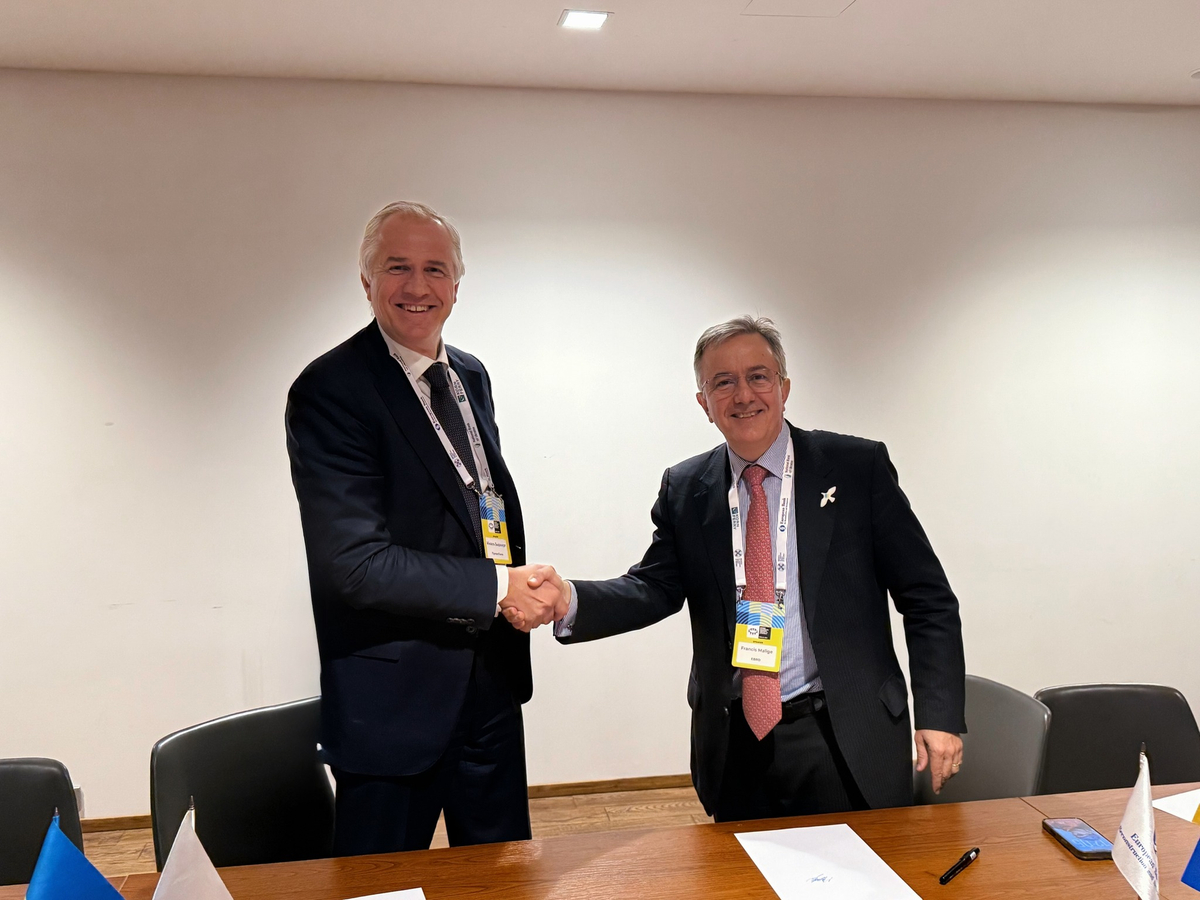
The European Bank for Reconstruction and Development (EBRD) is partnering with PrivatBank and Raiffeisen Bank Ukraine on a mechanism that will allow war-damaged borrowers to receive partial debt relief.
It is the first instrument of its kind piloted by the institution since Russia’s full-scale invasion began, reflecting the scarcity of tools covering war risks despite a flourishing business climate in Ukraine.
JOIN US ON TELEGRAM
Follow our coverage of the war on the @Kyivpost_official.
The Enterprise Security Enhancement (ESE), launched on May 11, operates through the EBRD’s existing portfolio risk-sharing (PRS) facilities with the two banks. If a borrower’s fixed assets – financed through a loan covered by a PRS facility – are directly damaged or destroyed in the war, the lender can grant partial debt forgiveness. The EBRD, drawing on donor funding, will then compensate the bank for the resulting credit loss.
The two banks chosen for the pilot are among Ukraine’s largest, each working closely with business and retail clients. State-owned PrivatBank is the country’s largest, serving more than 18 million individuals and over 910,000 business clients across more than 1,100 branches. Raiffeisen Bank Ukraine, owned by Vienna-based RBI, is the largest privately owned bank and the fourth-largest overall, with 306 branches and 2.52 million active clients.
Pilot allocations stand at €6.8 million ($8 million) for PrivatBank and €1.2 million ($1.42 million) for Raiffeisen Bank Ukraine, funded from EBRD grant resources. If scaled beyond the pilot, future tranches are expected to draw on external donors, including the European Commission under the Ukraine Investment Framework.

Other Topics of Interest
Trump’s China Visit: What to Expect
Trump and Xi are set for Beijing talks covering trade, tech, Iran, Taiwan and supply chains. Despite low expectations for breakthroughs, the summit may produce limited deals on tariffs, rare earths, chips and energy, aiming to stabilize escalating US-China tensions.
Under standard loan agreements, Ukrainian businesses remain fully liable for repayment even when the assets those loans financed are destroyed by Russian missiles or drones. War-risk insurance, meanwhile, remains largely unavailable or unaffordable for most borrowers.
The ESE is designed specifically for capital expenditure subloans covering fixed assets. It excludes working capital and carries minimum damage thresholds and per-project caps to prevent abuse. Claims must be verified by the partner banks in coordination with the EBRD or its appointed consultants before any payment is made. Anti-double-compensation rules bar claims where insurance or other recovery mechanisms already apply.
The Ukrainian government previously introduced its own compensation mechanism for war-damaged property under Cabinet Resolution No. 1541, which subsidizes part of the premium for paid war-risk insurance for businesses. Adopted in 2025, the measure’s practical effectiveness has yet to be formally assessed.
PrivatBank CEO Mikael Björknert flagged the lack of war-risk protection for enterprises in an interview with Kyiv Post on the sidelines of the IMF and World Bank Spring Meetings in Washington in April.
He said a meaningful segment of companies was holding back on investment due to fears about war-related damage, and that he had been engaging international institutions to help develop a functioning war-insurance market.
“After a while, you really need to start renewing. Otherwise, your business will go down,” Björknert told Kyiv Post.














Leave a comment