
Key Takeaways
- A greenshoe option lets underwriters sell up to 15% more shares than the original number specified in the IPO.
- Greenshoe options were first used by Green Shoe Manufacturing Co. (now part of Wolverine World Wide Inc.).
- These options provide price stability and reduce market volatility during the IPO.
- Underwriters can either fully or partially exercise the greenshoe option.
Get personalized, AI-powered answers built on 27+ years of trusted expertise.
What Is a Greenshoe Option?
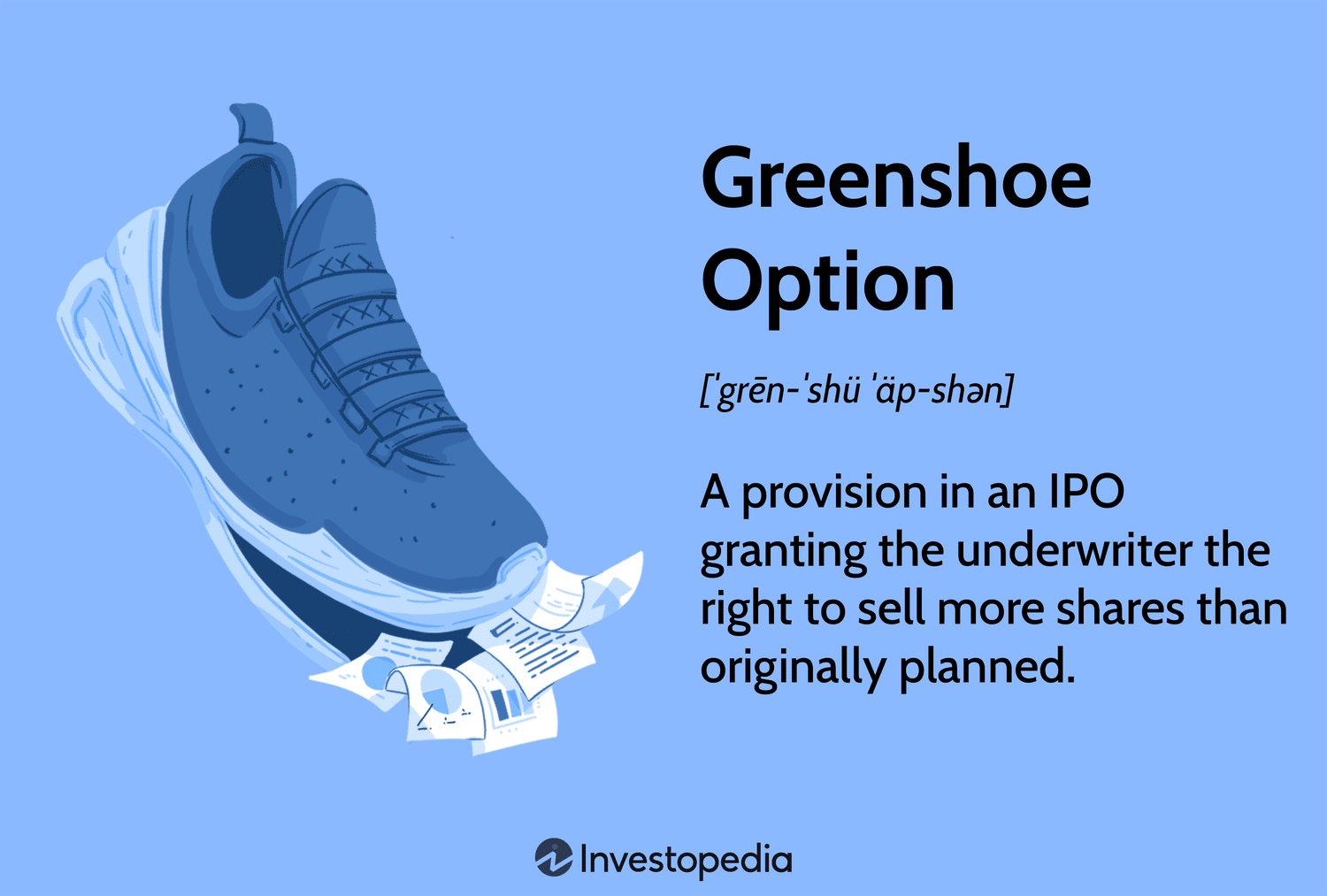
A greenshoe option is a provision in an underwriting agreement in an initial public offering (IPO), allowing underwriters to sell more shares than initially planned if demand exceeds expectations.
This over-allotment option is typically used to ensure price stability and liquidity, and to support stock prices in the market.
Lara Antal / Investopedia
How a Greenshoe Option Works
A greenshoe option provides additional price stability to a security issue because the underwriter can increase supply and smooth out price fluctuations. It is the only type of price stabilization measure permitted by the U.S. Securities and Exchange Commission (SEC).
Greenshoe options typically allow underwriters to sell up to 15% more shares than the original amount set by the issuer for up to 30 days after the IPO if demand conditions warrant such action. For example, if a company instructs the underwriters to sell 200 million shares, the underwriters can issue an additional 30 million shares by exercising a greenshoe option (200 million shares × 15%).
Since underwriters receive their commission as a percentage of the IPO, they have the incentive to make it as large as possible. The prospectus, which the issuing company files with the SEC before the IPO, details the actual percentage and conditions related to the option.
Fast Fact
Over-allotment options are known as greenshoe options because Green Shoe Manufacturing Co. (now part of Wolverine World Wide Inc. (WWW) as Stride Rite) was the first to issue this type of option.
How Underwriters Use the Greenshoe Option
Underwriters use greenshoe options in one of two ways.
- If the IPO is a success and the share price surges, the underwriters exercise the option, buy the extra stock from the company at the predetermined price, and issue those shares, at a profit, to their clients.
- If the price starts to fall, they buy back the shares from the market instead of the company to cover their short position, supporting the stock to stabilize its price.
Some issuers prefer not to include greenshoe options in their underwriting agreements under certain circumstances, such as if the issuer wants to fund a specific project with a fixed amount and has no requirement for additional capital.
Important
Underwriters can choose to either fully or partially exercise the option.
Example of a Greenshoe Option in Action
Facebook Inc., now Meta (META), agreed to a greenshoe option when it listed its shares in 2012. The underwriting syndicate, headed by Morgan Stanley (MS), agreed with Facebook to purchase 421 million shares at $38 per share, less a 1.1% underwriting fee. However, the syndicate sold at least 484 million shares to clients—15% above the initial allocation, effectively creating a short position of 63 million shares.
If Facebook shares had traded above the $38 IPO price shortly after listing, then the underwriting syndicate would’ve exercised the greenshoe option to buy the 63 million shares from Facebook at $38 to cover their short position and avoid having to repurchase the shares at a higher price in the market.
However, because Facebook’s shares declined below the IPO price soon after it commenced trading, the underwriting syndicate covered its short position without exercising the greenshoe option at or around $38 to stabilize the price and defend it from steeper falls.
What Does a Greenshoe Option Mean for Investors?
Greenshoe options can essentially result in more shares being available to buy at the IPO stage, opening the doors up to more participants. They can also reduce initial share price volatility.
Why Is It Called Greenshoe Option?
The term “greenshoe” is derived from Green Shoe Manufacturing Co., the first company to include this provision in its underwriting agreement. The company’s use of the clause helped it stabilize its stock price and increase the offering size.
What Are the Types of Greenshoe Options?
There are three main types of greenshoe option: full, partial, and reverse. With the full option, the underwriter sells the maximum amount of extra shares from the company. With the partial option, the underwriter sells more than the originally agreed amount but less than the maximum permitted. And with a reverse option, the underwriter sells the extra shares back to the issuing company.
What Is the Maximum Number of Shares Allowed in a Greenshoe Option?
Typically, underwriters can sell up to 15% more shares than the original number specified in the IPO. This over-allotment provision helps accommodate high demand while stabilizing the stock’s price in the early trading period.
The Bottom Line
Greenshoe options give underwriters the opportunity to sell more shares during an IPO. They help to meet high demand and increase the amount of capital that a company raises and are very common in the United States.
Typically, the over-allotment provision permits underwriters to sell up to 15% more shares at the agreed-upon IPO price and can be exercised within 30 days after the IPO.












Leave a comment