
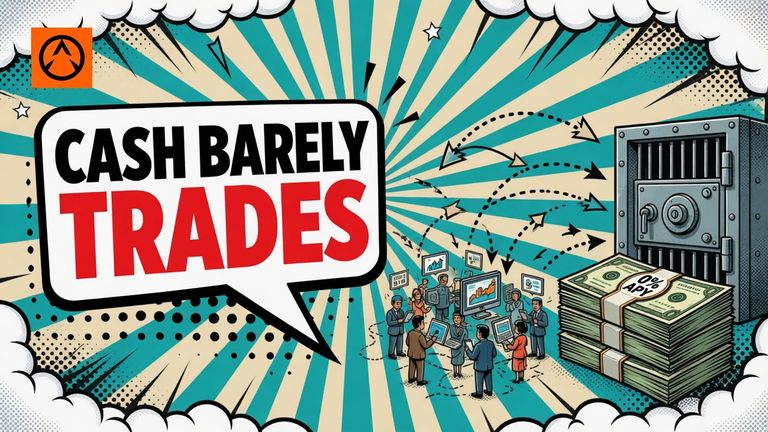
Tokenized cash has become the largest part of the real-world asset market represented on Dune, yet most of it rarely changes hands. The useful question is not whether the assets have been issued. It is whether people are using them once they exist.
Dune’s Q3 2026 report shows the wider market growing quickly, but the activity is concentrated far more heavily in some asset classes than others.
Size Is Not the Same as Trading
Dune says four RWA asset classes grew more than 140% over a year, reaching $33.9 billion. Cash equivalents account for about half of that market. They are issued and held onchain, but money funds and Treasury bills make up almost all tokenized cash, and both rarely trade.
That turns tokenized cash into more of a settlement and holdings product than an active trading market. Investors appear to use it to represent cash-like assets, not to exchange it continuously.
The structure also changes the risks. A token can have a stable net asset value and still have little secondary-market liquidity. Its reported value may be easy to observe while a seller has little market through which to exit.
Equities Carry Most of the Activity
Tokenized equities are the smallest of Dune’s four asset classes, but they grew the fastest and account for most trading. The market’s headline value and its trading activity are therefore being driven by different parts of the portfolio.
This is also where the tokenization story becomes easier to picture. Holding a tokenized share onchain is one thing. Trading those shares often enough to turn the position into cash is another.
Dune found that almost none of the tokenized cash equivalents sat in lending protocols. By comparison, about a fifth of tokenized credit was deposited there. Credit also has a bigger presence onchain than commodities, equities and cash equivalents in Dune’s data.
The pattern is notable. Tokenized government debt is the largest category, yet it plays a limited role in onchain lending, where government bonds are commonly used as collateral in traditional markets.
Holds Are Not the Same as Price Discovery
Some RWA growth is coming from investors accumulating the underlying asset rather than trading a token. Gold provides the clearest example.
The amount of gold held in tokenized form rose 73% over a year, compared with a 29% increase in the gold price. Most of the increase in tokenized holdings therefore came from more ounces being held, not simply from the underlying asset becoming more valuable.
That distinction matters. Issuance and holdings can rise without much trading, and a higher token balance does not automatically mean stronger price discovery or deeper liquidity.
Dune’s method tries to separate those effects. Its dataset tracks daily supply and balances, spot trades, perpetual futures, lending deposits, prices and net asset values. It also classifies supply changes by event type, allowing primary issuance to be separated from secondary movement.
Every table behind the report is available on Dune, including the product registry, balances, prices, lending deposits, spot trades and Hyperliquid perpetuals.
Liquidity Sits in Uneven Places
Dune’s available findings point to concentration by asset class. Equities generate most trading despite representing the smallest class. Cash makes up about half the market but rarely trades. Gold growth comes mainly from higher holdings, while oil exposure is dominated by perpetual futures rather than tokenized holdings.
There is not enough confirmed data to say which exchanges or individual venues dominate this activity. Dune labels spot and derivatives activity, including DEX pools and Hyperliquid perpetuals, but the brief does not provide a comparable breakdown by venue.
Still, the basic picture is clear. Tokenized cash has made a large part of the RWA market easier to hold onchain, not necessarily easier to trade. That distinction will matter as the market grows: issuance expands the list of assets represented in tokens, but repeated trading is what turns those representations into active markets.
The information discussed by Altcoin Buzz is not financial advice. This is for educational, entertainment, and informational purposes only. Any information or strategies are thoughts and opinions relevant to the accepted levels of risk tolerance of the writer/reviewers and their risk tolerance may be different than yours. We are not responsible for any losses that you may incur as a result of any investments directly or indirectly related to the information provided. Bitcoin and other cryptocurrencies are high-risk investments so please do your due diligence.
Copyright Altcoin Buzz Pte Ltd.












Leave a comment