
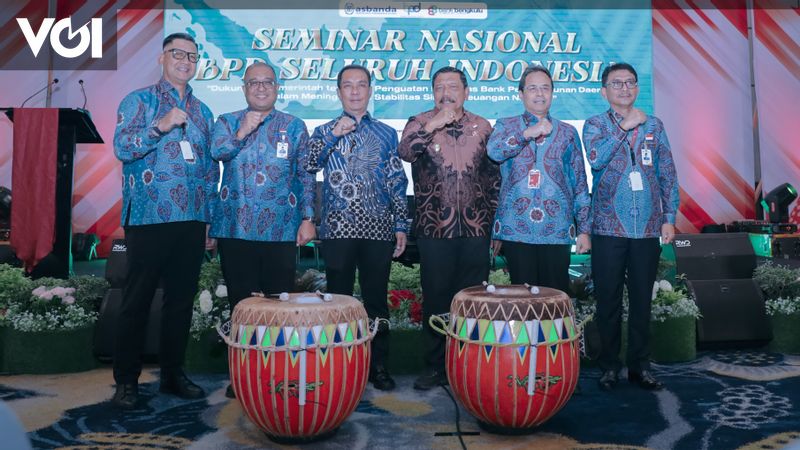
JAKARTA – The liquidity of Regional Development Banks (BPD) is in the spotlight amid changes in government fund management policies and increasing competition in fund-raising.
The Regional Development Bank Association (Asbanda) noted that the total assets of 27 BPDs nationwide had reached around Rp1,043 trillion as of June 2026. Meanwhile, the total credit disbursed reached around Rp673 trillion with third-party funds (DPK) of Rp770 trillion.
Although the BPD industry is fundamentally considered to be healthy, Asbanda reminded that pressure on funding sources needs to be a concern. Competition for community funds has the potential to increase the cost of funds or cost of funds (CoF), which in the end can affect the ability of BPD to distribute credit competitively.
Asbanda Chairman Agus Haryoto Widodo said the characteristics of BPD are different from other commercial banks because its funding structure has a strong link to the fiscal cycle of the local government.
The source of BPD funds comes from the circulation of the Regional Revenue and Expenditure Budget (APBD), government transfers, civil servant salaries, Regional Public Service Agency (BLUD) transactions, to Regional Owned Enterprises (BUMD).
“Policies aimed at increasing efficiency and accelerating the distribution of funds need to continue to consider their impact on the regional financial ecosystem,” said Agus at the National Seminar of the Bank for Regional Development of Indonesia or BPD-SI in Bengkulu, Friday, August 21.
According to Agus, the condition of banking liquidity nationwide is still strong. However, adequate liquidity in aggregate does not necessarily reflect the distribution of funds evenly across all banking groups, including BPD.
In fact, financing needs in the region continue to increase. If the BPD faces funding pressure and fund costs increase, the space for providing cheap financing for the productive sector in the region has the potential to be increasingly limited.
“BPD liquidity is part of the regional development capacity,” he said.
Asbanda also encourages national policies to maintain a balance between the efficiency of fund management at the central level and liquidity resilience in the regions.
In addition, the association asked for a level playing field for BPD in various government programs and transactions. BPD which has met the standards of technology, governance, services, and risk management is expected to have the same opportunity to become a bank distributor and government partner.
Asbanda also encourages that government funds placed in the BPD can be an instrument to strengthen intermediation in the region.
The funds are considered to be associated with financing priority sectors such as micro, small, and medium enterprises (MSMEs), food, housing, health, education, and infrastructure.
Thus, the liquidity available in the BPD does not only stop as savings, but can generate a multiplier effect on regional economic activities.
Member of the Indonesian Parliament, Fauzi Amro, assessed that the liquidity of the BPD nationally was still relatively thick. However, the high CoF is one of the vulnerabilities that need to be immediately overcome.
According to him, the cost of BPD funds is influenced by dependence on institutional funds with a special rate scheme and the pattern of turnover of APBD funds.
Fauzi encouraged three steps to strengthen BPD’s competitiveness, namely accelerating the consolidation of the Bank Business Group (KUB), modernizing Simpeda Savings into a digital account, and building a technology platform and cyber security together.
“The key to transformation and competitiveness of BPD remains in the hands of the BPD management itself through strengthening governance, acceleration of digitization, cost efficiency of funds, and the courage to finance MSMEs and productive sectors in the region,” said Fauzi.
The seminar is part of the series of the XXXVII-2026 Simpeda Savings National Lottery held by Asbanda together with Bank Bengkulu.
The English, Chinese, Japanese, Arabic, and French versions are automatically generated by the AI. So there may still be inaccuracies in translating, please always see Indonesian as our main language.
(system supported by DigitalSiber.id)
Add VOI as a Preferred Source
Follow VOI news updates across Google.
+











Leave a comment