
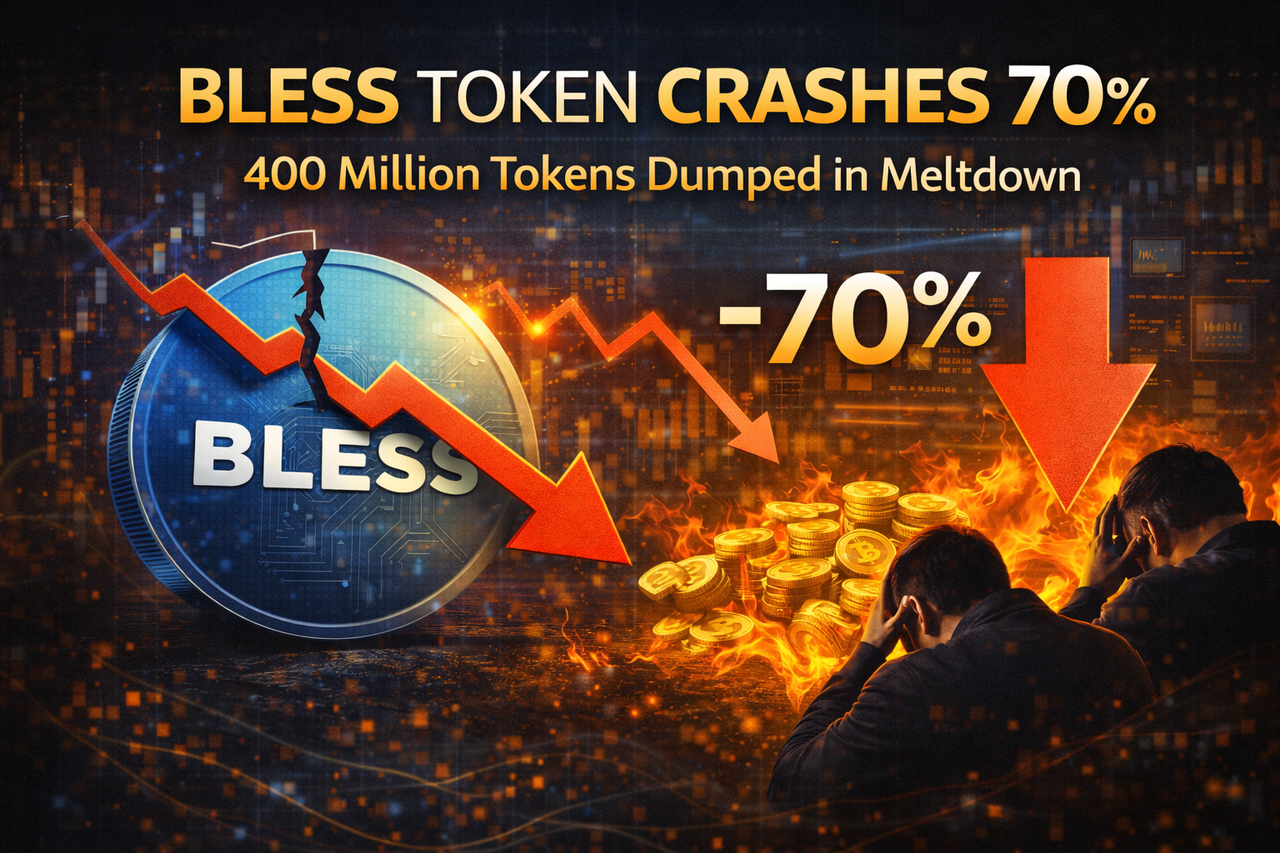
The decentralized physical infrastructure network (DePIN) sector faced a brutal wake-up call on April 16, 2026, when the native BLESS token experienced a catastrophic market collapse. After a series of massive, unannounced wallet movements from core project addresses, the BLESS token crashes by more than 70%, leaving retail investors and liquidity providers grappling with massive financial losses.
In this deep dive, we analyze the on-chain evidence behind the BLESS token crashes, exploring the technical failures in tokenomics and the broader implications for the 2026 AI-crypto landscape.
Key Takeaways:
The speed and scale of the BLESS devaluation have made it one of the most discussed events in the current market cycle. To understand the gravity of the situation, we must look at the immediate impact metrics:
-
Price Devastation: The token plummeted from its 24-hour peak of $0.0366 to a harrowing low of $0.0098, effectively wiping out months of gains in a single afternoon.
-
Massive Sell-Off: On-chain forensics confirmed that approximately 400 million tokens were moved out of project-controlled wallets, with the majority being offloaded onto centralized and decentralized exchanges.
-
DePIN Sector Shock: As a project once heralded for its “distributed computing” innovation, the crash has cast a shadow of doubt over similar low-cap DePIN and AI-narrative tokens.
-
Loss of Trust: The lack of a transparent vesting schedule and the team’s subsequent silence have led many to label the event a “soft rug pull” rather than a mere liquidity rebalance.
Deep Dive into the BLESS Token Dump: On-Chain Forensic Analysis
Blockchain transparency is a double-edged sword; while it allows teams to prove their integrity, it also leaves an indelible trail when things go wrong. When the BLESS token crashes, the ledger provided a minute-by-minute account of the exodus.
The Solana Genesis: Tracking 400M Tokens from Core Wallets to Exchanges
The initial red flag appeared on the Solana blockchain. Analysts observed several “Genesis” wallets—addresses that had held tokens since the project’s TGE (Token Generation Event)—suddenly becoming active. Approximately 200 million BLESS tokens were transferred in a single batch to a deposit address at Bitget.
In the crypto world, moving large quantities of tokens to a CEX (Centralized Exchange) is the universal signal for an impending sale. Because these tokens were not held in a multi-sig or a time-locked contract, there was no technical barrier to prevent the team from hitting the “sell” button. The sudden influx of $2.15 million worth of sell pressure onto a mid-tier exchange was the primary catalyst that sent the price into a tailspin.
The BSC Bridge Maneuver: Why Moving 50M BLESS to BNB Chain Sparked Panic
While the Solana sell-off was occurring, a secondary front opened up on the BNB Chain (BSC). The project team utilized a cross-chain bridge to move 50 million BLESS tokens to PancakeSwap and other BSC-based liquidity pools.
This maneuver was particularly alarming for two reasons:
-
Obfuscation: Bridging assets across chains is a common tactic used to distribute sell pressure and make it harder for casual observers to track the total volume being dumped.
-
Liquidity Draining: By selling into BSC pools, the team effectively drained the USDT and BNB reserves that were meant to provide a floor for retail traders, ensuring that the BLESS token crashes would be felt across the entire multi-chain ecosystem.
Liquidity Vacuum: Calculating the Damage of the $3.8M Instant Sell-Off
Liquidity is the lifeblood of any cryptocurrency. At the time of the dump, the BLESS/USDT pair had a combined liquidity depth of less than $1.5 million across all major venues. When the team attempted to liquidate nearly $3.8 million worth of tokens, they created a “liquidity vacuum.”
The market simply did not have enough buy orders to absorb the supply. For every 10 million tokens sold, the price slipped by nearly 5-8%, creating a cascading effect. As the price dropped, it triggered automated liquidation protocols and retail stop-losses, which added even more sell pressure to an already broken market.
The Institutional Failure: Why Bless Network’s Tokenomics Failed Investors
To understand why the BLESS token crashes happened so easily, we must look at the structural flaws in the project’s economic design. Many investors were blinded by the “AI” and “DePIN” buzzwords, failing to audit the underlying distribution model.
The Missing Lock: Analyzing the Absence of Transparent Vesting Contracts
In a professional crypto project, team and foundation tokens are subject to a vesting schedule. This usually involves a “cliff” (a period where no tokens are released) followed by a linear monthly release over 24 to 48 months.
Upon further inspection of the BLESS smart contracts after the crash, it was revealed that:
-
The team wallets were “EOA” (Externally Owned Accounts) rather than programmatic lock-up contracts.
-
There were no on-chain “Time-Locks” preventing the sudden movement of the 400M tokens.
-
The project had ignored community requests for a third-party audit of their token distribution.
Fully Diluted Valuation (FDV) vs. Market Cap: The Warning Signs We Missed
One of the most significant red flags was the massive discrepancy between the circulating market cap and the Fully Diluted Valuation (FDV). At its peak, BLESS had a circulating market cap of $18.38 million, but an FDV of nearly $100 million.
This meant that over 80% of the total supply was still held by the project, waiting to be “unlocked.” When a project has such a high percentage of non-circulating supply in the hands of the founders, any shift in sentiment can lead to a massive supply shock. The BLESS token crashes are a textbook example of what happens when a “low float, high FDV” project hits a wall.
Team Communication Breakdown: Silence as a Catalyst for the 70% Drop
In the midst of a crisis, communication is everything. However, as the price of BLESS plummeted, the official Telegram and X (formerly Twitter) accounts went silent. Instead of explaining the wallet movements—which they could have claimed were for “ecosystem development” or “market making”—the team chose to ignore the community.
This silence acted as a vacuum that was quickly filled by fear, uncertainty, and doubt (FUD). Without a counter-narrative from the founders, investors assumed the worst: that the project was being abandoned. This psychological shift turned a 30% correction into a 70% total collapse.
Broader Market Impact: What the BLESS Crash Means for DePIN & AI Tokens in 2026
The BLESS token crashes do not happen in a vacuum. Because BLESS was part of the highly-touted DePIN and AI narrative of 2026, its failure has systemic implications for the industry.
| Impact Category | Effect on Market | Risk Level |
| Retail Sentiment | Investors are now fleeing “low-cap” AI tokens in favor of established majors. | High |
| VC Funding | Venture Capitalists are tightening due diligence on DePIN tokenomics and lock-ups. | Medium |
| DEX Liquidity | Liquidity providers are pulling back from pairs with high “team-hold” ratios. | High |
The distributed computing niche, which relies on users lending their hardware to the network, is particularly vulnerable. If users feel that the native rewards token is subject to arbitrary dumping by the founders, they will stop contributing their hardware, effectively killing the network’s utility. The BLESS token crashes serve as a warning that without utility and trust, the “Physical Infrastructure” part of DePIN cannot survive.
Investor Defense Strategy: How to Spot a “Token Dump” Before it Happens
While the BLESS token crashes were devastating, they were also predictable for those using the right tools. Protecting your portfolio in the 2026 market requires moving beyond “vibe-based” investing and into data-driven analysis.
Tooling for Success: Using Arkham and Solscan to Monitor Insider Wallets
Every investor should have a dashboard set up to monitor the top wallets of their holdings. Tools like Arkham Intelligence allow you to label wallets and receive push notifications when a “whale” or “team wallet” interacts with an exchange.
If you had set an alert for the Bless Network treasury wallets on Solscan, you would have received a notification the moment the 200M tokens moved toward Bitget. In a market where the BLESS token crashes 50% in just a few hours, those extra minutes of lead time are the difference between exiting with a profit and being “bag-held” to zero.
Smart Contract Audits: Verifying “Time-Lock” and “Vesting” Functions
Before committing significant capital to a DePIN project, you must verify the contract status. Professional projects will list their vesting contracts on platforms like TokenUnlocks or Hacken. If a project claims to have a lock-up but the tokens are sitting in a standard wallet address, you are effectively trusting the founders’ pinky-promise. The BLESS token crashes proved that in crypto, code is law, and if the code doesn’t lock the tokens, the team eventually will dump them.
Conclusion
The incident where the BLESS token crashes by over 70% serves as a grim reminder of the volatility and ethical risks inherent in the decentralized finance space. By dumping 400 million tokens without warning, the Bless Network team has not only destroyed their own project’s valuation but has also invited intense scrutiny onto the DePIN sector as a whole. Investors must prioritize transparency and on-chain verification over hype, as the era of “trust me” crypto is rapidly coming to an end. Only projects with verifiable, immutable tokenomics will survive the inevitable regulatory and market shakeouts of late 2026.
FAQ
Q: Why did the BLESS token crash so suddenly?
A: The BLESS token crashes were primarily caused by the project team moving 400 million tokens to exchanges, creating an overwhelming sell pressure that the market’s limited liquidity could not absorb.
Q: Is the Bless Network project a rug pull?
A: While the team has not officially shut down, the unannounced dumping of 400M tokens is considered a “soft rug pull” by many, as it decimated the value for retail holders while the team cashed out.
Q: How can I track if a project is about to dump tokens?
A: You can prevent being caught when a BLESS token crashes by using on-chain tools like Arkham or Solscan to monitor team wallets and ensuring that token vesting is enforced by smart contracts.
Q: Will the BLESS token price recover?
A: Recovery is unlikely in the short term. When a BLESS token crashes due to team dumping, the fundamental trust required for a price rebound is usually permanently damaged, leading to a long-term decline.
Q: What does this crash mean for other DePIN tokens?
A: The BLESS token crashes have increased market skepticism. Investors are now more likely to demand proof of locked liquidity and transparent vesting from other DePIN and AI-related projects before investing.










Leave a comment