
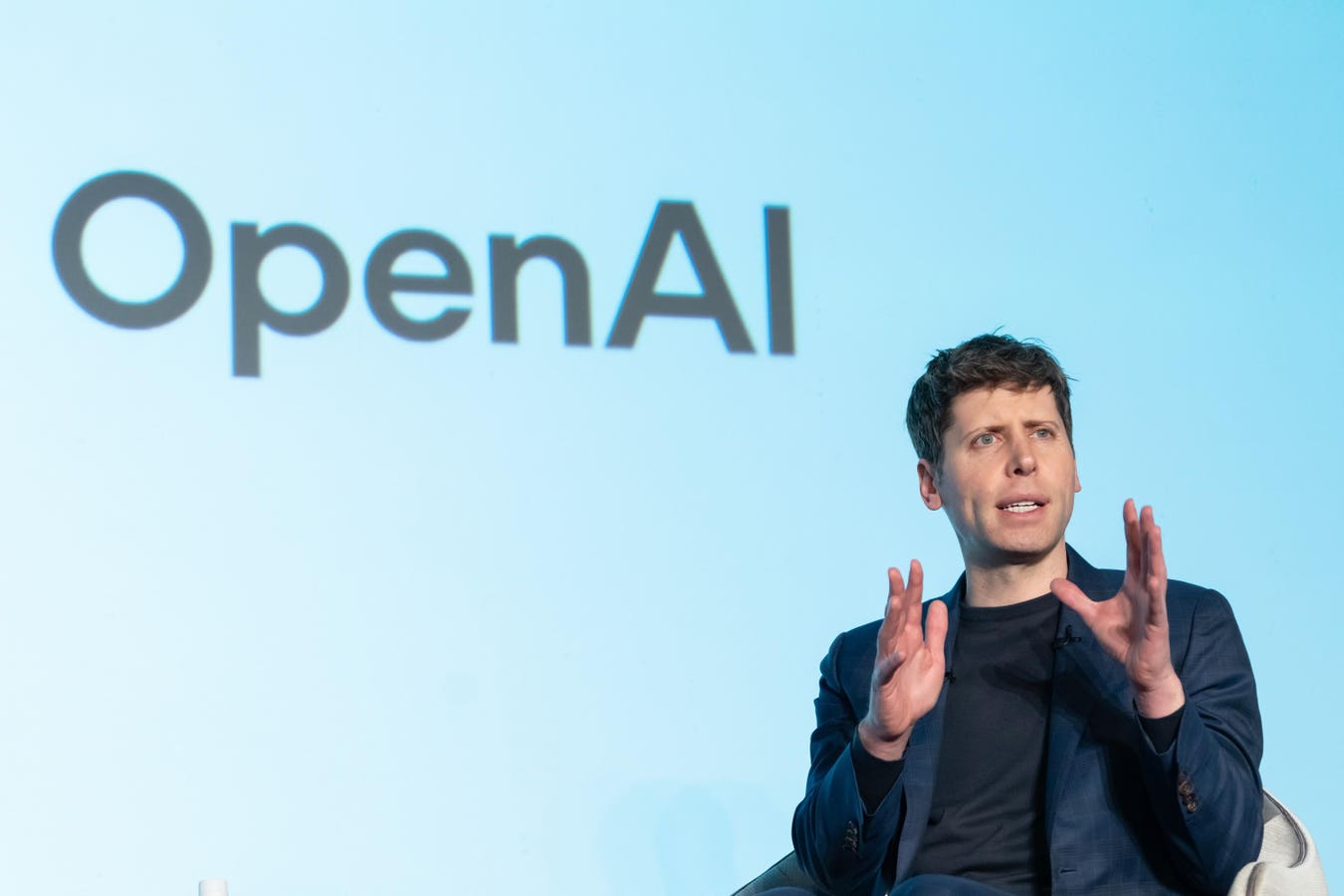

TOKYO, JAPAN – FEBRUARY 3: Open AI CEO Sam Altman speaks during a talk session with SoftBank Group CEO Masayoshi Son at an event titled “Transforming Business through AI” in Tokyo, Japan, on February 03, 2025. SoftBank and OpenAI announced that they have agreed a partnership to set up a joint venture for artificial intelligence services in Japan today. (Photo by Tomohiro Ohsumi/Getty Images)
Getty Images
OpenAI is offering private-equity firms a guaranteed minimum return of 17.5%, significantly above what is typical for preferred equity instruments, as it races to secure distribution partners for a new enterprise joint venture, according to a Reuters report. The company is also promising early access to models not yet in public release, with firms including TPG and Advent International named as targets for the deal.
The joint venture, first reported by Reuters on March 16, carries a pre-money valuation of roughly $10 billion. Private equity investors would collectively commit approximately $4 billion in exchange for equity stakes and board seats. TPG is set to serve as anchor investor, with Advent International, Bain Capital and Brookfield Asset Management as co-founding participants.
Rival Anthropic is pursuing a structurally similar arrangement, courting Blackstone, Hellman & Friedman and Permira for its own enterprise-focused venture. But Anthropic’s offer includes no equivalent financial guarantee, the anonymous sources, told Reuters, a gap that defines the competitive terms of what has become a direct contest for private equity capital and enterprise market share.
Why Private Equity Firms, Why Now
The strategy is new to the AI sector. Both companies are courting buyout firms because PE firms control large portfolios of established companies and directly influence how those businesses budget for software and technology. A joint venture structure gives OpenAI and Anthropic a shortcut into hundreds of corporate customers simultaneously, bypassing deal-by-deal enterprise sales cycles.
“There’s a big race to lock in as much enterprise, as many desks as possible,” said Matt Kropp of Boston Consulting Group’s AI unit, adding that once a company has a customized AI model integrated into a client’s systems, switching to a competitor becomes substantially harder.
The joint venture structure also serves internal financial purposes. Deploying engineers to customize models for enterprise clients involves high upfront costs. Routing those costs through a separately capitalized vehicle eases near-term pressure on both companies’ balance sheets and produces cleaner segment reporting, two people familiar with the discussions told Reuters. That reporting clarity matters: both OpenAI and Anthropic are considering going public as early as this year, and a well-structured enterprise unit would support the IPO narrative.
The Financial Context Behind The Pitch
OpenAI’s willingness to guarantee a 17.5% minimum return sits against a financial backdrop of significant losses. Internal projections show the company is on track for $14 billion in losses in 2026 alone, even as annualized revenue crossed $20 billion in 2025, a 233% year-over-year increase. The company does not expect to reach profitability until 2029.
OpenAI raised $110 billion earlier in 2026, with $50 billion from Amazon, $30 billion from SoftBank and $30 billion from Nvidia. The PE joint venture is a separate vehicle targeting enterprise distribution, not a primary fundraising instrument. Still, the guaranteed return structure means OpenAI is committed to a specific cost of capital, at scale, regardless of how the venture performs.
Anthropic’s position differs in financial profile. The company raised a $30 billion Series G at a $380 billion valuation in February 2026, and has lifted its internal 2026 revenue target to as much as $18 billion. Its enterprise market share grew from 18% to 29% in 2025, with eight of the Fortune 10 counted as customers, according to Menlo Ventures data.
Not Every PE Firm Is Convinced
Thoma Bravo, one of the world’s largest software-focused buyout firms, decided against participating after internal discussions led by managing partner Orlando Bravo. According to Reuters, Bravo raised questions about the long-term profit profile of the joint ventures, noting that many of its portfolio companies are already deploying AI tools independently. Thoma Bravo declined to comment.
Other investors have questioned the premise more broadly. Several large PE firms already have direct access to both OpenAI and Anthropic without committing capital, making the incremental value of a formal joint venture relationship unclear. These firms have also noted that with technology valuations under pressure, such a venture may not materially change access to AI tools or generate the additional revenue its structure implies. Sources also pointed to LP pressure on buyout firms to demonstrate a credible AI strategy as a driver of interest, separate from the economic merits.
The investment terms include seniority over other joint venture partners and downside protection, Reuters reported. Several additional firms are in talks to take smaller stakes without board seats or lead roles.
The Broader Competitive Backdrop
The PE push unfolds amid a sharpened rivalry between the two companies. In late February, Anthropic walked away from a potential $200 million Defense Department contract after negotiations broke down over whether its Claude models could be used in fully autonomous weapons systems and mass domestic surveillance. The Pentagon responded by designating Anthropic a national security supply chain risk, an unprecedented action against a U.S. technology company. Hours later, OpenAI announced it had reached a deal with the Defense Department on its own terms.
The episode produced visible consumer consequences for OpenAI. ChatGPT uninstalls surged 295% in the days following the announcement, while Claude climbed to the top of U.S. app store download charts and Anthropic reported record sign-ups. Anthropic has since filed suit to challenge the Pentagon’s supply chain risk designation.
The enterprise joint venture race is, in part, OpenAI’s response to that dynamic. Anthropic has historically held an edge in enterprise, and OpenAI’s doubling down in that segment, with financial terms designed to be difficult to match, reflects the competitive pressure the company faces on that front.












Leave a comment