

Investing in U.S. tech stocks has long been one of the best moves to make with your money. But which tech exchange-traded fund (ETF) is the best fit for your goals if you want to invest in a bunch of tech companies all at once?
Many investors like the Invesco QQQ Trust (QQQ 1.51%), which tracks the performance of the tech-heavy Nasdaq-100 index. Buying shares of this fund — which some call the Qs — is a simple way to invest in tech industry leaders. For the past 10 years through March 31, this fund had delivered average annual returns (by net asset value) of 18.98 %.
An alternative is the Vanguard Mega Cap Growth ETF (MGK 1.31%). This ETF owns 59 holdings with a big emphasis on tech stocks. For the past 10 years, as of March 31, it had delivered average annual returns (by net asset value) of 16.95%. Both funds have a solid track record of outperforming the S&P 500 index.
Let’s look at which of these two tech ETFs could be the better buy.

Image source: Getty Images.
MGK: Lower fees; lagging performance
Many Vanguard ETFs are broadly diversified, low-cost funds that track an index. This one is more concentrated. The Vanguard Mega Cap Growth ETF has 59 holdings, and 68% of the fund consists of tech stocks.
The fund’s top five holdings as I write this are:
- Nvidia (NVDA 4.39%) (13.8% of the fund)
- Apple (AAPL +0.68%) (12.6%)
- Alphabet (GOOGL 1.15%)(GOOG 1.03%) (9.9% — including Class A and Class C shares)
- Microsoft (MSFT +3.04%) (9.02%)
- Amazon (AMZN 1.19%) (4.6%)
This fund is top-heavy. Those top five tech stocks make up about 50% of the holdings. If you want a more diversified portfolio of growth stocks, this ETF is not the right choice.
The Vanguard Mega Cap Growth ETF has beaten the S&P 500 consistently, but it has significantly underperformed the Invesco QQQ ETF for the past 10 years.
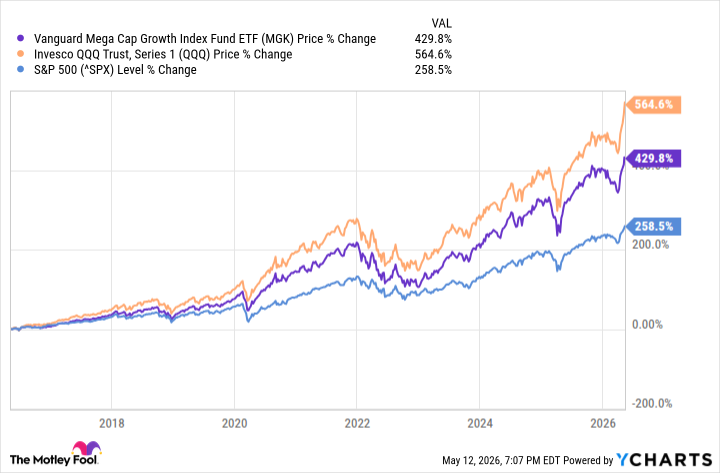
The Vanguard fund has gained 6.4% year to date as I write this (while QQQ has gained 15.1%), and for the past year it’s gained 30% while QQQ is up 39%.
Like most Vanguard ETFs, the Vanguard Mega Cap Growth ETF charges low fees — its expense ratio is only 0.05%. But the fund does not appear to be “cheap” if you look at its price-to-earnings (P/E) ratio of 39. That’s higher than the QQQ fund’s earnings multiple, which offers a price-to-earnings (P/E) ratio of around 34.
If you buy MGK instead of QQQ, you might pay too much for too little performance.
QQQ: Tried-and-true way to buy America’s tech leaders
The Invesco QQQ ETF holds 102 stocks and has a total of $463 billion of assets under management. It charges an expense ratio of 0.18%, which is not as low as other funds, but is still highly competitive compared to many other ETFs.
This fund is almost as tech-heavy as the Vanguard Mega Cap Growth ETF. The Invesco QQQ ETF portfolio allocation is 64% to tech stocks. The fund’s top five holdings as I write this are:
- Nvidia (8.8%)
- Alphabet (7.4%)
- Apple (7.1%)
- Microsoft (5.05%)
- Amazon (4.8%)
These top five stocks make up 33.2% of the fund. This makes the Invesco QQQ ETF a bit less top-heavy and more diversified than MGK.
MGK vs. QQQ: Which ETF should you buy?
If you want to take a concentrated position on tech stocks, just buying the Qs seems like a simpler choice. The Vanguard Mega Cap Growth ETF is constructed to be top-heavy with just a few stocks. It doesn’t offer any additional diversification. The Vanguard fund’s fees are a bit lower, but not enough to make up for long-term underperformance.
If you believe that the future of U.S. tech stocks is bright, buying the Invesco QQQ Trust could be a better choice than the Vanguard Mega Cap Growth ETF.













Leave a comment