
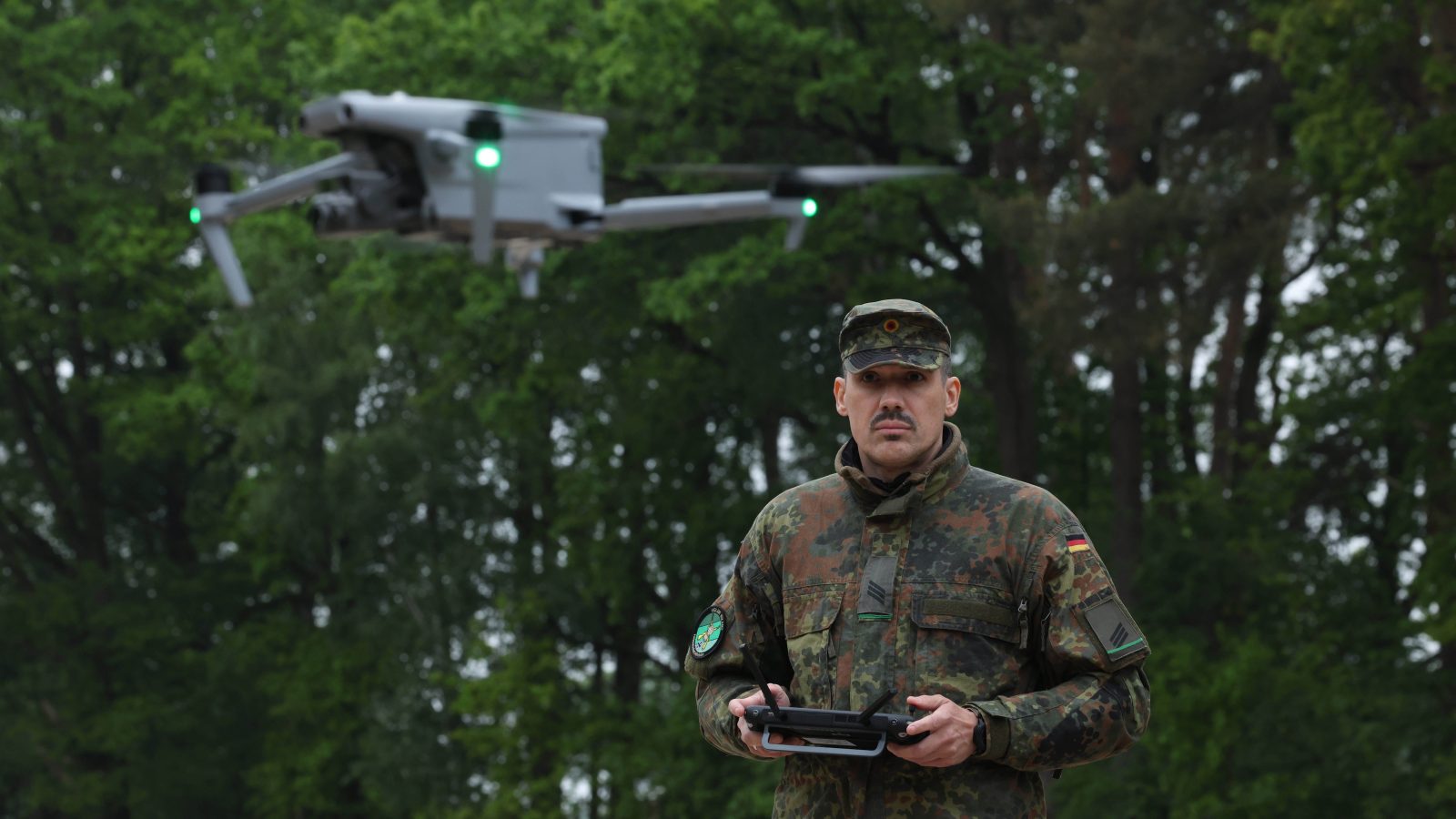
Ministerial reshuffles are increasingly preoccupying investors focused on themes of military sovereignty, maritime security and drone technology.
One of the first announcements of Andy Burnham as UK prime minister was his appointment of former defence minister John Healey as chancellor, with investors immediately expecting higher military spending.
Defence stocks rallied. Babcock gained 6 per cent, BAE Systems 3 per cent, Chemring 3 per cent and Qinetiq 4 per cent, amid “growing consensus for a new fiscal compact to find more money for defence in the long-term”, according to Neil Wilson, investor strategist at Saxo UK. The Danish bank has long argued that smaller firms involved in AI and drone manufacture will benefit most from the defence spending trend.
Musical chairs among military commanders and defence ministers have been particularly evident in war-torn Ukraine, where President Volodymyr Zelenskyy was forced to replace Oleksandr Syrskyi, commander-in-chief of Ukraine’s armed forces, with Major General Mykhailo Drapatyi.
The latter is close to digital-friendly defence minister Mykhailo Fedorov, whose dismissal led to several days of protests on Kyiv’s cobbled streets. Both favour extensive use of robotics, drones and air defences, fostering links with US big tech companies.
Ukraine’s next generation weapons developers, and the investment community surrounding them, have vocally backed this changing of the guard. “Everyone recognises Drapatyi will maintain a tech-driven trajectory, with a primary focus on military technology,” says Vadym Hlushko, head of analytics at the MARS military think-tank in Kyiv.
Regardless of who controls Ukraine’s defence budget, supported by corporate and country donors, “technological innovation will continue at scale”, believes Hlushko. “Technological advantage offsets our personnel deficits. The core investment thesis for Ukrainian defence tech relies on this structural logic, rather than the specific individuals holding leadership positions at any given moment.”
Analysis of Kyiv’s fightback against Russia’s full-scale invasion has shifted definitively from battlefield defences on the vast southern steppeland to surprise sky attacks on Russian energy infrastructure.

Intrigues at the highest levels of the military machine are seen by Ukraine’s financial community as part of the country’s ongoing digital revolution, including collaboration with US tech leaders Palantir and SpaceX.
“Ukraine has been moving towards a more agile, technology-driven model of defence for several years,” argues Andriy Kolodyuk, founder of Aventures Capital and chairman of the Ukrainian Venture Capital and Private Equity Association.
“The increasing role of AI, autonomous systems, drones, digital command-and-control, and closer collaboration with private technology companies reflects this broader transformation.”
Investors, he believes, should welcome continued reforms that accelerate innovation, improve procurement, and strengthen co-operation between government, industry and start-ups. Kolodyuk speaks from experience. As well as being a serial entrepreneur himself, he has acted as something of a Godfather figure for young start-up founders seeking venture capital backing for the last two decades.
Silicon steppelands
“Maintaining this pace of technological adaptation will remain one of Ukraine’s key strategic advantages and an important factor in attracting international investment,” believes Kolodyuk, who has likened Ukraine’s contemporary technological renaissance to the ascendance of California’s Silicon Valley at the turn of the century.
“Ukraine has built one of the world’s most dynamic defence innovation ecosystems, with more than 2,000 companies developing battle-tested technologies across drones, AI, cyber security, electronic warfare and autonomous systems,” he argues.
Now, with European defence spending increasing, he and his colleagues in Ukraine’s financial sphere seek to attract investors who wish to access technologies that have already been validated in the most demanding operational environments.
Family offices can access specialised defence and dual-use venture capital funds raising new money and offer “an efficient way to gain diversified exposure to this rapidly growing sector while supporting Europe’s long-term security and technological sovereignty”.
Funds specifically focused on Ukrainian military technology include D3 Venture Capital, Green Flag Ventures, Freedom Fund VC, MITS Capital, Varangians, Defender, Angel One and UA1.
Increasingly, investors recognise that technologies protecting critical infrastructure, democratic societies and civilian deterrence are compatible with responsible investing
Ukrainian defence-tech start-ups raised $105mn in 2025, according to MARS, with fundraising in 2026 already running at twice the pace of last year. But most investment vehicles, according to industry commentators, remain at an early stage and are undercapitalised relative to demand.
Innovative drone manufacturers including Kvertus and Huless, pioneering dual-use technology projects, have been busy duplicating drones using 3D printers, backed by funds raised from Ukrainian companies and western venture capital funds.
While ESG regulations for many private banking and institutional mandates once forbade investment in military technology, the situation is fast evolving. “Increasingly, investors recognise that technologies protecting critical infrastructure, democratic societies and civilian deterrence are compatible with responsible investing,” says Kolodyuk. He draws attention to the 15,000 dual-use entrepreneurs designing drones and other aerial devices in Ukraine, which protect citizens and provide security for energy and food supply.
Combat-proof portfolios
Rather than just following different geographical conflicts around the globe, which have defined opportunities, analysts feel investors are now ultimately driven by the quality of start-up founders, their technologies, and market opportunities. Drone technologies which have been tested in Ukraine’s military theatre, according to private equity players, are able to demonstrate their products are “combat proof”.
But investors have many risks to manage, including physical security for their teams. “Russian strikes simultaneously strengthen the strategic investment thesis for the sector, while increasing the risk profile for those with physical assets or teams on the ground in Ukraine,” says Hlushko at the MARS think-tank.
Investors, he says, typically manage these risks through production decentralisation, investing in underground facilities and adapting logistics.
But a broader set of opportunities is also playing out for portfolio investors with a lower risk appetite. Family offices, investment houses and wealth managers across Europe are urging clients to back these trends.
They point to a world which realigned geopolitically, when Russia launched its full-scale invasion in 2022. “Europe has been at war with Russia since 2022, when Moscow attacked Ukraine. That was an epochal event,” says Beat Wittmann, chairman and founder of Porta Advisors in Zurich, formerly a senior private banker at UBS and Julius Baer.
“One of the results of this is that Europeans have rightly understood that they need to prioritise sovereignty — and that includes financial sovereignty — in defence, industry and technology, but that is a journey and it’s a matter of political will,” says Wittmann, who advises wealthy European families, many of them interested in investing in their continent’s defence.
Chain reactions
Russia’s attacks on Ukraine and America’s war in the Middle East, he says, have led to the severance of supply chains, reducing dependence on raw materials and prioritising investments in critical infrastructure, transportation, energy transition and communications technology.
“For investors, this means Europe has entered a super cycle of investment, after the peace dividend has been distributed for more than 30 years,” he says, with infrastructure and defence neglected during that time.
“The focus was on how to redistribute and consume wealth. Now it has to shift back to investment, in order to produce higher economic growth, higher productivity and more resilience.
“It is time to go into European equities, because valuations are much lower now,” argues Wittmann. “The growth prospects are structurally very positive over the next three to five years, because there will be a lot of investment into defence, industry, technology and all critical infrastructures.”

Transport infrastructure is a key priority, because in case of Russian attacks on a Nato country, the alliance must be able to move 800,000 troops and 200,000 military vehicles through Europe’s network of roads, railways and rivers.
“Topographically and geographically, Germany is at the centre of this, between the west and the east, and that infrastructure has to be ready,” he says. “But it’s not ready as of today, and this is not something that you fix in three weeks.”
Rather than investing in individual defence stocks or start-ups, Wittmann suggests opting for “the multiplier effect” from European markets. “You can buy stocks across Poland and Germany; that’s the first line which will lift all boats.” The second stage is buying diversified ETFs focused on defence, resilience and infrastructure.
Private warnings
Private markets, however, should be treated with caution. “Private markets have attracted, over the past two years, a lot of interest. But I think they are richly priced and overinvested, leading to many disappointments,” he says.
Defence start-ups, such as those in Ukraine, must be backed by “strong and relevant” intellectual property, plus the ability to scale, build and finance a business.
“In Europe, there is a less-than-ideal ecosystem to support that. Traditionally, the US has a clear advantage because there are deep capital markets,” says Wittmann. This lack of depth is another reason he suggests European investors should focus on the “attractive valuations” from diversified public markets rather than private opportunities.
Along with other analysts, he does not doubt most components of high-tech equipment, including military drones and interceptors used by many countries, originate from China’s Pearl River Delta.
“When there is a place to invest, it’s an absolute reality that China has the dominant position as the industrial workshop of the world, not only in quantity but also in quality,” he says. “We should never underestimate that.”
This state of affairs will begin slowly changing, he predicts. “When it comes to national or collective security in Europe, there is a strong push now to focus on European hardware and we are developing software too. This means we will be producing, procuring, deploying and financing purely European projects.”












Leave a comment