
Lack of products and insufficient evidence of outperformance in some parts of the market mean that, despite years of growth, there are still significant challenges to impact investment achieving institutional scale.
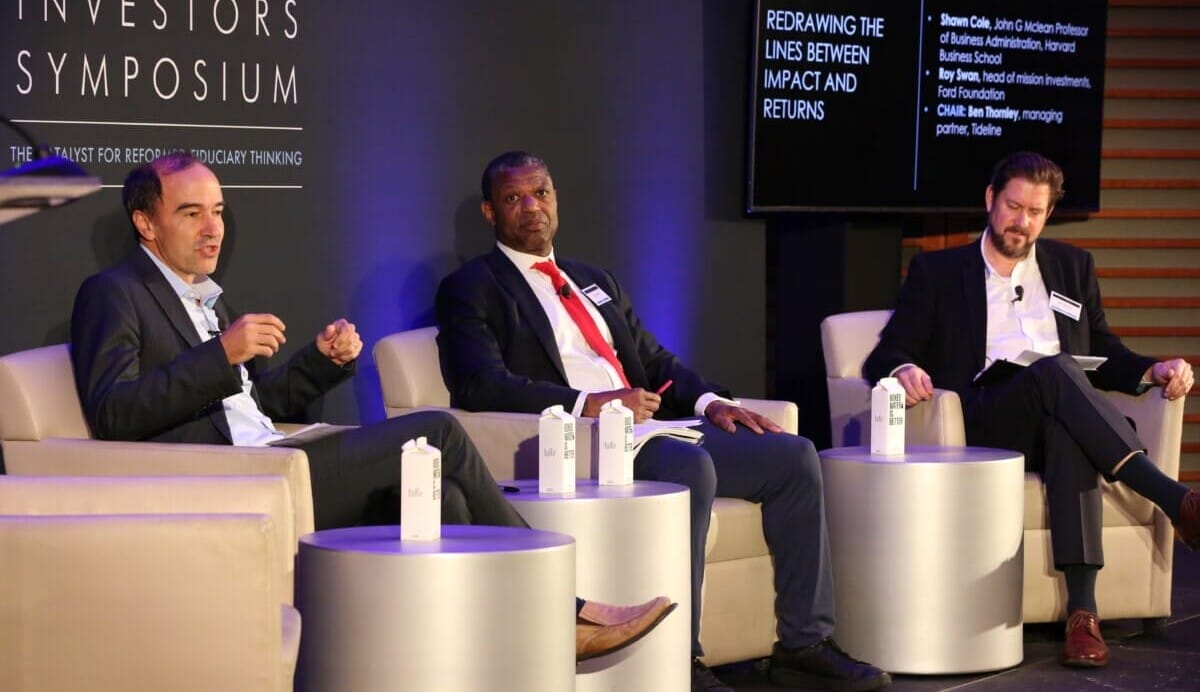
Impact investing has come a long way in the past two decades, going from a niche strategy to a $1.5 trillion industry, according to the Global Impact Investing Network. But at the Fiduciary Investors Symposium, Shawn Cole, John G Mclean Professor of Business Administration at Harvard Business School, said the ability of large asset owners to allocate to the area at scale remains constrained.
“If we think about… people who have $50 billion, $100 billion or more to manage, I think it does seem to be a bit of a challenge in terms of available product. We have the large PE firms in the US offering a few funds,” he told the symposium at Harvard University.
“Impact investing – what it does really well is on the venture side. It’s out there sniffing around in the world trying to figure out what the important trends 5, 10, 20 years down the line, we see some early successes there get adopted by mainstream.
“But of course more data, more product [means] better and positive experiences.
“Once people are very comfortable that they can put this type of strategy into their portfolio without undue financial risk, or even with anticipation of effective risk management, we’ll see it continue to grow.”
The case is building for impact investing’s ability to generate outperformance, but the problem is that data remains “scattered”.
“There’s a recent paper in the JFE (Journal of Financial Economics) that looks at more recent US impact investing funds and finds very similar performance between impact funds and traditional VC,” Cole said.
“I think we’re starting to get the evidence, it’s still pretty scattered – folks like Cambridge Associates are not reporting quarterly data like they do for VCs. I think we definitely need a lot more data infrastructure, more experience sharing from organisations that have done this successfully or poorly, and what they’ve learned.”
Cole’s own research affirms impact investing’s ability to generate alpha over time. In a 2020 research paper, Cole examined the performance of a private equity portfolio from the International Finance Corporation which includes investments across 130 countries over 58 years, and found that the portfolio has outperformed S&P 500 by 15 per cent. It’s not a significant amount of alpha on an annual basis but to Cole, this is a “stunning” result.
“You might say, ‘look, Shawn, if I’m investing in an agricultural processing plant in Mali, that’s a little bit less liquid than the S&P 500. I might want a higher premium for that’. And I would say ‘yes, absolutely’.
“But at the same time, US capital markets had a pretty amazing run from 1950 to present, and that is very deliberate impact strategy.”
“There’s some evidence in the private markets [of impact investing outperformance], I would say to me the public markets’ evidence is much less compelling. [There are] 1000 papers literally trying to find correlations between ESG and impact strategy and equity returns, and it’s really a mixed bag.”
Roy Swan, head of mission investments at Ford Foundation, said impact investing has led it to discover some truly cutting-edge companies, including AI darling Anthropic, which is speculated to launch a blockbuster IPO as early as October.
Swan conceded he had not heard of Anthropic or Claude until Ford Foundation struck a deal with the bankrupt crypto exchange FTX, alongside a consortium of buyers, to purchase the majority of FTX’s stake in the AI startup.
“I did a deep dive, but specifically what we were focused on was the symbolic implications of picking an LLM company that had specifically been formed to pursue humanitarian, safety first AI,” Swan said.
“And the company was formed by people who left OpenAI… because they thought they could do a better job creating guard rails around artificial intelligence.”
Ford Foundation invested when Anthropic was valued at $18 billion. Today, the company is valued at $965 billion pre-IPO.
While it is it is the case that companies like Anthropic won’t have any trouble raising capital from the broader investor community, Swan said it is not the point of why impact investors want to be involved in it.
“Impact investing does not mean funding something that might not otherwise get funding, it means investing for the purpose of double or triple bottom line investments,” he said. Double or triple bottom line refers to the concepts of additional non-monetary metrics companies are evaluated against by shareholders.
“I think we can be too critical of impact investment opportunities versus traditional. So we’re fine with investing in entities that will generate a profit regardless of the consequences known as negative externalities, that’s fine; but if it’s an impact investment, it better be perfect.
“What we do is our traditional investment analysis, we think about whether the impact fits with something that we understand well enough from a diligence perspective, and then the secret sauce is resumes and references.”
The fund will examine whether the impact credentials of a company are authentic or “market opportunism” throughout this process. But just like any form of investment, impact investments can generate losses.
“We don’t let perfect be the enemy of good. We’re trying to do good in the world, that includes virtue signalling, because we believe that good role modelling is a good thing,” he said.
“If we think about the world we want to leave for our children and grandchildren, we believe it’s great to be able to allocate capital a way where the intention is to do well and do good.”











Leave a comment