
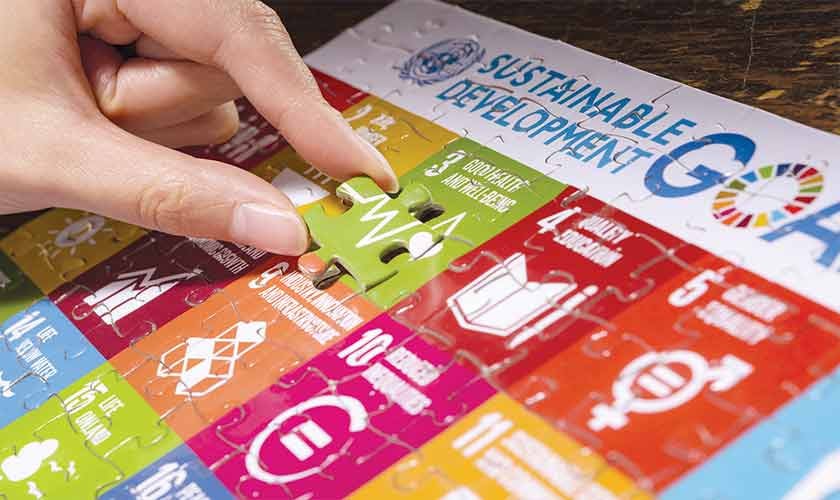
SUSTAINABLE DEVELOPMENT

Sustainable development means development that satisfies the needs of the present generation without compromising the ability of future generations to meet their own needs.
The concept emerged from the United Nations Brundtland Commission’s 1987 report, which emphasised that economic development must go hand in hand with environmental conservation. It strongly condemned the narrative that we are above nature and can manage it as we will. The aforementioned report motivated us to let go of an ego-centric approach and adopt a more eco-centric perspective. It introduced the idea that we are part of nature and that, for us to have a sustainable future, we must respect and preserve nature while pursuing economic growth.
If our home were on fire, we would leave no stone unturned to put it out and preserve it. It’s really that simple. Likewise, Planet Earth is our home, and if it were on fire, we should also leave no stone unturned to put out that fire.
The UN points out that our unsustainable reliance on fossil fuels to support economic growth is the main cause of climate change. When we burn fossil fuels (coal, oil and gas) to produce electricity and run the transport sector and industries, we emit greenhouse gases into the atmosphere. This increases the concentration of greenhouse gases in our atmosphere, causing our previously stable climate to change.
Germanwatch’s Climate Risk Index highlights that Pakistan was the 15th most affected country by climate change impacts during 1995–2024. The Sustainable Development Policy Institute (SDPI) points out that Pakistan loses roughly one per cent of its gross domestic product (GDP) each year due to climate-induced damages. Now is the time for Pakistan to make sustainable development a compulsory part of education at all levels. People in Pakistan must understand what climate change is, its root causes, how it threatens our future, and what we can do to minimise its consequences.
We must rethink our concept of development and realign it with sustainability so we can meet our needs without hindrance, and future generations can also meet theirs without difficulty or compromise
Most importantly, we must choose an ecocentric approach to public policymaking to create a sustainable and resilient Pakistan, strong enough to meet the challenges of today and tomorrow. It is possible, and we have what it takes, to create a sustainable Pakistan for us and future generations.
We must understand that we need to shun the status quo and desperately need a paradigm shift when it comes to managing resources in Pakistan. It is crucial that we learn to do more with less. In fact, doing more with less should be our core ideology and mantra to get things done in Pakistan. The United Nations Population Fund (UNFPA) Pakistan predicts that Pakistan’s population will reach 403 million by 2050. The UNFPA estimates that Pakistan’s current population is 240.5 million.
This means that our population will increase by over 160 million people in the coming 24 years. However, our available natural resources will unfortunately remain the same. This highlights the dire need for us to do more with fewer resources, recycle each drop of water, harvest each drop of rain, eliminate food waste from our society, grow food in indoor vertical farms, produce 100 per cent of our electricity from renewable sources, and make our cities and rural areas more walking- and cycling-friendly to bend the greenhouse gas emissions curve in Pakistan.
We need to think outside the box and make choices we haven’t made before. Phasing out our reliance on fossil fuels is one example. A car-free week is another example. How about introducing free public transport to encourage people to leave their cars at home and take public transport instead? We must rethink our concept of development and realign it with sustainability so we can meet our needs without hindrance, and future generations can also meet theirs without difficulty or compromise.
We need a paradigm shift in our business-as-usual approach and make sustainable development a foundation stone of public policymaking in Pakistan.
The writer is a Stockholm-based policy analyst and the founder of Project Green Earth (www.projectge.org). He can be reached at: [email protected]







Leave a comment