
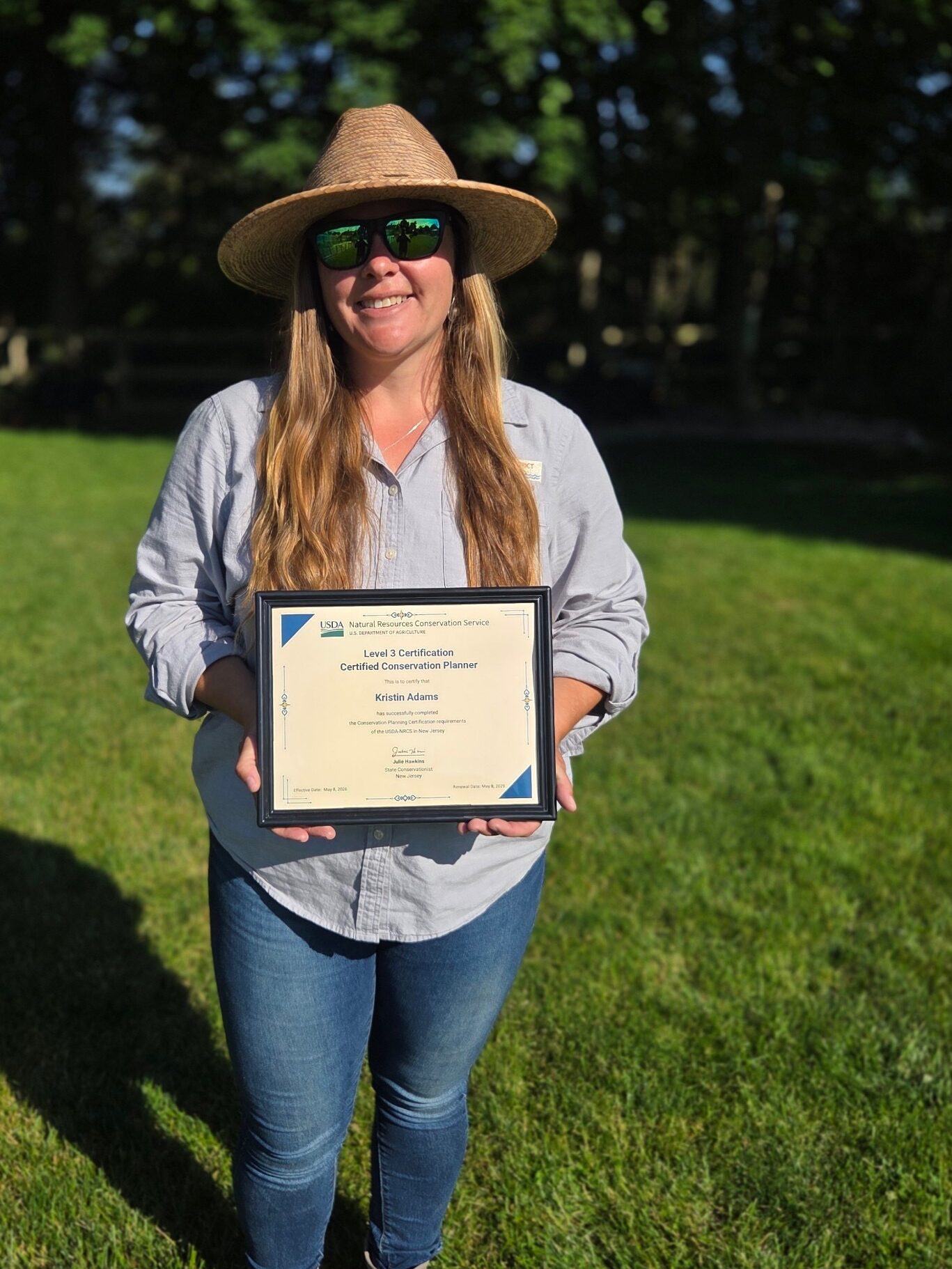

‘SIGNIFICANT PROFESSIONAL MILESTONE’: Kristin Adams is the first OCSCD staff member to earn this level of certification.
(Photo Courtesy Ocean County Soil Conservation District)
After six years gaining hands-on experience and training, Kristin Adams has become the first Ocean County Soil Conservation District staff member to become a Level 3 USDA-NRCS (U.S. Department of Agriculture- Natural Resources Conservation Service) Certified Conservation Planner.
“This nationally-recognized certification represents a significant professional milestone, reflecting years of education, technical training, field experience and demonstrated competency in conservation planning,” the district noted.
“I’m really grateful for the opportunity to follow two of my passions simultaneously: conservation and agriculture/aquaculture,” said Adams. “I really enjoy working on the COASTAL (Conservation Opportunities Advancing Sustainable Technologies for Aquaculture Leases) project, a partner-driven, farming for restoration project, where I work with oyster farmers in the Barnegat Bay to help restore oyster reefs managed by Stockton University.”
Due to this new certification, Adams – who grew up in Harvey Cedars and now resides in West Creek – will be able to work more independently on conservation planning projects and expand OCSCD services and assistance, including facilitating the district’s annual Local Working Group meeting in partnership with USDA-NRCS. This meeting brings together farmers, landowners, conservation organizations, municipal officials and interested residents to identify local natural resource concerns and discuss conservation priorities.
“Public participation is an important part of the conservation planning process, helping ensure that conservation efforts reflect the needs of Ocean County’s communities and landscapes,” said the district.
The NRCS partners with local soil conservation districts across the country to provide technical and financial assistance to farmers, urban growers and private landowners. Together, they help develop voluntary conservation plans that address soil health, water quality and wildlife habitats through various programs.
Conservation planners help people care for the land by combining sound science with practical solutions. Their work protects natural resources while supporting productive agriculture, aquaculture and healthy communities. Many conservation plans also help landowners participate in voluntary USDA conservation programs that provide technical and financial assistance for implementing conservation improvements.
According to the OCSCD, “The work that certified conservation planners perform is essential to protecting the natural resources we all depend upon. From preserving healthy soils and improving water quality to enhancing wildlife habitat and strengthening the resilience of agricultural lands, conservation planners help landowners make informed decisions that benefit both their properties and the environment.
“Conservation planners work directly with agriculture and aquaculture producers, municipalities, woodland owners, and other landowners to develop customized conservation plans that address natural resource concerns while supporting the owner’s goals.”
New Jersey’s diverse landscapes present unique conservation challenges. Every property is different, and soil types, slopes, drainage and vegetation all influence how land should be managed. Conservation planners visit properties, evaluate these conditions, identify resource concerns and recommend practical conservation practices that improve both environmental health and long-term land productivity. Their work may address issues such as soil health and soil erosion, water quality and stormwater runoff, plant productivity and health, wildlife and aquatic habitat, wetlands protection, nutrient management, forest health and climate resilience.
Conservation planners work with vegetable farms, cranberry and blueberry growers, horse farms, nurseries, forests, wetlands, suburban communities, and oyster and clam farms within the local estuaries to help address erosion, improve water quality, restore habitat, manage stormwater and strengthen climate resilience.
As the district pointed out, “Level 3 Certified Conservation Planner is a significant professional achievement. Certification is earned through progressive levels of training that combine classroom instruction, technical coursework, mentoring, field experience and competency evaluations. … Planners must demonstrate their ability to independently develop comprehensive conservation plans that address multiple natural resource concerns while balancing environmental stewardship with the landowner’s objectives. This rigorous process ensures that certified planners have both the technical expertise and practical experience needed to provide high-quality conservation assistance.
“Achieving Level 3 Certified Conservation Planner designation is more than a professional credential – it represents a commitment to lifelong learning, technical excellence and public service,” the district added. “It reflects the ability to develop thoughtful, science-based conservation plans that help protect soil, improve water quality, enhance wildlife habitat and strengthen the resilience of our natural landscapes.”
The OCSCD congratulated Adams on earning Level 3 Certified Conservation Planner designation, and emphasized, “Her achievement reflects the district’s ongoing commitment to providing knowledgeable, professional conservation assistance and advancing the stewardship of New Jersey’s valuable natural resources.”










Leave a comment