
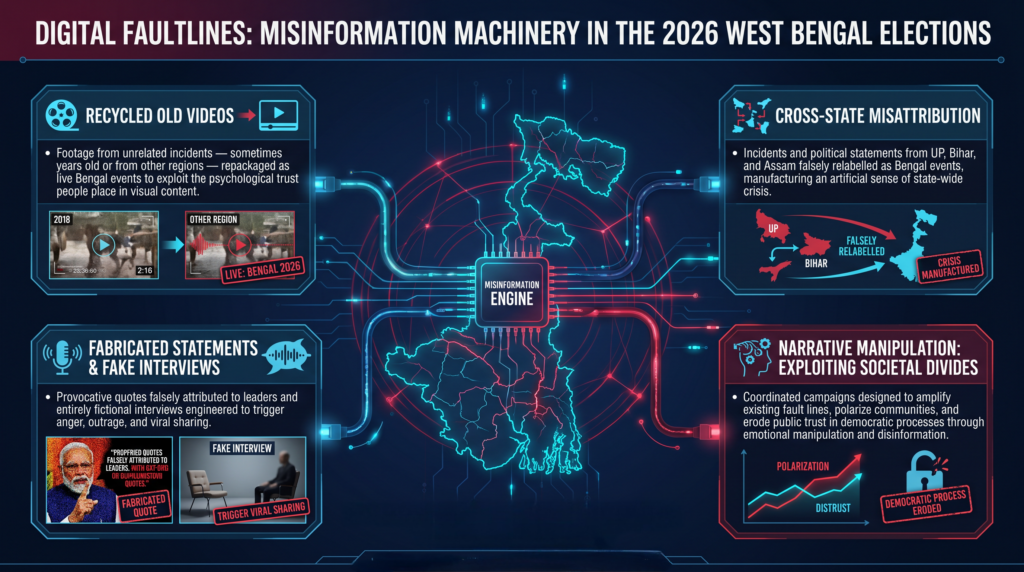
The 2026 West Bengal Assembly elections were not confined to traditional democratic processes such as political campaigning, policy debates, and voter outreach. Instead, they unfolded as a high-stakes digital information war in which misinformation played a central role in shaping public discourse. DFRAC’s investigation, based on content circulating on the social media platform X, reveals that misinformation was not incidental but systematic. Coordinated networks leveraged digital tools to manufacture narratives, distort facts, and amplify socio-political faultlines. The scale, speed, and sophistication of these campaigns point to a deeply embedded misinformation ecosystem capable of influencing electoral behaviour in significant ways.
To understand the contours of this ecosystem, DFRAC monitored and analysed misinformation trends throughout the election cycle. The study focused on viral posts and trending hashtags, engagement patterns such as shares, reposts, and comments, and the typologies of content being circulated, including videos, images, and text-based claims. It also examined how narratives were clustered and repeatedly amplified to create a sense of legitimacy. Crucially, the analysis incorporated cross-verification with credible sources alongside reverse image and video searches to identify manipulated, misleading, or misattributed content. This methodological approach made it possible to map not just individual instances of misinformation, but the broader patterns through which they spread and gained traction.
Recycling Old Videos: Manufacturing a False Present
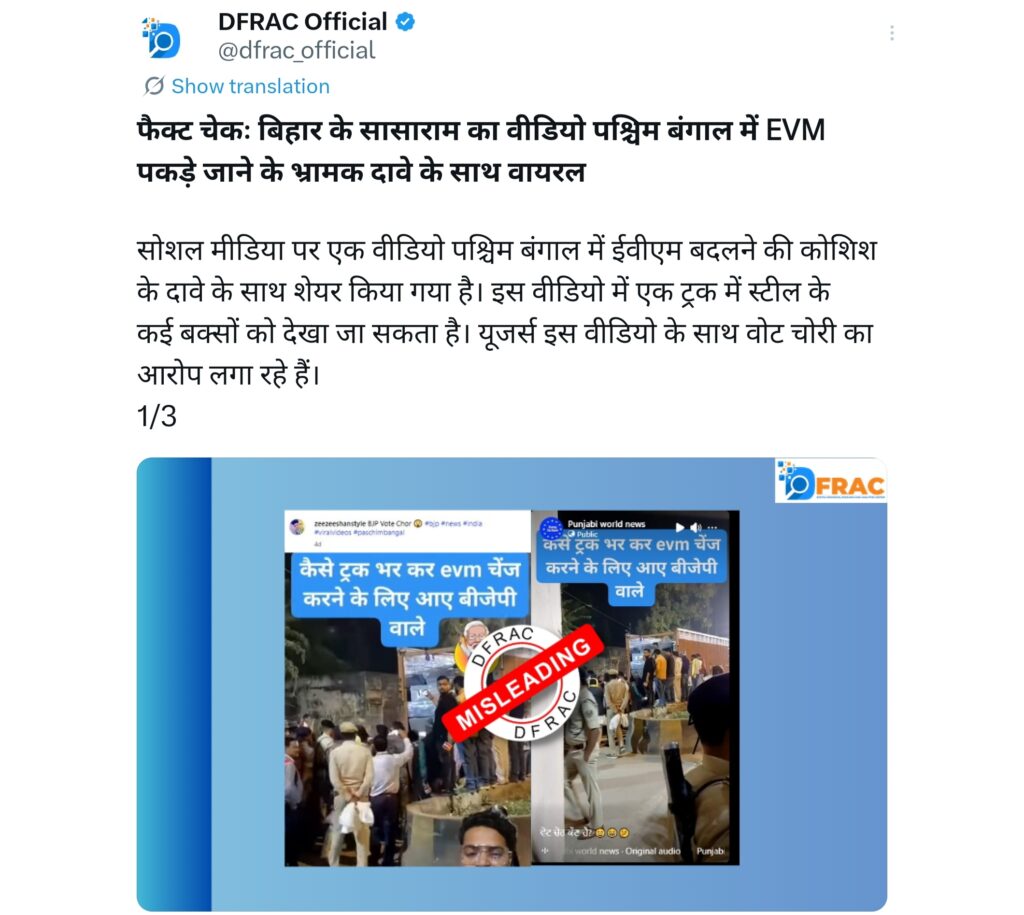
One of the most pervasive tactics observed during the elections was the recycling of old videos to manufacture a false sense of present reality. Content from unrelated incidents sometimes years old or originating from entirely different regions was repackaged and circulated as if it were unfolding in West Bengal during the election period. Videos depicting communal clashes from other states, for instance, were falsely presented as evidence of ongoing violence in Bengal. Similarly, footage of protests, accidents, or law enforcement actions from different contexts was repurposed to suggest administrative breakdown or political unrest. This strategy proved particularly effective because visual content carries a strong psychological impact; people tend to trust what they see, especially when it reinforces their existing beliefs. The absence of context further enhanced the perceived credibility of such misleading posts.
Cross-State Mis-attribution: Constructing a False Narrative
Closely linked to this was the tactic of cross-state misattribution, which involved deliberately assigning events from other parts of India to West Bengal. Statements made by political leaders in different states were edited or reframed to appear as if they were directed at Bengal’s electorate. Incidents from states such as Uttar Pradesh, Bihar, or Assam were falsely labelled as taking place within Bengal. This approach served multiple strategic purposes: it created an artificial sense of crisis, imported politically charged narratives into the state’s discourse, and exploited the limited capacity of many users to verify the geographical origins of digital content. Over time, this constant stream of misattributed information contributed to a distorted perception of reality, where voters were exposed to an inaccurate portrayal of the state’s socio-political environment.
Fabricated Statements and Narrative Engineering
Beyond visual manipulation, fabricated statements emerged as another powerful tool of misinformation. Quotes were falsely attributed to political leaders and public figures, often crafted to appear provocative or inflammatory. In some instances, entirely fictional interviews were produced and circulated widely. These fabrications were designed not merely to misinform but to provoke emotional reactions such as anger, outrage, or fear that would encourage further sharing. By placing divisive words in the mouths of influential figures, such content sought to erode public trust and deepen political and social polarization.
This process was part of a broader phenomenon of narrative engineering, in which individual pieces of misinformation were not isolated but interconnected. Coordinated campaigns ensured that multiple forms of misleading content videos, text posts, fabricated quotes, and even selective statistics worked together to reinforce a single underlying narrative. For example, a false claim about communal tension could be supported simultaneously by an old video presented as current, a fabricated statement attributed to a political leader, and misleading data points. Together, these elements created a seemingly coherent and persuasive narrative, making it more difficult for users to distinguish fact from fiction.Perhaps the most consequential impact of this misinformation ecosystem was the amplification of communal faultlines. A significant portion of the misleading content was explicitly designed to target religious and ethnic identities, often portraying one community as a victim and another as an aggressor. While such narratives are not new to Indian politics, the scale and speed at which they spread during the 2026 elections marked a notable escalation. Social media platforms enabled these messages to reach vast audiences within a short span of time, increasing the risk of real-world tensions. The use of emotionally charged language combined with provocative visuals made such content highly shareable, and many users, often unknowingly, became participants in the misinformation cycle by forwarding unverified information.
Conclusion:
The 2026 West Bengal Assembly elections highlight the growing sophistication and organization of misinformation campaigns within India’s electoral landscape. The coordinated deployment of AI-manipulated content, recycled visuals, fabricated statements, and cross-state misattribution demonstrates an adaptive and strategic misinformation machinery. As digital platforms continue to play an increasingly central role in political communication, the challenge of addressing misinformation will remain critical to safeguarding the integrity of democratic processes.














Leave a comment