

In an increasingly connected world, global trade in goods and services is an essential driver of the global economy. In this context, Copyright and intellectual property They emerge as fundamental pillars, not only for the protection of creative works and technological assets, but also for promoting innovation and economic development.
Furthermore, by analyzing the trade war between the United States and China, we can see how economic rivalry not only reflects a struggle for global dominance, but also how roles are distributed in the trade of tangible and intangible goods.
This analysis is framed in the context of the World Book and Copyright Day, held on April 23, and the next World Intellectual Property Day, on April 25, dates that underline the relevance of these disciplines for the global and regional economy.
Global Trade: A Transition from Physical to Digital
International trade has undergone significant evolution in recent decades, marked by the digitalization of key sectors such as books and intellectual property. This transition has created unprecedented opportunities, but also challenges that deserve attention.
?Book sector
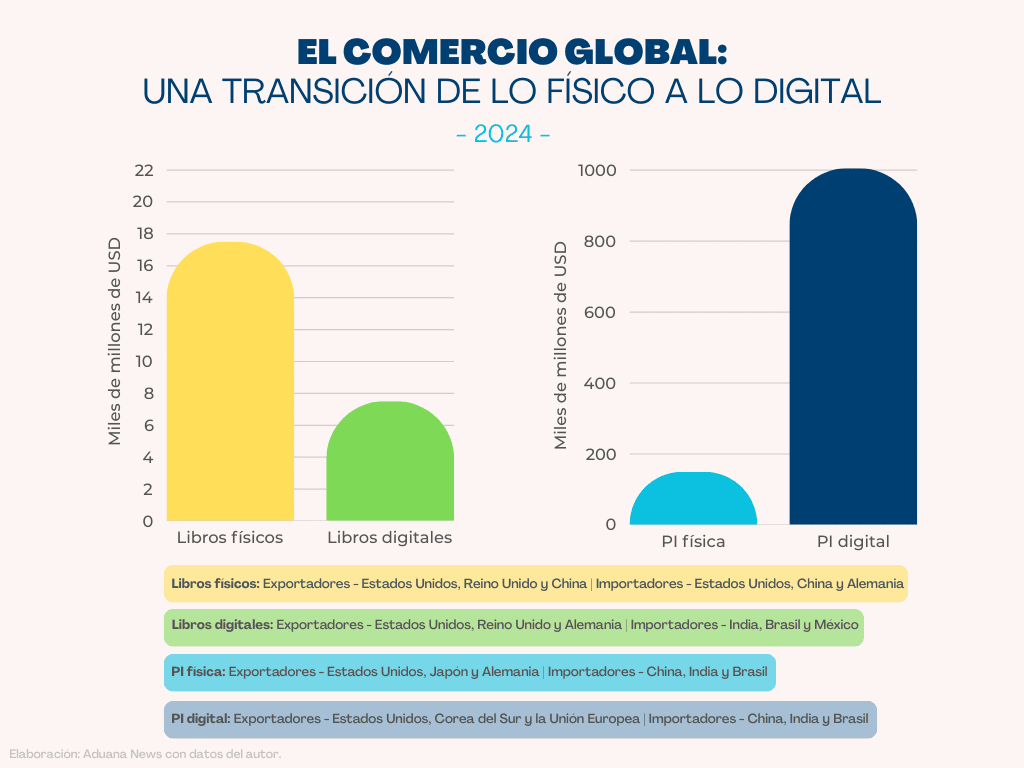
- physical books: In 2024, exports of printed books reached approximately $17.5 billion, led by the United States, the United Kingdom, and China. The main importing countries include the United States, China, and Germany, with a high demand for academic, technical, and literary content.
- Digital books: With exports valued at $7.5 billion, e-books and audiobooks accounted for the 30% of the global market In 2024, the United States, the United Kingdom, and Germany stand out as the main exporters, while India, Brazil, and Mexico lead imports, driven by their increasing digitalization.
?Intellectual property sector
- Physical intellectual property: Exports of tangible goods, such as CDs, DVDs and physical video games, generated $150 billion in 2024, led by the United States, Japan, and Germany. China, India, and Brazil stood out as the largest importers
- Digital intellectual property: Dominating global trade with more than USD 1.05 trillion In exports, digital goods include software, music, and video games. The United States, South Korea, and Europe lead this segment, while China, India, and Brazil are the main consumers.
United States vs. China: Trade and Strategic Rivalry
The contrast between these two economic giants is clearly reflected in the figures:
- United States: A world leader in intangible exports thanks to its dominance in digital goods such as software, music, e-books, and video games. Its ability to innovate and export knowledge positions it as a benchmark in the global trade of digital intellectual property.
- ChinaKnown as the “world’s factory,” it is unbeatable in physical goods such as printed books, manufactured goods, and tangible intellectual property. Its focus on mass production and competitive costs allows it to dominate global physical trade.
This confrontation between the two countries also translates into disputes over intellectual property, with mutual accusations of technology theft and copyright infringement. Digitalization is forcing China to adapt and compete in a field where the United States leads.
Piracy and Counterfeiting: Global Challenges
Piracy and counterfeiting generate global economic losses estimated at USD 1 trillion annually, seriously affecting copyright and intellectual property.
?Public measures
1. International treaties:
- El TRIPS Agreement of the WTO and the Berne Convention are essential to protect intellectual works and combat piracy.
- Legislation such as the DMCA In the United States, they are strengthening protection in digital environments.
2.Customs operations:
- Traditional operations are evolving toward a comprehensive approach that includes digital assets through advanced technologies such as artificial intelligence.
?Private measures
1.Blockchain and tracking technologies:
- Tools used by companies to authenticate products and guarantee their origin.
2. Systems on digital platforms:
- Services like Spotify and Netflix have implemented mechanisms to block pirated content.
Impact of Artificial Intelligence (AI)
AI is transforming content creation and protection, but it poses significant ethical and legal challenges.
?Measures in progress
1. Specific regulation:
- El AI Regulation of the European Union seeks to ensure transparency and protect rights in digital environments.
2.Interdisciplinary collaboration:
- Governments, businesses, and academia are working together to establish international standards and promote responsible use of AI.
Latin America and Argentina: A Regional Perspective
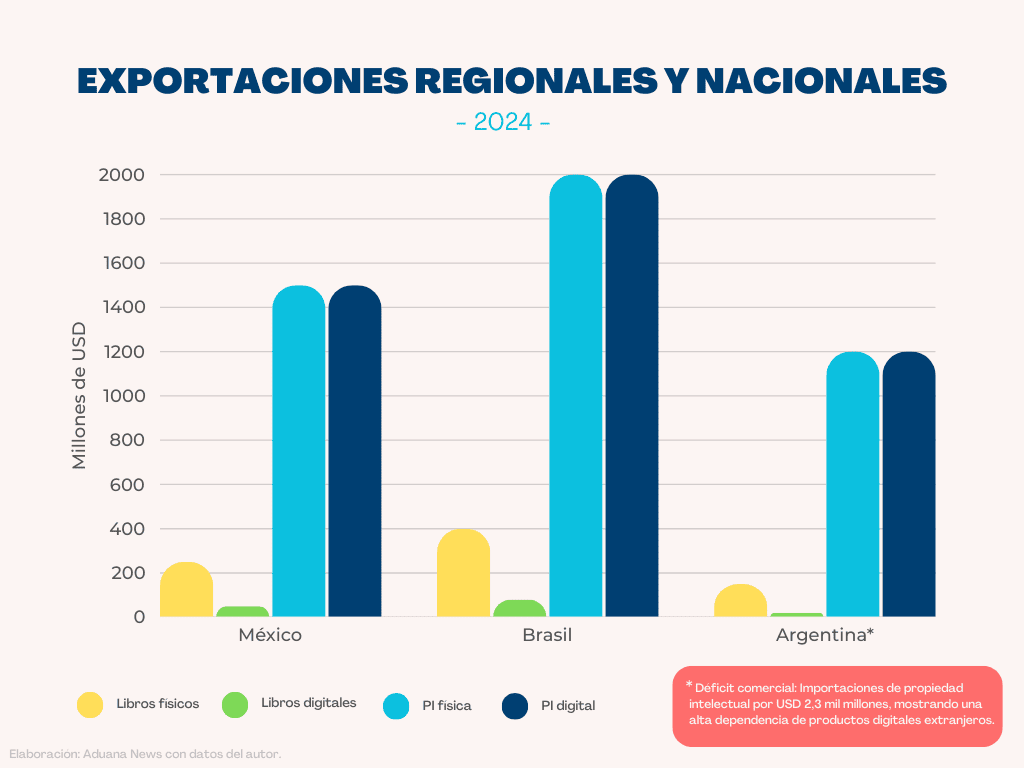
Latin America and Argentina are a clear example of how the transition to digital is redefining foreign trade. Figures for 2024 show the following:
?Regional and National Exports
(I.e.Mexico
1. Physical exports:
- Books: USD 250 million.
- Intellectual Property: USD 1.5 billion.
2. Digital exports:
- Books: USD 50 million.
- Intellectual Property: USD 1.5 billion
(I.e.Brazil
1. Physical exports:
- Books: USD 400 million.
- Intellectual Property: USD 2 billion.
2. Digital exports:
- Books: USD 80 million.
- Intellectual Property: USD 2 billion
(I.e.Argentina
1. Physical exports:
- Books: USD 150 million.
- Intellectual Property: USD 1.2 billion.
2. Digital exports:
- Books: USD 20 million.
- Intellectual Property: USD 1.2 billion.
- Trade deficit: Imports of intellectual property by $2.3 billion, showing a high dependence on foreign digital products.
?Protection measures
- Brazil and Mexico: They actively participate in international treaties such as the TRIPS Agreement and Berne Convention, while developing national legislation against digital piracy.
- Argentina: Law 11.723 and Law 24.766 guarantee the protection of copyright and intellectual property, while Customs adopt artificial intelligence to monitor digital and physical goods.
Conclusion: Fair and Sustainable Trade
The international trade in books and intellectual property reflects not only a transition to digital technology, but also strategic tensions between the United States and China. Latin America and Argentina, although facing challenges such as piracy and technological dependence, have the opportunity to strengthen their local industries, reduce their trade deficits, and foster innovation.
In the framework of the World Book and Copyright Day and the World Intellectual Property Day, it is clear that joint efforts between governments, businesses, and international organizations are key to protecting creators’ rights and ensuring fair, strategic, and sustainable trade, as well as fostering cultural and technological sustainability worldwide.

The author has a degree in Administration and a Master’s degree in International Relations (UNCBA), with an outstanding career as an official of the Customs Regulation and Control Agency (ARCA) for 39 years. A former OAS and Spanish Government fellow, he has been a university professor at undergraduate and graduate levels in various Argentine universities for 33 years, and a member of the Soft Landing World Network.
Foreign Trade specialist and independent consultant, he is the author of the books: “Customs Operations from A to Z”, as well as“Intangibles: how to export services and not die trying”He has held important positions such as Deputy Director General of Metropolitan Customs Operations, Regional Director of the Waterway, and Administrator of the Customs of Córdoba and Rosario. He has served as First General Counsel at the General Directorate of Customs – Aduana Córdoba, and currently works as a foreign trade consultant.














Leave a comment