
Key Takeaways
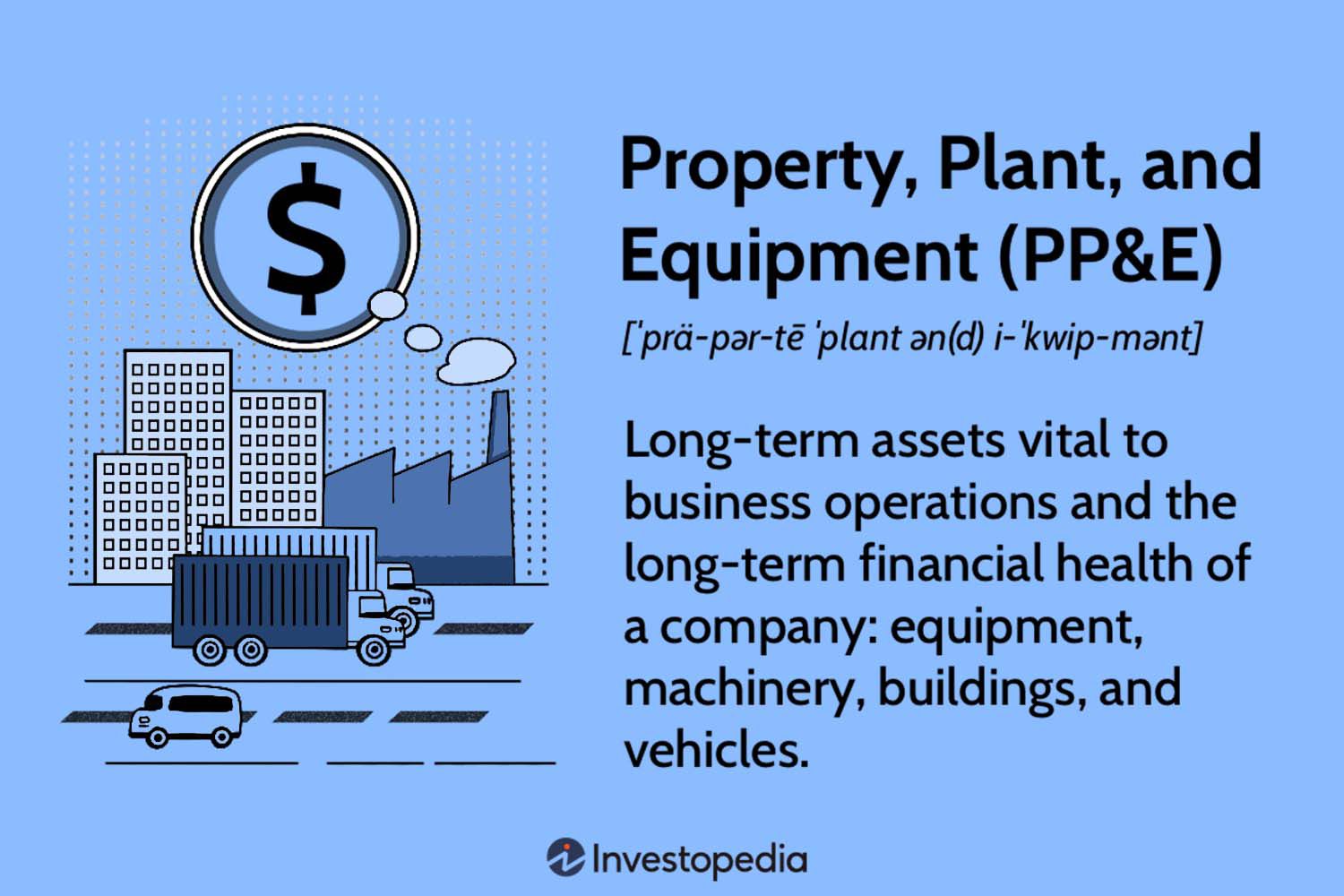
- Property, Plant, and Equipment (PP&E) can be physically touched, unlike a patent or copyright.
- PP&E can’t easily be liquidated to raise cash, but it can be used to secure loans.
- PP&E is calculated by adding the gross value of these assets to capital expenditures minus the accumulated depreciation that has been calculated and adjusted in each accounting period.
- A business that invests in PP&E expects to be functional and healthy for the long term.
Investopedia / Julie Bang
What Is Property, Plant, and Equipment (PP&E)?
Property, plant, and equipment (PP&E), a key component of a company’s financial health, is one category of long-term tangible assets businesses hold, such as vehicles and equipment.
PP&E can be physically touched, unlike a patent or copyright, which is why they’re also referred to as fixed assets. PP&E can’t be quickly sold to raise cash in a financial crisis and is noncurrent in financial terms with a useful life of more than a year.
Formula for Calculating PP&E and Why It Matters
PP&E is measured by adding the gross value of these assets to capital expenditures and then subtracting the accumulated depreciation that’s been calculated and adjusted in each accounting period. The equation looks like this:
Net PP&E = Gross PP&E + Capital Expenditures – Accumulated Depreciation
Assume Company A owns a building valued at $1,000,000. The building has depreciated by $600,000 over time. The company must purchase another building for $1,000,000. The combined depreciation for both buildings is $30,000. The equation would look like this:
$1,000,000 + $1,000,000 – $600,000 – $30,000 = $1,370,000
Exxon Mobil’s Sept. 30, 2018 balance sheet provides another example of the calculation and its portrayal of a company’s financial health. PP&E is recorded at $249.153 billion and this contributes a significant percentage of the corporation’s total assets of $354.628 billion.
How Property, Plant, and Equipment (PP&E) Works
Businesses own numerous assets, including real estate, vehicles, machinery, and intellectual property. These assets contribute to and can be critical to the company’s financial well-being and balance sheet. Accounting for assets can be complicated because they’re divided into several categories for accounting purposes. PP&E is one of these categories.
PP&E provides a snapshot of a company’s financial stability and strength. A business won’t commit money to purchase these assets if it has any qualms about its future because they can’t easily be liquidated to raise cash. However, they can be used to secure loans.
Except for land, PP&E value is modified over time as the assets age. This depreciation is calculated during each reporting period, and the measurements are cumulative. The result over time is referred to as accumulated depreciation. Land appreciates rather than depreciates, so it’s accounted for at market value.
Important
PP&E should only be used by a company if it can establish an asset’s cost with reasonable accuracy.
Recording Property, Plant, and Equipment (PP&E)
Recording PP&E begins with the actual cost of an asset and then adds the cost of any improvements or additions made to it over time. The calculation equation defines the asset’s contribution to book value, which is the number reported on the balance sheet.
Keep in mind that this is only one component of the value of a company’s assets. It doesn’t reflect the overall, true value of all assets combined. Intangible assets such as copyrights and patents aren’t included here. Nor does PP&E consider the value of current assets that can be converted to cash within a year.
The Bottom Line
PP&E is a company’s property, plant, and equipment—notably, vehicles, real estate, equipment, and machinery that can’t easily or quickly be sold to raise cash. PP&E is critical to a company’s financial health because these assets are a key requirement for the company to remain in business. Although they can’t be quickly or easily sold, these assets can be used as collateral for loans.
The resulting number of the PP&E equation tells investors whether the company believes in itself. A business that invests in these assets expects to be functional and healthy for the long term. However, PP&E should always be considered in tandem with other balance sheet factors.













Leave a comment