
Amazon.com Inc. (AMZN) reported a staggering $115.9 billion in operating cash flow (OCF) in 2024, more than a third more than the year before. That’s enough to buy every person in the state of California two new iPhone 16 Pros—with billions left over.
While OCF is a financial metric that’s less glamorous than profit margins, it’s arguably more important. We take you through the details below.
Key Takeaways
- Operating cash flow (OCF) is the first section of a cash flow statement, showing cash from operating activities.
- OCF is calculated using an indirect or direct method.
- The OCF indirect method of calculation starts with net income, which is then adjusted for non-cash items.
- The OCF direct method tracks actual cash transactions.
- A positive OCF indicates that a company can fund its operations from its core business activities without relying on external financing or investment capital.
Investopedia / Dennis Madamba
What Is Operating Cash Flow (OCF)?
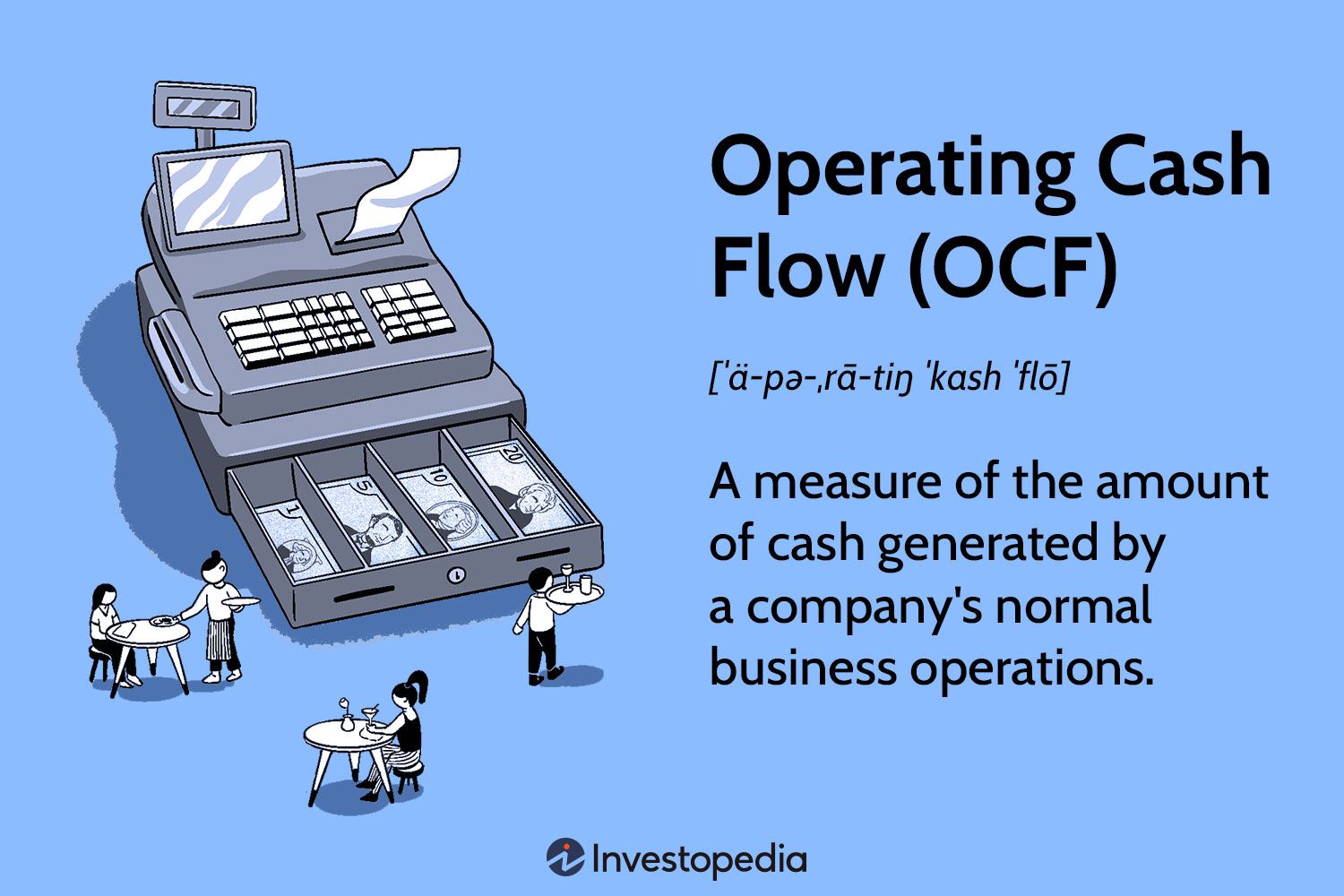
OCF measures the amount of cash generated by a company’s core business operations over a specific period. It’s the cash inflows and outflows directly related to producing and selling the company’s products or services.
OCF specifically excludes cash flows from investing activities (like purchasing equipment) and financing activities (such as issuing stock or paying dividends).
Specifically, we can formulate OCF as follows:
OCF = Net Income + Non-Cash Expenses – Increase in Working Capital
OCF provides a clear picture of how much cash a business generates from its day-to-day operations before considering any external funding sources or capital expenditures.
This makes OCF crucial when assessing a company’s operational efficiency and whether it’s sustainable financially. By focusing solely on core business operations, OCF helps investors and analysts determine whether a company can support itself through its primary business model.
Companies report OCF as part of their cash flow statement, which breaks down all cash movements into three categories: operating activities, investing activities, and financing activities.
Below is the 2024 cash flow statement from Amazon’s 10-K annual report filed with the U.S. Securities and Exchange Commission.
Importance of Operating Cash Flow
OCF is important for the following reasons:
- A measure of financial health: OCF provides a clear picture of a company’s ability to generate cash from its core business activities. Think of two lemonade stands. Stand A has high sales, but mostly on credit, which amounts to low immediate cash. Stand B has moderate sales, mostly in cash. This amounts to a high OCF. Stand B has better financial health and operational efficiency because it converts sales to cash quickly.
- Liquidity indicator: It serves as a key sign of a company’s short-term ability to move money around to pay bills, etc.
- Investment potential: A strong OCF signals to investors that a company can fund its operations, invest in growth, and potentially provide returns to shareholders.
- Ability to pay debts: Companies with positive OCF are better positioned to service their debts, enhancing creditworthiness and reducing their financial risk.
- Ability to sustain operations: OCF reflects a company’s ability to weather economic fluctuations without external support.
- Tax implications: The IRS considers business expenses that contribute to OCF as potentially tax-deductible.
Important
The operating cash flow ratio represents a company’s ability to pay its debts with its existing cash flows. It is determined by dividing operating cash flow by current liabilities. A ratio greater than 1.0 indicates that a company is in a strong position to pay its debts without incurring additional liabilities.
Operating Cash Flow Components
OCF consists of cash inflows and outflows related to a company’s core business operations.
Cash inflows typically include the following:
- Revenue paid in cash (cash revenue) from sales of goods or services
- Collections of accounts receivable
- Other cash receipts from business operations
- Refunds or reimbursements received
Cash outflows generally comprise the following:
- Payments for inventory and raw materials
- Employee salaries, wages, and benefits
- Operating expenses (rent, utilities, insurance, etc.)
- Tax payments
- Payments to suppliers and vendors
Changes in working capital also significantly impact OCF. Working capital represents the difference between current assets and current liabilities. Here are examples of how this works:
- A decrease in accounts receivable (customers paying faster) increases OCF.
- An increase in inventory (more cash tied up in goods) decreases OCF.
- An increase in accounts payable (delaying payments to suppliers) temporarily boosts OCF.
- A decrease in accrued expenses (paying obligations sooner) reduces OCF.
Fast Fact
OCF excludes cash flows from investing and financing activities, and focuses solely on a company’s core operations. This separation allows for a more accurate assessment of a company’s operational efficiency and financial health.
Methods of Calculating Operating Cash Flow
The two primary ways to calculate OCF are the indirect and the direct methods.
Indirect Method
The indirect method starts with net income and adjusts for non-cash items and changes in working capital to arrive at OCF. This method is commonly used by companies in the U.S..
Key adjustments include the following:
- Adding back non-cash expenses (e.g., depreciation and amortization)
- Adjusting for changes in working capital accounts (e.g., accounts receivable, inventory, and accounts payable)
- Removing non-operating gains or losses
The basic formula for the indirect method is as follows:
OCF = Net Income + Depreciation & Amortization – Changes in Net Working Capital
For example, if a company reports net income of $100 million, depreciation of $150 million, an increase in accounts receivable of $50 million, and a decrease in accounts payable of $50 million, the OCF would be calculated as follows:
OCF = $100M + $150M – $50M – $50M = $150M
Direct Method
The direct method records all transactions on a cash basis, displaying actual cash inflows and outflows during the accounting period. While the Financial Accounting Standards Board (FASB) prefers this method for its clarity, it requires more work and is thus used less.
The direct method accounts for the following:
- Cash received from customers
- Cash paid to suppliers and employees
- Interest and dividends received
- Income taxes and interest paid
The basic formula for the direct method is as follows:
OCF = Cash Revenue – Operating Expenses Paid in Cash
For instance, if a company has cash receipts of $80 million, cash payments to suppliers of $25 million, and employee wages of $10 million, the OCF would be as follows:
OCF = $80M – $25M – $10M = $45M
Both methods should yield the same result for OCF. The choice between them often depends on the company’s accounting practices and the level of detail desired in financial reporting.
Example of Calculating Operating Cash Flow
Let’s consider a small retail business. Here are the variables used in the OCF calculation:
- Net income: $50,000
- Depreciation expense: $10,000 (a non-cash expense)
- Increase in accounts receivable: $5,000 (customers owe more)
- Increase in inventory: $3,000 (more inventory purchased)
- Increase in accounts payable: $8,000 (owed more to suppliers)
OCF Calculation
Here’s how it works:
- Start with net income: $50,000
- Add back depreciation: + $10,000
This is added back because depreciation is an expense that doesn’t involve actual cash outflow. - Subtract the increase in accounts receivable: – $5,000
This is subtracted because increased receivables mean sales were made on credit, not cash. - Subtract the increase in inventory: – $3,000
This is subtracted because increased inventory means cash was spent on buying more goods. - Add the increase in accounts payable: + $8,000
This is added because the company held onto cash by delaying the payment of the amounts owed to its suppliers.
Result: $50,000 + $10,000 – $5,000 – $3,000 + $8,000 = $60,000 OCF
The Bottom Line
OCF helps determine the financial success of a company’s core business activities and indicates whether a company has enough positive cash flow to maintain operations.
OCF is one of three cash flows listed on a company’s statement of cash flows. The other two are Investing Activities and Financing Activities.














Leave a comment