
ETF net assets increased 42% in three months
4 out of 10 deficit polarization even at the maximum net profit
Financial Supervisory Service “located investment and highlighted risks such as short-term trading and leverage”
![[Source = Financial Supervisory Service]](https://wimg.mk.co.kr/news/cms/202609/11/news-p.v1.20260911.59c14157bf1a426bb4aa3ac2203955d1_P1.png)
Asset managers posted the highest net profit ever in the second quarter of this year thanks to the rise of the domestic stock market and the expansion of the exchange-traded fund (ETF) market. This is due to a significant increase in the size of fund management, which has led to an increase in commission income, and a significant improvement in securities investment performance of unique accounts that managers invest in with equity capital.
According to the Financial Supervisory Service’s “operational performance of asset management companies in the second quarter of 2026” released by the Financial Supervisory Service on the 11th, the net profit of 513 domestic asset managers in the second quarter was KRW 2.6889 trillion. It increased 1.2226 trillion won (83.4%) from 1.46 trillion won in the previous quarter, and 214.3% compared to 855.5 billion won in the same period last year. It is the largest quarterly in history.
Operating profit also increased significantly. Operating profit in the second quarter was KRW 2.4195 trillion, up 78.9% from the previous quarter and 227.5% from the same period last year. The annualized return on equity (ROE) jumped 20.8 percentage points to 51.9% from 31.1% in the previous quarter.
One of the pillars of good performance is the fund market, which has grown rapidly, centered on ETFs. In the second quarter, asset managers’ commission income reached 2.6072 trillion won, up 37.7 percent from the previous quarter. Among them, fund-related fees, including management fees and performance fees, increased 39.1% to KRW 2.326 trillion, and discretionary and advisory fees also increased 33.1% to KRW 574.6 billion.
The strong stock market also improved the investment performance of managers in their own accounts. Securities investment gains and losses earned through the management of proprietary assets amounted to 829.7 billion won, up 159.6% from 319.6 billion won in the previous quarter. This is due to a 97.2% increase in securities investment profits from 576 billion won to 1.136 trillion won.
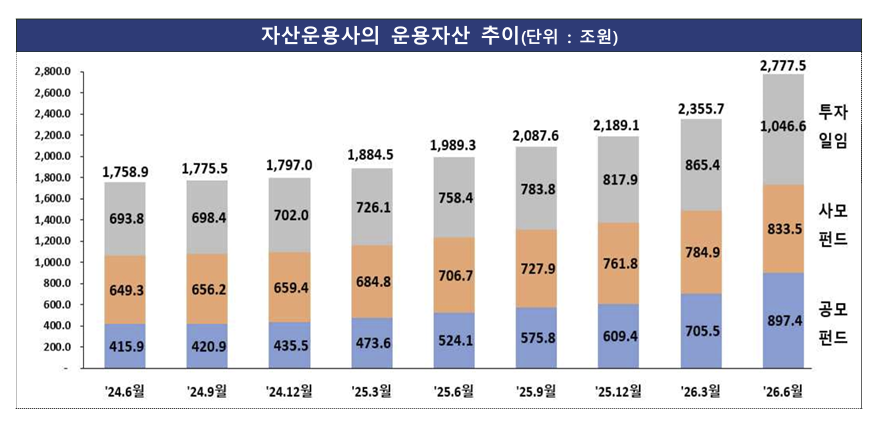
Operating assets have also increased significantly. At the end of June, asset managers’ total operating assets reached 2777.5 trillion won, up 421.8 trillion won (17.9%) from the end of March. Among them, the fund’s net assets increased 16.1% to 1,730.9 trillion won and the discretionary investment valuation increased 20.9% to 1,046.6 trillion won.
In particular, the growth of public offering funds was remarkable. Net assets of public offering funds rose 191.9 trillion won (27.2%) to 897.4 trillion won in three months. During the same period, ETF net assets (NAV) surged 42.1% from 360.7 trillion won to 512.4 trillion won. Net assets of equity-type public offering funds also increased 54.1% from 264.6 trillion won to 407.7 trillion won.
On the other hand, net assets of private equity funds amounted to 833.5 trillion won, up only 48.7 trillion won (6.2%) from the previous quarter.
Although the entire industry achieved record-high performance, the difference in performance between individual management companies widened. Of the total 513 companies, 293 companies (57.1%) recorded a surplus. The ratio of deficit companies was 42.9%, up 5.3 percentage points from 37.6% in the previous quarter.
There was also a clear difference between public offering and private equity management. The deficit ratio of 77 public offering managers fell to 14.3 percent from 15.6 percent in the previous quarter, while that of 436 private equity managers rose 6.4 percentage points from 41.5 percent to 47.9 percent, approaching half.
The Financial Supervisory Service evaluated, “The increase in fund-related commission income, such as management and performance compensation, and the increase in investment profits in securities in unique accounts led to the improvement in performance.” However, he pointed out that risks are also being highlighted, such as concentrating investment funds in specific industries and stocks and increasing excessive short-term trading and leveraged investment in ETFs.
The Financial Supervisory Service plans to strengthen monitoring of managers with weak soundness while continuing efforts to ease market volatility, including curbing leverage and debt investment.













Leave a comment