
Key Takeaways
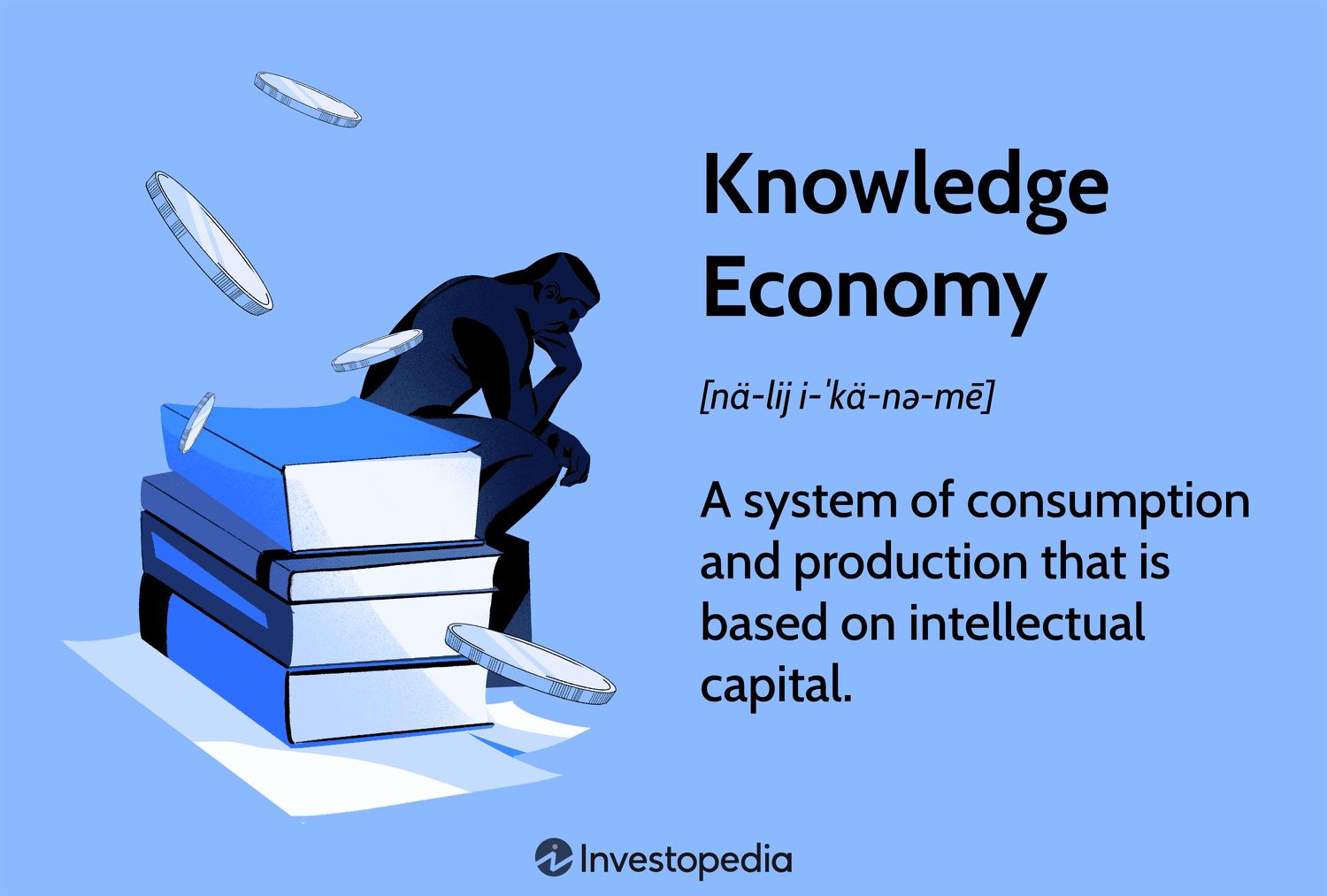
- The knowledge economy describes the contemporary commercialization of science and academic scholarship.
- Innovation based on research is commodified via patents and other forms of intellectual property.
- The knowledge economy lies at the intersection of private entrepreneurship, academia, and government-sponsored research.
- Knowledge-related fields and industries represent a large share of the activity in most highly developed countries.
- A knowledge economy depends on skilled labor and education, strong communications networks, and institutional structures that motivate innovation.
Get personalized, AI-powered answers built on 27+ years of trusted expertise.
What Is the Knowledge Economy?
The knowledge economy is an economy of products and services produced with human capital—knowledge, skills, and intellectual property—rather than physical assets such as land and physical labor.
It refers to the ability to capitalize on scientific discoveries and applied research.
The knowledge economy represents a large share of the activity in most highly developed economies.
A significant component of its value might be intangible assets, such as the value of its workers’ knowledge or of intellectual property such as patents and proprietary procedures.
Investopedia / Tara Anand
Understanding the Knowledge Economy
Developing economies tend to be heavily focused on agriculture and manufacturing, which involve physical resources.
Highly developed countries have a larger share of service-related activities. The latter include knowledge-based economic activities such as research, technical support, and consulting.
The knowledge economy is the marketplace for the production and sale of scientific and engineering discoveries.
This knowledge can be commodified in the form of patents or other intellectual property protections. The producers of this information, such as scientific experts, research labs, and technology developers, are also considered to be part of the knowledge economy.
Growth
The world economy has become more knowledge-based thanks to globalization, which can reveal the best practices of each country’s economy.
Knowledge-based factors also create an interconnected and global economy where human expertise and trade secrets are considered important economic assets and resources.
Generally accepted accounting principles (GAAP) don’t allow companies to include these assets on their balance sheets, however.
Important
The Bayh-Dole Act of 1980 was a major turning point in the treatment of intellectual property in the United States. It allowed universities to retain title to inventions or discoveries made with federal R&D funding and to negotiate exclusive licenses.
Knowledge Economy and Human Capital
The knowledge economy reflects the way that education, knowledge, and human capital can serve as productive assets or business products to be sold and exported to yield profits for individuals, businesses, and the economy.
Intellectual vs. Physical
This component of the economy relies heavily on intellectual capabilities rather than on natural resources or physical contributions.
Products and services that result from intellectual expertise advance technical and scientific fields in the knowledge economy. This encourages innovation in the economy as a whole.
The World Bank defines knowledge economies according to four pillars:
- Institutional structures that provide incentives for entrepreneurship and the use of knowledge
- Availability of skilled labor and a good education system
- Access to information and communication technology (ICT) infrastructures
- A vibrant innovation landscape that includes academia, the private sector, and civil society
Fast Fact
The modern commercialization of academic research and basic science has its roots in governments seeking military advantage.
Example of a Knowledge Economy
Academic institutions, companies engaging in research and development (R&D), programmers developing software and search engines, and health workers using digital data to improve treatments are all components of a knowledge economy.
They pass on the results of their efforts to workers in more traditional fields such as farmers who use software applications and digital solutions to manage their crops more effectively.
These fields also include advanced technological-based medical procedures such as robot-assistant surgeries and schools that provide digital study aids and online courses for their students.
How Big Is the Knowledge Economy?
It’s difficult to gauge the value of the global knowledge economy because it’s not a clearly defined category such as manufacturing. However, one market research firm valued the 2024 global intellectual property market alone at $11.6 billion, with a projected value of $27.74 billion by 2033.
What Are the Most Valuable Skills in the Knowledge Economy?
Higher education and technical training are obvious assets but communication and teamwork are also essential skills for a knowledge-based economy, according to the Organization for Economic Cooperation and Development. It’s unlikely that any single knowledge worker can generate groundbreaking innovations alone so these interpersonal and workplace competencies are essential for a knowledge-based economy to thrive.
Which Country Has the Biggest Knowledge Economy?
The United Nations Development Program’s Global Knowledge Index ranks knowledge economies by country. It scores each country based on “enabling factors” such as education levels, technical and vocational training, innovation, and communications technology. In 2024, Sweden was the top-ranked knowledge economy with a score of 68.3%. The second- to fifth-placed countries were Finland, Switzerland, Denmark, and The Netherlands, with scores of 68%, 67.9%, 66.8%, and 66.8%, respectively. The U.S. ranked seventh with a score of 66.2%.
The Bottom Line
The term “knowledge economy” describes the commercialization of intellectual pursuits.
This type of economy capitalizes on research and scientific discoveries. It’s a significant component of highly developed economies. Intellectual property plays a significant role in a knowledge economy.
Unfortunately, GAAP doesn’t recognize these assets on companies’ balance sheets so you won’t be able to pinpoint ownership by researching financial statements.











Leave a comment