
Kathmandu. Hesitation of foreign investors to come to Nepal, outright theft of startup youth’s ‘business ideas’, and the rampant sale of substandard goods in the market in the name of Jumla’s apples or Palpa’s Dhaka, all these problems had a single main root – a legal system nearly six decades old.
The ‘Patent, Design and Trademark Act’ enacted in 2022 BS was unable to cope with the current era of artificial intelligence, startup ecosystems, and globalization.
However, this situation is about to end. The government has prepared and published the draft of the ‘Industrial Property Act, 2082’ by modernizing the administration of overall intellectual and industrial property.
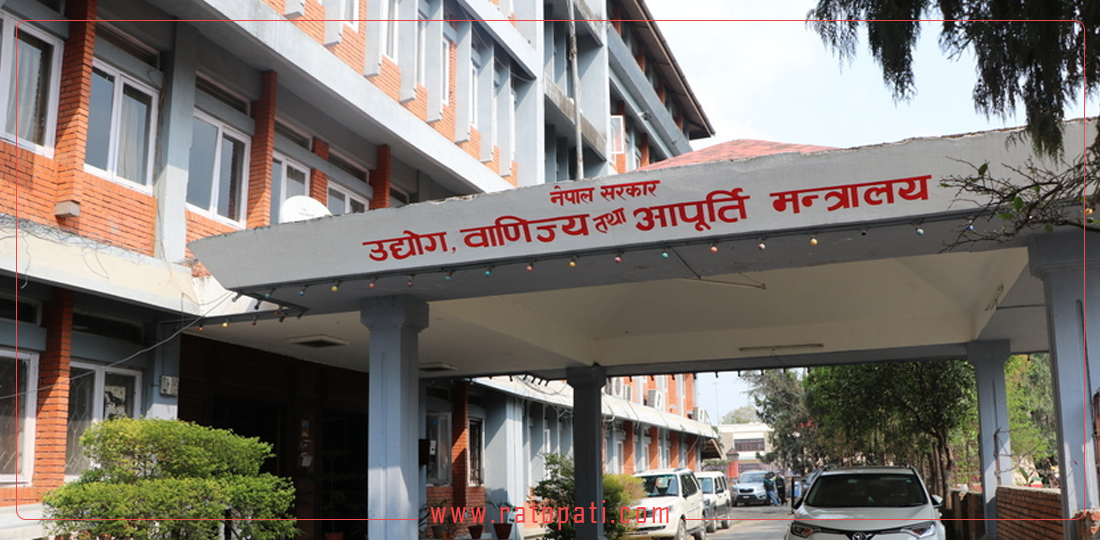
The Ministry of Industry, Commerce and Supplies has issued a notice seeking opinions and suggestions from stakeholders and the general public on this bill. This proposed bill makes a historic effort to simultaneously address innovation, traditional knowledge, public health, foreign investment, and institutional good governance.
Global Branding of Indigenous Skills and Products
The draft clearly defines geographical indications. Now, Ilam’s tea, Jumla’s apples, Mustang’s Marpha, Gulmi’s coffee, or Bhaktapur’s JuJu Dhau can be formally registered as ‘Geographical Indications’.
Once such an indication is registered, no product produced outside that specific geography will be allowed to sell that specific name or put it on packaging. This will free consumers from substandard and counterfeit goods, and local farmers and producers will get a high and fair price for their produce.
The protection of intellectual property is the responsibility of the state, but when a multinational company registers a patent for a life-saving drug and excessively increases its price, citizens’ lives are put at risk. In times of national crisis like a global pandemic or earthquake, the state may have to stand by as a mute spectator if the patent holder does not transfer technology.
Similarly, Ayurvedic formulas from village healers, knowledge of herbs, or traditional knowledge of indigenous communities will no longer be taken by foreign companies or domestic corporate houses for free and patented. Section 75 of the bill clarifies that prior approval from the concerned body or community is mandatory before establishing rights over any industrial property based on traditional knowledge.
Furthermore, a provision has been made to ensure that the concerned community receives its due share of the commercial profit earned by the company from the use of such knowledge, as per the agreement.
Up to 1 Million Fine for Stealing Startup ‘Ideas’
Today, when young entrepreneurs and startups try to establish themselves in the market with new ideas, the trend of established large companies or competitors stealing their ideas, branding, and packaging and doing business has increased alarmingly in Nepal. In such a situation, there was no clear law to seek justice.
‘Commercial Confidentiality’ has been legally recognized for the first time in Chapter 8 of the bill to address this problem. It will be considered a serious offense if an employee, former employee, or business partner of a company leaks the company’s secret formula, customer database, or business plan to a competitor.
Strict action will be taken for imitating others’ trademarks, stealing patents, engaging in unfair competition, or breaching commercial confidentiality. According to Sections 80 and 81 of the bill, those who commit such offenses will face heavy fines ranging from 500,000 to 1,000,000 rupees, depending on the nature of the offense. Repeat offenders will face double the penalty. Additionally, the draft includes strict provisions for compensation for economic losses incurred by the actual creator due to theft, and for the confiscation and destruction of counterfeit goods sent to the market.
On the other hand, a historic and welcome provision has been included in the bill to encourage innovation by providing a 50 percent (half) discount on application registration fees for economically weak micro, small, and startup enterprises.
Breaking Patent Monopoly on Medicines: Compulsory Licensing
The protection of intellectual property is the responsibility of the state, but when a multinational company registers a patent for a life-saving drug and excessively increases its price, citizens’ lives are put at risk. In times of national crisis like a global pandemic or earthquake, the state may have to stand by as a mute spectator if the patent holder does not transfer technology.
To legally address such adverse situations, a provision for compulsory licensing has been made in Chapter 2 (Section 17) of the bill. In the event of a national crisis, serious impact on public health, abnormal price increases of essential goods by the patent holder, or creation of artificial shortages (hoarding) in the market, the government can take strict measures. In such a situation, the government can grant permission to any government agency or domestic producer to use the technology and produce medicines or essential goods without the consent of the patent holder.
However, a balanced provision has been made to provide royalty or compensation to the patent holder based on fair valuation when the state uses the technology in this manner.
Industrial Property Office to be Established
The bill attempts to break the delays of months, and in some cases years, of waiting to register trademarks or patents, files getting stuck in various branches, and bureaucratic sluggishness.
Currently, only a small branch of the Department of Industry handles intellectual property administration nationwide, which is insufficient. According to Chapter 10 (Section 78) of the draft, the Government of Nepal will establish a separate and autonomous ‘Industrial Property Office’ led by a Joint Secretary (Gazetted First Class) to handle this work.
In addition, a powerful ‘Industrial Property Promotion Council’ will be formed under the chairmanship of the Minister of Industry, comprising secretaries from various ministries, the Vice-Chancellor of NAST, and experts, for policy coordination and reform measures.
To prevent delays in work, the Act itself specifies timelines. For example, the office must complete the preliminary examination within 35 days of receiving an application. If documents are incomplete, a period of 90 days will be given. All information regarding registration, renewal, and opposition will be made public through an electronic bulletin and website. This will end the role of intermediaries and make the system completely transparent and predictable.
WTO Standards: Strong Basis for Attracting Foreign Investment
Signs that are internationally renowned but not registered in Nepal (e.g., Coca-Cola, Google, Toyota, etc.) cannot be registered in Nepal by imitation. The provision of granting priority date facilities to foreign applications will introduce Nepal to the world stage as a safe and investment-friendly destination for foreign capital and new technology transfer.
Foreign investment will not flow into Nepal without giving foreign investors confidence that their technology, software, and brands will have full legal protection in Nepal. Keeping this reality in mind, the bill has incorporated the provisions of the World Trade Organization (WTO) TRIPS Agreement and the Paris Convention verbatim into domestic law.
The current era is the era of digital technology. A new law for the registration and protection of Integrated Circuit Layout Designs has been added in Chapter 7 of the bill to protect the design of microchips or semiconductors used in computers, mobile phones, and modern electronic machines.
Furthermore, signs that are internationally renowned but not registered in Nepal (e.g., Coca-Cola, Google, Toyota, etc.) cannot be registered in Nepal by imitation. The provision of granting priority date facilities to foreign applications will introduce Nepal to the world stage as a safe and investment-friendly destination for foreign capital and new technology transfer.
Proposal for Fines for Stealing Ideas and Trademarks
Strict legal provisions are being prepared against those who steal others’ business ideas, brands (trademarks), and patents. The proposed draft proposes fines of up to 1.5 million rupees and compensation for damages for intellectual property theft and imitation.
The bill provides for even stricter penalties for repeat offenders. It is mentioned in the draft that if a person or organization that has already been penalized commits the same offense again, double the amount of the fine imposed for each instance will be recovered.
The proposed bill’s Chapter 11 specifies different rates of fines depending on the nature of the offense. Accordingly, those who imitate others’ trademarks, use them without authorization, misuse geographical indications (GI), and engage in unfair competition in the market will face the highest fines ranging from 1 million to 1.5 million rupees. The old law had a provision for a fine of 100,000 rupees.
Similarly, fines ranging from 500,000 to 1,000,000 rupees are proposed for imitating patents, breaching or leaking trade secrets. Those who steal others’ business names and packaging (trade dress) and use traditional knowledge and biodiversity without prior approval will also fall under the same fine bracket. For those who imitate and commercially use registered industrial designs, utility models, and integrated circuit layout designs, a fine of 300,000 to 500,000 rupees is provided in the draft. Fines ranging from 100,000 to 500,000 rupees may be imposed for any other act contrary to the Act.
The bill provides for even stricter penalties for repeat offenders. It is mentioned in the draft that if a person or organization that has already been penalized commits the same offense again, double the amount of the fine imposed for each instance will be recovered.
In addition to fines, the offender will also be required to pay compensation equal to the actual loss incurred by the victim of theft or imitation. The regulatory body will also be given the authority to confiscate and destroy all goods sent to the market through imitation.











Leave a comment