
Investors are shifting from traditional jewelry to digital gold primarily due to cost- efficiency, accessibility and security. While jewelry remains culturally significant for weddings and festivals, it is increasingly viewed as an inefficient investment vehicle compared to digital alternatives like Digital Gold, Gold ETFs, and Sovereign Gold Bonds (SGBs).
Transition Drivers
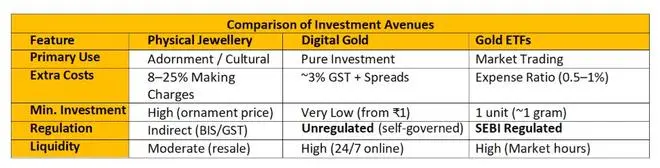
· Jewellery carries extra making charges (8–25 per cent) that are not recovered on resale, unlike digital gold which reflects pure metal value.
· Physical gold involves storage costs and theft risk, while digital gold eliminates these concerns.
· Digital platforms allow small, flexible investments, unlike higher upfront costs of physical gold.
· Digital gold ensures 24K purity.
· Millennials and Gen Z are driving the shift with a preference for simple, app-based investing aligned with a digital-first lifestyle.
Gold ETF & digital gold in India
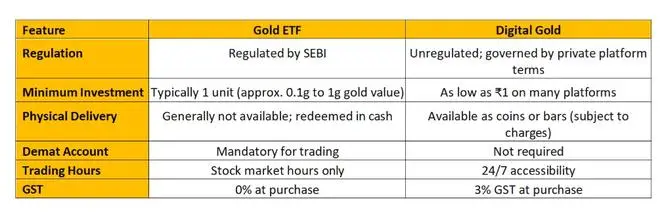
· Gold ETFs and digital gold are both popular but differ in investment process, costs, regulation, and taxation; the choice depends on individual goals and risk appetite.
· Gold ETFs trade on stock exchanges, track gold prices, and offer transparency, liquidity, and cost-efficiency without physical ownership.
· Digital gold represents physical gold held in secure vaults, offering convenience, flexibility, and easy access via online platforms.
· Overall, digital gold and ETFs provide a simpler, more efficient alternative to physical gold investments.
India’s gold ETF demand hit record highs in 2025, becoming a key investment driver as high gold prices reduced jewellery demand. This trend is expected to continue into 2026, with investors increasingly using ETFs to balance their portfolios during global uncertainty.
Performance matrix – Gold ETF
· In 2025, net inflows surged 283 per cent y-o-y to ₹429.6 billion, making India the 3rd largest gold ETF market globally.
· AUM rose 88 per cent to ₹64,777 crore, while holdings increased 65 per cent to a record 95 tons.
· Investment demand (ETFs, bars, coins) contributed ~40 per cent of total gold consumption.
2026: Outlook
· ETFs are expected to remain a key driver, offsetting weak jewellery demand.
· Jan’26 saw record inflows of ₹24,040 crore; Feb’26 moderated due to profit booking.
· AUM reached ₹1.84 lakh crore in Jan’26.
Market Influencers
· Gold delivered strong returns of 76.5 per cent in 2025 vs 10.5 per cent for Nifty 50.
· Global uncertainty and a weak rupee boosted its safe-haven appeal.
· Younger investors are increasingly shifting to digital, liquid gold options like ETFs.
Physical Gold Jewelry
· Demand fell 24 per cent y-o-y to 430.5 tons in 2025; total gold demand declined 11 per cent. 2026 demand is expected to remain weak due to high prices.
· Despite lower volumes, sales value rose 30 per cent to ₹7.5 lakh crore, driven by price increase.
· Consumers shifted to lightweight and lower-purity jewellery (14k, 18k). Around 40 per cent of sales came from exchanging old jewellery.
Shifting Preferences: The World Gold Council predicts a gradual structural shift where investment demand (ETFs, bars, and coins) continues to outpace traditional jewellery consumption.
The author is Head of Commodities & CRM at Ventura.
Published on April 12, 2026









Leave a comment