
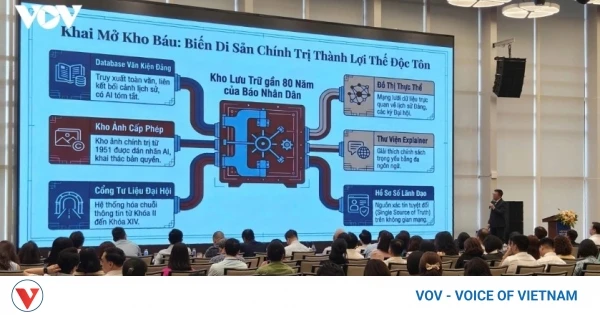
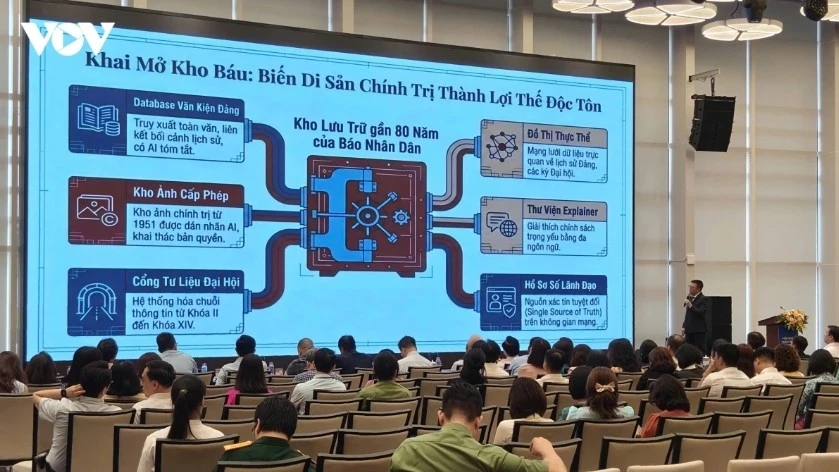
However, alongside these opportunities, media agencies are also facing growing risks of unauthorised copying, sharing and exploitation of content, especially as artificial intelligence becomes increasingly involved in the search, aggregation and distribution of information.
This reality underscores an urgent need for the press to properly recognise the value of its assets and adopt more effective approaches to managing, protecting and utilising them in the digital era.
Protecting copyright for sustainable development
Journalism is a distinctive type of asset, built on intellectual capital, brand value, data, technology and distribution systems. Each journalistic work is not merely a standalone information product, but also the result of a process of creative labour, verification, accumulation and trust-building with the public.
With a history spanning more than 100 years, Vietnam’s revolutionary press possesses a vast body of archival data covering periods of national liberation struggles as well as the country’s development and nation-building. If digitised, properly organised and effectively utilised, this data could become an important resource for developing in-depth journalistic products, content services, knowledge databases and new economic models for journalism.
However, in the digital environment, journalism assets are more vulnerable than ever to unauthorised exploitation. Content produced through significant editorial effort and financial investment by newsrooms can be copied, reposted on social media, or used as data by technology platforms without appropriate agreements.
However, in the digital environment, journalism assets are more vulnerable than ever to unauthorised exploitation. Content produced through substantial editorial effort and financial investment by newsrooms can be copied, reposted on social media, or used as data by technology platforms without appropriate agreements.
However, in the digital environment, journalism assets are more vulnerable than ever to unauthorised exploitation. Content produced through substantial editorial effort and financial investment by media agencies can be copied, reposted on social media, or used as data by technology platforms without appropriate agreements.

Le Quoc Minh, member of the Party Central Committee, Deputy Head of the Party Central Committee’s Commission for Information, Education and Mass Mobilisation, Editor-in-Chief of Nhan Dan Newspaper, and Chairman of the Vietnam Journalists Association, said that without effective copyright protection, journalism will face serious challenges in achieving sustainable development.
“We need to continue raising awareness and intensify efforts to protect copyright. The legal framework is largely in place. The question now is how to strengthen sanctions against major corporations, domestic companies and even individuals. Violations must be penalised consistently to address the current situation where journalism content spreads widely on social media, while the producing media agency may receive only a few thousand likes, whereas an individual who reposts the same content can attract hundreds of thousands or even millions of likes. If copyright cannot be protected, the efforts of journalism will be wasted,” he said.
The issue of journalism copyright in the digital era was discussed at the forum “Journalism Copyright in an Era of Protecting the Value of Journalism,” held as part of the 2026 National Press Festival.
From this reality, many participants said media agencies need to rethink how they manage content assets, from production and storage to distribution and monitoring of content reuse on digital platforms. Rather than relying solely on external sanctions, each press agency must also proactively establish internal copyright protection processes. These include centralised data management, assigning identifiers to content, tracking content reuse and establishing coordination mechanisms with technology platforms when violations are detected.
Journalism data can become a “gold mine” if properly protected

Pham Manh Hung, Deputy General Director of Voice of Vietnam (VOV), said stronger coordination is needed among legal reform, enhanced state management and governance reform within media agencies.
“In terms of legal frameworks, regulations are needed to require cross-border platforms to negotiate payments with Vietnamese media agencies. There must also be sanctions to establish order in cyberspace. With the strength of the State and the legal system, policies can fully support press agencies in protecting copyright.
The second issue is internal governance. Journalism must restructure itself and make use of state governance capacity to help media agencies adopt more effective measures to protect their content copyright. Organisations such as the Vietnam Journalists Association need to discuss and advocate policies for more effective measures to protect journalism data resources,” Hung stressed.
Vietnam has joined multiple multilateral international treaties on copyright and related rights. This provides an important foundation for protecting intellectual property assets, including journalistic products, in the digital environment.
At the same time, new regulations on copyright and related rights are helping improve the domestic legal framework, particularly as journalism data is becoming increasingly valuable for artificial intelligence systems.
However, experts said the biggest challenge now lies not only in legal regulations but also in enforcement. To protect journalism assets, media agencies need to take a more proactive role in identifying and proving ownership, applying technologies to monitor violations and coordinating with relevant agencies when necessary.
According to Pham Thi Kim Oanh, Deputy Director General of the Copyright Office under the Ministry of Culture, Sports and Tourism, intellectual property is first and foremost a civil right, meaning rights holders must take the initiative in protecting their own interests.
“Intellectual property is a civil asset, so we must make strong efforts to protect our rights. Self-protection must begin from the earliest stages. Individual media outlets may not have dedicated legal or technology teams of their own, but they can cooperate with technology companies to apply these measures. In practice, if legal issues arise with partners, they can contact the Copyright Office for support,” she added.
Journalism data accumulated over more than a century can truly become a “gold mine” only when placed within a modern and transparent ecosystem for management and use, and protected by sufficiently strong mechanisms.
In the digital era, particularly as artificial intelligence is increasingly becoming a common channel for searching, aggregating and distributing information, media agencies can no longer stop at content production alone.
More importantly, they must know how to organise data, protect copyright, build new models for content use and turn archives accumulated over generations into development resources.
Only then can journalism’s data “gold mine” be not only preserved, but also better utilised, enhanced in value and made to contribute meaningfully to the sustainable development of Vietnamese journalism amid global digital transformation.
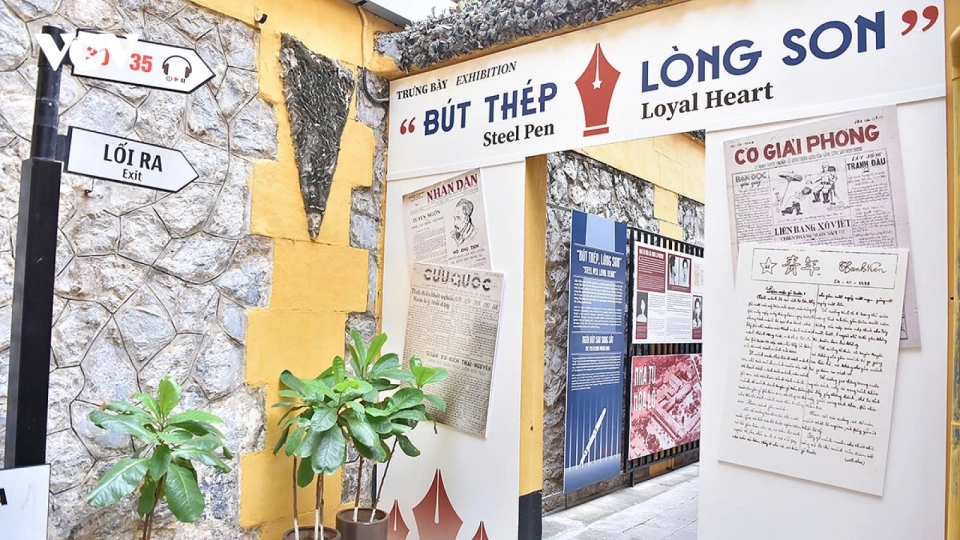
Hanoi exhibition honours legacy of Vietnam’s revolutionary press
VOV.VN – A special exhibition titled “Steel Pen, Loyal Heart” highlighting the history and legacy of Vietnam’s revolutionary press opened at the Hoa Lo Prison Relic Site in Hanoi on June 16 to mark the 101st anniversary of Vietnam Revolutionary Press Day (June 21, 1925–2026).















Leave a comment