
When Conflict Rewires Commodity Routes: The Logic Behind Gold’s New Pathways
Physical commodity markets have always been sensitive to geopolitical shocks, but few assets respond as rapidly or as visibly as gold. Hong Kong gold imports from Dubai amid the US-Iran war represent precisely this kind of shock-driven realignment, where gold’s safe-haven role collides with acute logistical disruption to create entirely new trade flows. Unlike bulk commodities that move by sea over weeks, gold travels predominantly by air, meaning any sustained disruption to flight corridors can sever supply chains within days.
This structural vulnerability becomes a defining factor when military conflict introduces sustained airspace uncertainty across a major transit corridor. The escalating US-Israel war with Iran has done precisely this, introducing operational paralysis across one of the world’s most commercially significant airspace regions. Furthermore, it has forced gold merchants to make rapid, costly decisions about where to redirect substantial physical holdings.
The resulting flow of discounted bullion into Hong Kong is not a random market anomaly. It is the predictable outcome of logistical necessity colliding with deliberate infrastructure investment.
When big ASX news breaks, our subscribers know first
The Air Freight Dependency That Makes Gold Uniquely Vulnerable to Conflict
Understanding why flight disruptions hit gold so much harder than other commodities requires appreciating the asset’s unique logistics profile. Gold’s extraordinary value-to-weight ratio makes air freight the overwhelmingly preferred delivery mechanism for inter-hub transfers. A single commercial cargo flight can carry hundreds of millions of dollars worth of bullion in a shipment that would take many truckloads or multiple container ship deliveries to replicate with heavier commodities.
This efficiency advantage, however, becomes a critical vulnerability when airspace is restricted. When flight routes are suspended or rendered operationally uncertain:
- Storage costs begin accumulating immediately, with financing charges eroding trader margins on a daily basis
- Physical delivery commitments become impossible to honour, increasing counterparty risk across open contracts
- Liquidity pressure builds as merchants cannot convert inventory to cash through their established distribution channels
- Re-export pipelines stall, forcing the search for alternative markets capable of absorbing physical volume quickly
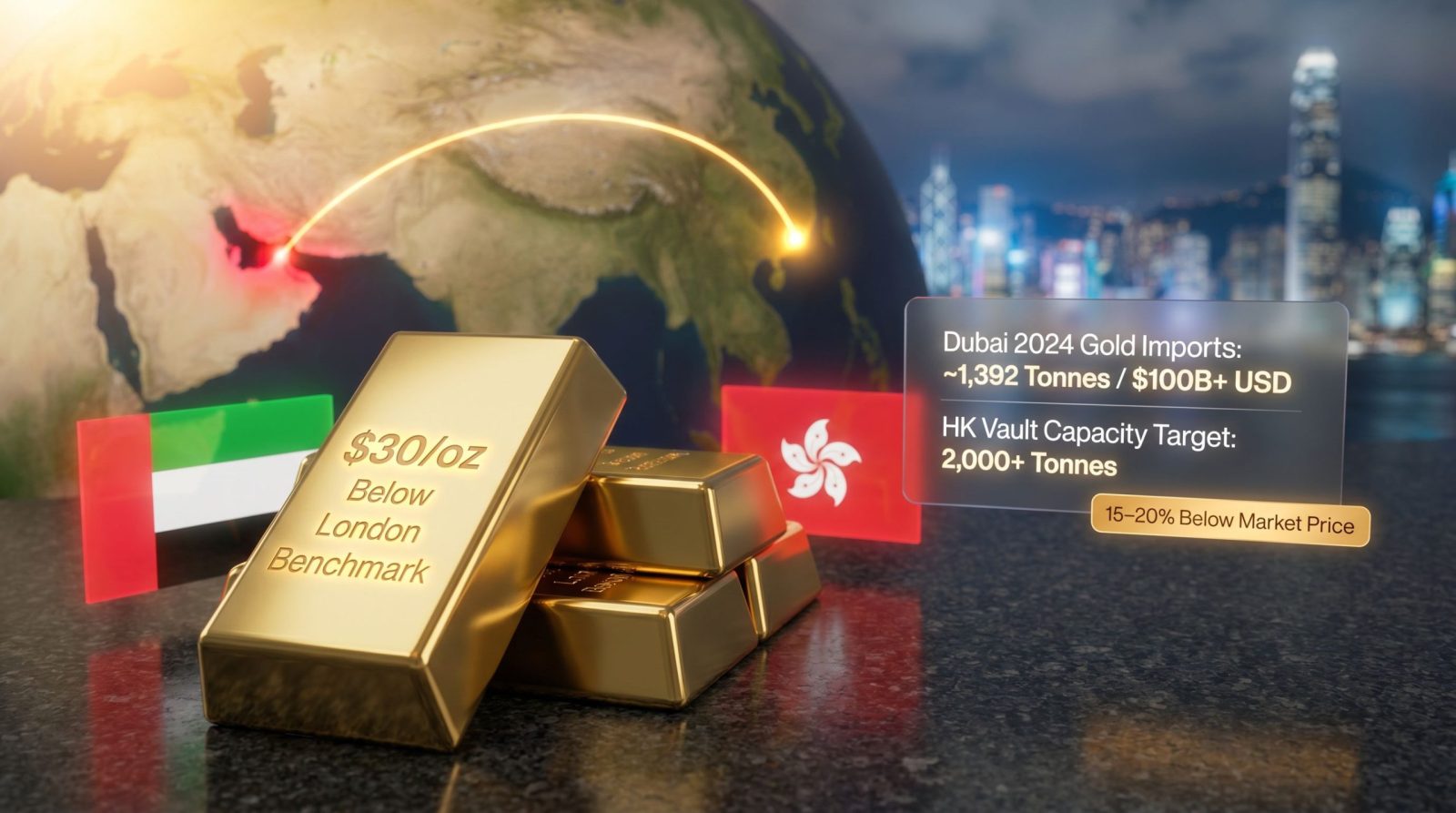
Dubai’s position as a global gold transit powerhouse rested precisely on this air freight model. With approximately 1,392 tonnes of gold imported in 2024 at a market value exceeding $100 billion USD, the emirate had constructed one of the world’s most sophisticated bullion re-export ecosystems, connecting African, Russian, and Central Asian supply sources with Asian and European demand centres through high-frequency air freight operations.
The US-Israel war with Iran has directly compromised this system. According to Reuters, multiple international airlines have suspended flight operations across affected airspace, removing the physical delivery infrastructure that underpins Dubai’s gold transit model. For merchants who had positioned inventory in Dubai for regional distribution, this created an urgent problem with no clean solution.
Why Hong Kong Is Receiving Discounted Gold From Dubai Amid the US-Iran War
Since early April 2026, physical gold arriving in Hong Kong from Middle Eastern and Russian merchants has been offered at discounts of 15 to 20 per cent below prevailing market prices, according to Haywood Cheung Tak-hay, Chairman of the Hong Kong Gold Exchange (HKGX), speaking to the South China Morning Post. Separately, certain transactions have reportedly occurred at discounts of up to $30 per ounce below the London benchmark, reflecting the severity of the liquidity pressure facing some sellers.
This pricing behaviour is not a reflection of weak demand for gold. It is a textbook indicator of forced liquidation under logistical duress, where the seller prioritises the speed of settlement over price maximisation.
The mechanism driving the discounts is straightforward. Merchants from the Middle East and Russia who had originally planned to sell physical gold through Dubai’s established distribution network found themselves unable to execute those plans once conflict disrupted flight operations. Facing accumulating storage and financing costs with no clear timeline for operational normalisation, these traders redirected their inventory to Hong Kong.
Critically, the redirection has also eliminated a layer of transaction costs. Under the previous model, gold would follow a two-step pathway:
- Initial sale in Dubai through established intermediary networks at or near benchmark pricing
- Re-export to Hong Kong through those intermediaries, with standard margin structures preserved at each stage
The conflict has collapsed this model. According to Cheung, traders are now bypassing Dubai intermediaries entirely and selling directly into the Hong Kong market, a structural shift that removes middlemen costs from the transaction and enables the lower pricing while still generating viable settlement proceeds for the seller.
Who Is Selling, and Why Hong Kong Specifically?
The gold flowing into Hong Kong at discounted rates originates primarily from two merchant categories, each with distinct motivations for choosing Hong Kong as their alternative settlement venue.
Middle Eastern traders had positioned gold inventory in Dubai for regional distribution. With their preferred hub operationally impaired, they require a market with deep buyer liquidity, strong legal enforceability of contracts, and the capacity to absorb large physical volumes without price collapse.
Russian-affiliated gold holders have increasingly used Dubai as a neutral re-export point following Western sanctions that restricted their access to European and North American gold markets. With Dubai disrupted, Hong Kong offers a combination of geopolitical neutrality, free capital movement, and institutional credibility that satisfies their operational requirements.
Both groups share a common calculus: they need a market that will buy quickly, pay reliably, and allow unrestricted repatriation of proceeds. Hong Kong currently satisfies all four of the key institutional criteria that drive routing decisions in crisis conditions:
- Enforceability of contracts under a transparent common law legal system
- Absence of capital controls restricting repatriation of sale proceeds
- Perceived neutrality relative to the conflict generating the displacement
- Deep local buyer networks capable of absorbing large physical volumes on short notice
Hong Kong’s Infrastructure Advantage: Built for This Moment
Hong Kong gold imports from Dubai amid the US-Iran war have not arrived into a market operating by chance. The city has been deliberately building the institutional and physical infrastructure to compete as Asia’s premier bullion storage and trading hub, and the current disruption represents a real-world stress test of those preparations arriving at precisely the right moment.
Key elements of Hong Kong’s bullion hub development include:
- Tax incentive frameworks designed to attract gold trading entities and competing directly with Singapore’s established offering
- Expanded vault capacity targeting over 2,000 tonnes within a three-year horizon, representing a substantial increase over current installed capacity
- New domestic refinery development, with facilities such as Point Gold International expanding Hong Kong’s processing capability and reducing its dependency on overseas refining
The competitive comparison with Singapore is worth examining in detail, as both cities have historically competed for the same institutional gold trading mandates:
| Attribute | Hong Kong | Singapore |
|---|---|---|
| Vault Capacity Target | 2,000+ tonnes (active expansion) | Established but smaller footprint |
| Capital Flow Restrictions | None | Minimal |
| Legal Framework | Common law, strong enforcement | Common law, strong enforcement |
| Geopolitical Positioning | Neutral on Middle East conflict | ASEAN-aligned, Western-leaning |
| Bullion Policy Posture | Aggressive expansion underway | Stable but less growth-oriented |
| Current Inbound Flow | Surging due to Dubai redirection | Stable |
Hong Kong’s current positioning advantage over Singapore derives primarily from its perceived neutrality in the conflict driving the displacement, combined with its more aggressive vault and refinery expansion programme. For merchants specifically seeking to avoid markets with political alignments that could complicate future operations, Hong Kong’s profile is structurally more attractive in the present environment.
The Arbitrage Window and What It Signals About Market Efficiency
The emergence of sub-benchmark physical gold pricing in Hong Kong creates a geographic price dislocation with significant implications for sophisticated institutional buyers. In addition to this opportunity, the mechanics of the arbitrage are straightforward in principle:
- Physical gold purchased in Hong Kong at 15 to 20 per cent below market represents an immediately calculable discount to fair value
- That gold can be held and re-exported to markets where benchmark pricing prevails, capturing the spread as logistics normalise post-conflict
- The profitability of this trade depends on the duration of the dislocation and the transaction costs of storage and re-export
Geographic price dislocations of this magnitude historically correct within months of the underlying logistical disruption resolving, as arbitrage pressure from institutional buyers gradually equalises pricing across markets. However, the opportunity window remains meaningful while the conflict persists and Dubai’s operational normalisation timeline remains uncertain.
It is worth noting a less commonly discussed dynamic: the discounted Hong Kong sales create a localised counter-pressure on spot prices in that specific market even while the broader global gold price benefits from conflict-driven safe-haven demand. This creates a two-speed market where global benchmark prices and local physical prices temporarily diverge — a condition that experienced commodity traders specifically monitor as an entry signal. Furthermore, the geopolitical gold drivers at play here are reinforcing one another in ways that make this dislocation particularly pronounced.
Dual Demand Drivers: Safe-Haven Psychology Meets Supply Chain Disruption
The US-Iran war is generating gold demand pressure through two simultaneous and reinforcing mechanisms that together create a structurally bullish medium-term environment for the asset.
Supply-side disruption is compressing physical delivery reliability across established corridors, creating scarcity premiums in certain markets and forcing re-routing costs that effectively increase the delivered price of gold relative to benchmark quotes.
Demand-side acceleration is operating in parallel. As reported by the South China Morning Post, regional investors across the Middle East and beyond are increasing gold allocations as a hedge against further conflict escalation. This is consistent with the well-documented pattern of retail and institutional gold buying increasing during periods of sustained geopolitical uncertainty, particularly in regions directly affected by the conflict.
The LBMA and COMEX markets are also reflecting these dynamics, with benchmark pricing absorbing the broader safe-haven demand even as localised physical markets in Hong Kong show the counter-pressure of discounted forced sales. In addition, record gold ETF inflows have been observed globally, reinforcing the thesis that institutional and retail participants alike are treating the conflict as a catalyst for increased gold exposure. Consequently, central bank gold buying has continued to provide a structural demand floor beneath market pricing even as tactical dislocations emerge.
These twin forces have historically produced durable gold price appreciation when sustained over a multi-month period, though investors should note that past patterns in commodity markets during conflict periods do not reliably predict future price outcomes and carry material uncertainty.
The next major ASX story will hit our subscribers first
Key Data Points: Hong Kong’s Gold Surge at a Glance
| Metric | Value or Status |
|---|---|
| Discount on physical gold in Hong Kong | 15 to 20% below market price (since early April 2026) |
| Spot discount in certain transactions | Up to $30 per ounce below London benchmark |
| Dubai 2024 gold imports | Approximately 1,392 tonnes, valued at over $100 billion USD |
| Hong Kong vault capacity target | 2,000+ tonnes within a three-year horizon |
| Primary displacement trigger | US-Israel war with Iran; airline flight suspensions |
| Seller profiles | Middle Eastern merchants; Russian-affiliated gold holders |
| Hong Kong market advantage | Free capital flows, legal certainty, geopolitical neutrality |
| Policy infrastructure | Tax incentives, new refineries, active storage expansion |
Scenarios: Will Hong Kong Permanently Capture Dubai’s Market Share?
The longer-term significance of the current surge in Hong Kong gold imports from Dubai amid the US-Iran war depends heavily on how the conflict evolves and whether the logistical disruptions prove temporary or structural. Four distinct scenarios frame the range of outcomes:
| Scenario | Key Variable | Probable Hong Kong Impact |
|---|---|---|
| Rapid conflict resolution | Diplomatic intervention | Temporary flow reversal toward Dubai |
| Prolonged conflict (6 to 18 months) | Sustained escalation | Structural embedding of Hong Kong routes |
| Permanent Dubai infrastructure impairment | Extended flight suspension | Long-term market share capture |
| Multi-hub equilibrium emerges | Trader risk diversification | Hong Kong retains elevated share permanently |
The most strategically significant outcome for Hong Kong’s long-term positioning is the multi-hub equilibrium scenario. Once gold merchants have invested in establishing direct relationships with Hong Kong buyers, vault operators, and logistics providers, the switching costs associated with reverting entirely to Dubai become non-trivial. Even a successful conflict resolution would not erase the operational knowledge and commercial relationships built during the disruption period.
This dynamic is consistent with a broader pattern observable across commodity markets: crisis-driven supply chain diversification tends to be partially permanent, as the revealed vulnerability of a single dominant hub creates lasting motivation to maintain alternative routing infrastructure.
What Market Participants Should Monitor Going Forward
For those tracking this situation as it develops, several specific data points will indicate whether the current surge becomes a durable structural shift or a temporary logistical workaround:
- Official Hong Kong import data, when published by relevant authorities, will quantify the actual scale of the Dubai redirection and provide a baseline against which future months can be compared
- Airline route restoration announcements across the Persian Gulf remain the primary variable determining the duration of Dubai’s operational impairment and the longevity of the current trade flows
- Hong Kong vault capacity milestones will signal whether the city’s infrastructure expansion is keeping pace with the increased physical gold flows it is absorbing
- Price convergence between Hong Kong and London will indicate when arbitrage pressure has normalised the dislocation; persistent discounts beyond six months would suggest ongoing structural supply pressure rather than temporary crisis redirection
This article is informational in nature and does not constitute financial or investment advice. Gold markets involve substantial risk, and outcomes discussed here involve significant uncertainty. Readers should conduct independent research and seek qualified financial guidance before making investment decisions.
Want To Stay Ahead Of The Next Major ASX Mineral Discovery?
Discovery Alert’s proprietary Discovery IQ model delivers real-time alerts on significant ASX mineral discoveries, turning complex commodity data into actionable insights for both short-term traders and long-term investors — explore historic discovery returns to understand the scale of opportunity, and begin your 14-day free trial at Discovery Alert to position yourself ahead of the broader market.














Leave a comment