
The Quiet Revolution Reshaping Who Controls the World’s Gold
When commodity cycles turn, they rarely do so quietly. But the transformation currently underway across Africa’s gold sector is something categorically different from a standard price rally. What is emerging is a fundamental restructuring of who holds power in the world’s most important precious metals market. This shift is driven by the convergence of record bullion prices, assertive sovereign policy agendas, and a new generation of African-owned capital competing directly with Western multinationals for production dominance.
Understanding this shift requires looking beyond the price ticker. Africa gold prices and mining investment are no longer two separate analytical conversations. They have become deeply intertwined forces reshaping continental economics, central bank reserve strategy, and the negotiating dynamics between host governments and multinational operators in ways that will define the sector for decades. Furthermore, the gold market outlook for the region continues to evolve rapidly as these dynamics intensify.
When big ASX news breaks, our subscribers know first
What $4,700-Per-Ounce Gold Actually Does to Continental Economics
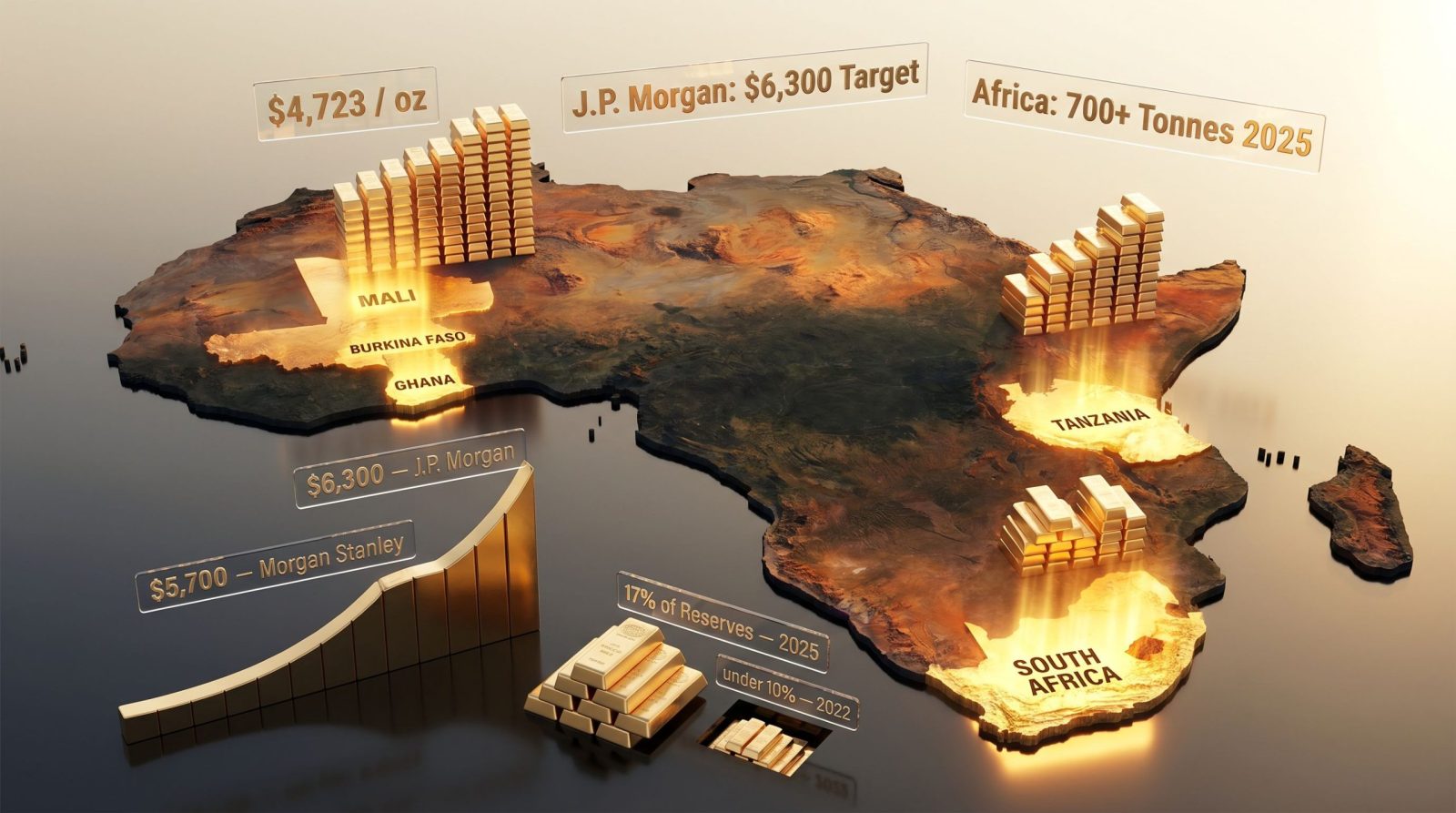
The mechanics of elevated bullion pricing are straightforward in theory but transformative in practice. As of May 8, 2026, spot gold traded at $4,723.11 per ounce, according to real-time data from Investing.com, reflecting a 0.77% single-session gain and putting bullion on track for a 2.3% weekly advance described as its strongest performance since late March 2026.
For gold-producing economies, this price environment is not simply a revenue windfall. It is a structural lever that amplifies the economic consequences of every policy decision made in mining ministries across the continent.
Consider the position of Ghana, where gold represents approximately 25% of total annual export value. At that level of export dependency, a sustained price move of $1,000 per ounce does not merely add a percentage point or two to export revenues. It reshapes the country’s current account position, alters its debt-service capacity, and fundamentally shifts what governments can demand from mining operators without triggering capital flight.
Africa’s projected gold export revenues reached approximately $45 billion in 2025, positioning the continent as one of the world’s most significant foreign exchange earners through a single commodity class. That figure, once largely extracted and value-added elsewhere, is now being scrutinised by African policymakers as a pool of wealth that should generate far greater domestic economic capture.
The relationship between gold price levels and government negotiating leverage is not linear. Above certain price thresholds, mining project margins widen sufficiently that operators can absorb substantially higher fiscal burdens while still meeting return hurdles. At $4,700 per ounce, the price environment creates conditions for policy assertiveness that simply did not exist at $1,800 per ounce.
The Multi-Factor Case for Gold Reaching $6,300 Per Ounce
The bullion rally driving Africa’s strategic repositioning is itself supported by a layered set of macroeconomic and geopolitical forces that analysts view as more durable than typical speculative cycles. Consequently, the gold price forecast from leading institutions points firmly upward, supported by multiple structural drivers.
Geopolitical Risk Pricing and Forward Markets
Gold surged this week on optimism surrounding potential U.S.-Iran diplomatic progress related to an ongoing conflict that began on February 28, 2026, with prices reaching as high as $4,750 per ounce earlier in the week before settling back. Ross Norman, Chief Executive Officer of precious metals platform Metals Daily, observed that markets were already assigning pricing weight to a diplomatic resolution that had not yet been formally concluded, indicating the kind of expectation-driven forward pricing behaviour that tends to sustain rather than reverse precious metals momentum.
This pattern, where bullion markets price in resolution scenarios before agreements materialise, is a well-documented psychological dynamic in safe-haven assets. It means gold can retain elevated valuations through an extended period of diplomatic uncertainty rather than collapsing the moment tensions ease.
Alongside U.S.-Iran tensions, ongoing instability across the Middle East, Eastern Europe, and parts of Africa itself has compressed global risk appetite, channelling capital toward non-sovereign, non-correlated stores of value. Gold remains the dominant beneficiary of this dynamic.
Macroeconomic Tailwinds: Yield Compression and Dollar Weakness
The broader rally has been reinforced by softer U.S. Treasury yields and a weakening dollar environment, both of which structurally support gold valuations through well-established inverse relationships. When real yields decline, the opportunity cost of holding non-yielding bullion falls. When the dollar softens, gold becomes cheaper for non-USD investors, expanding the global buyer base and amplifying demand signals.
Despite countervailing pressure from rising oil prices and periodic profit-taking activity, these macroeconomic tailwinds have proven resilient enough to sustain the bullish trend that analysts broadly view as intact. In addition, Gold Fields has flagged oil shock as a key driver of rising mining costs, highlighting how geopolitical disruptions are feeding directly into operational expenditure across the sector.
Institutional Price Forecasts for 2026
The world’s largest investment banks have published bullish targets that reflect structural rather than cyclical conviction:
| Institution | 2026 Year-End Target | Long-Term Forecast | Analytical Basis |
|---|---|---|---|
| J.P. Morgan | $6,300 per ounce | $4,500 per ounce | Structural demand shift, reserve diversification |
| Morgan Stanley | $5,700 per ounce | Not specified | Safe-haven flows, de-dollarisation |
Source: Reuters (J.P. Morgan, February 25, 2026); Business Insider Africa (Morgan Stanley, May 8, 2026)
For investors tracking Africa gold prices and mining investment: J.P. Morgan’s $6,300 per ounce year-end 2026 forecast, if realised, would represent a further 33% appreciation from current May 2026 spot levels, a magnitude of movement that would dramatically expand African government revenues, widen already-profitable mine margins, and intensify the resource sovereignty dynamics already reshaping the sector.
Africa’s Gold Production Machine: Scale, Growth, and Strategic Weight
Africa’s status as a global gold production powerhouse is not a recent development, but the scale and strategic intentionality now attached to that production capacity represents something genuinely new. Understanding global gold production trends provides useful context for just how significant Africa’s growing share of output has become.
Continental gold production surpassed 700 tonnes in 2025, with major contributions from Ghana, South Africa, and Burkina Faso. Research platform Farmonaut has confirmed that Africa and Canada together produced more than 850 tonnes of gold in 2023, collectively accounting for approximately 21% of global gold output. That single data point positions Africa as a material determinant of global precious metals supply, not merely a peripheral contributor.
The Continental Production Landscape
The geographic distribution of African gold production spans a diverse range of jurisdictions, each with distinct geology, political frameworks, and investment climates:
| Country | Strategic Role | Primary Operators |
|---|---|---|
| Ghana | West Africa’s largest producer | Newmont, AngloGold Ashanti, Gold Fields |
| South Africa | Deep-level expertise, historic production base | Harmony Gold, Sibanye-Stillwater, Gold Fields |
| Mali | High-growth output, elevated regulatory complexity | Barrick Gold, Endeavour Mining, B2Gold |
| Burkina Faso | Rapid expansion, significant political volatility | West African Resources, Endeavour Mining |
| Tanzania | State equity focus, growing output | Barrick Gold, AngloGold Ashanti |
| Namibia | Southern Africa diversification | B2Gold, Harmony Gold |
| Egypt | Underexplored, growing international interest | AngloGold Ashanti |
Technology as a Competitive Differentiator
Across these jurisdictions, the operational sophistication of African gold mining is accelerating. Miners are increasingly deploying satellite-based exploration technologies and integrated digital operational systems to improve discovery rates, extraction efficiency, and environmental compliance monitoring. This technology adoption is gradually reshaping the risk-return profile of African projects by reducing exploration uncertainty and improving environmental, social, and governance (ESG) performance metrics that international capital markets increasingly require for investment access.
Renewable energy integration is also gaining traction, with solar deployment at operations in Burkina Faso and hydropower expansion in the Democratic Republic of Congo reducing operational energy costs while improving ESG credentials.
How African Governments Are Turning Price Momentum Into Policy Power
The most consequential dimension of the current gold cycle for long-term investors is not the price level itself but how African governments are translating elevated bullion valuations into structural reforms that permanently alter the operating environment for international miners.
Central Bank Gold Accumulation: Building Reserve Resilience
According to the Africa Finance Corporation’s State of Africa’s Infrastructure Report, the continent’s total central bank reserves climbed from $480 billion in 2024 to $530 billion in 2025, with rising gold prices and active bullion purchasing across the continent acting as primary drivers. Furthermore, central bank gold demand has proven to be one of the most consistent structural forces underpinning global bullion prices throughout this cycle.
The compositional shift in those reserves is equally significant:
- Gold now accounts for approximately 17% of Africa’s total central bank reserves, up from under 10% in 2022 and 2023
- Physical gold holdings have grown from 663 tonnes in 2022 to an estimated 738 tonnes in 2025, a 75-tonne increase over three years
- Central banks in Ghana, Tanzania, Uganda, Rwanda, and Namibia are purchasing gold directly from domestic small-scale miners, simultaneously supporting local production networks, reducing dollar-denominated reserve exposure, and building sovereign balance sheet resilience
This accumulation strategy is not simply yield-seeking behaviour. It reflects a deliberate architectural decision to anchor reserve management in a domestically produced asset rather than one subject to U.S. monetary policy decisions and dollar fluctuations. The de-dollarisation dimension of African central bank gold buying is arguably as important as the financial return dimension, yet it receives considerably less analytical attention in mainstream commentary.
Resource Sovereignty in Practice: Three Country Case Studies
Burkina Faso: Aggressive Stake Expansion
The military-led government under Captain Ibrahim Traoré has announced plans to raise the state’s ownership stake in the Kiaka gold mine from 15% to 40%, with the demand directed at Australia-listed West African Resources. While the outcome of those negotiations remains uncertain, West African Resources projects annual production of between 430,000 and 490,000 ounces from its Burkina Faso operations, making the financial stakes of the equity renegotiation substantial. The result of this process will function as a regional benchmark for state ownership demands across West Africa.
Mali: Fiscal Pressure Without Operator Retreat
Despite a revised mining code imposing both higher taxes and increased state equity requirements, international mining companies continue to expand their Mali commitments. The economic logic is straightforward: at gold prices above $4,500 per ounce, project margins remain wide enough to absorb elevated fiscal burdens while still generating returns that justify continued capital deployment. This dynamic illustrates a critical threshold effect where, at extreme price levels, even materially higher sovereign demands do not trigger the capital flight that would occur in more moderate commodity environments.
Morocco: African-Owned Capital at Continental Scale
Morocco’s Managem Group, operating under royal ownership, represents the most compelling evidence that African-aligned capital is capable of competing directly with Western multinationals for continental production dominance. Soaring gold prices are actively boosting mining power and state control across the continent, and Managem’s trajectory exemplifies this broader pattern.
The company has committed $750 million to expanding gold production across its African portfolio by 2030, with operations spanning eight African countries including Sudan, the Democratic Republic of Congo, Gabon, Senegal, Guinea, and Cote d’Ivoire. Its performance metrics for 2025 are striking:
- Net profit surged 384% to $322 million
- Gold production increased 26% year-over-year
- Average realised prices climbed 44% to $3,445 per ounce
- The production expansion target represents a 134% increase, scaling from 213,000 ounces in 2025 to 500,000 ounces annually by 2030
- Revenue target: exceeding $2 billion within two years
Managem’s trajectory establishes a new archetype in Africa gold prices and mining investment: state-aligned continental capital pursuing aggressive expansion rather than passive royalty collection.
Navigating the Risk Landscape in Africa’s Gold Sector
The opportunity presented by the continent’s gold sector cannot be honestly assessed without examining the structural risks that could disrupt even the most optimistic scenarios. However, understanding gold as a strategic investment means weighing both the considerable upside and the risks that accompany exposure to frontier mining jurisdictions.
Political and Regulatory Volatility
The Burkina Faso and Mali situations illustrate how rapidly military-led governments can alter operating conditions for international miners. The withdrawal of a French-backed contractor from Mali’s largest gold mine, with over 600 jobs affected, demonstrates that even high commodity prices cannot indefinitely shield operators from the consequences of deteriorating political relationships. Investors should consider the meaningfully different risk profiles across Francophone West Africa versus Anglophone East and Southern Africa when constructing exposure to the continent.
The Resource Curse Paradox
Higher gold prices do not automatically translate into broad-based economic development. Historical commodity cycles across the continent have demonstrated that without strong institutional frameworks, governance reforms, and deliberate revenue deployment strategies, windfall commodity revenues can intensify rather than resolve inequality and governance challenges. The structural conditions that determine whether a gold boom generates lasting economic transformation or concentrated wealth accumulation are institutional, not geological.
Investment Access: Matching Vehicle to Risk Appetite
Different investor mandates require different approaches to accessing Africa’s gold sector. The risk-return and liquidity profiles vary considerably across available vehicles:
| Investment Vehicle | Risk Level | Liquidity | Best Suited For |
|---|---|---|---|
| Listed mining equities (Newmont, Gold Fields, Endeavour) | Medium | High | Institutional and retail investors |
| Royalty and streaming agreements | Medium | Medium-High | Specialist resource funds |
| Physical gold (bars, coins) | Low to Medium | Medium | Wealth preservation mandates |
| Artisanal and small-scale mining partnerships | High | Low | Impact capital and development funds |
| African sovereign instruments backed by gold reserves | Medium | Medium | Fixed income investors seeking EM exposure |
The next major ASX story will hit our subscribers first
Scenario Pathways: Africa’s Gold Sector Through 2030
Three plausible scenarios frame the range of outcomes for the continent’s gold trajectory through the end of the decade.
Scenario 1: The Sovereignty Dividend (Base Case)
Gold prices stabilise between $4,500 and $5,500 per ounce. African governments successfully negotiate higher state equity and royalty structures without triggering significant operator withdrawal. Domestic processing capacity gradually expands, capturing more value within the continent. Central bank gold reserves continue growing, deepening monetary sovereignty.
Scenario 2: The Investment Retreat (Downside Case)
Aggressive resource nationalism in key West African jurisdictions triggers withdrawal by major international operators. Political instability disrupts production in Mali and Burkina Faso simultaneously. A gold price correction toward $3,000 to $3,500 per ounce compresses project margins and state revenues concurrently. International capital redirects toward more stable gold jurisdictions in Latin America and Southeast Asia.
Scenario 3: The Continental Gold Standard (Upside Case)
Gold prices reach J.P. Morgan’s $6,300 per ounce year-end target. Managem’s continental expansion succeeds, establishing a replicable model for African-owned mining capital. Multiple central banks formalise gold-backed reserve frameworks, accelerating de-dollarisation. Africa captures more than 25% of global gold production by 2030, with in-country processing becoming a standard expectation rather than an exception.
Frequently Asked Questions: Africa Gold Prices and Mining Investment
What is the current gold price in Africa?
Gold is globally priced, trading at approximately $4,723 per ounce as of May 8, 2026, according to real-time data from Investing.com. African producers sell at prices benchmarked to international spot markets, meaning the current elevated environment directly benefits continental mining revenues and government royalty receipts.
Which African countries produce the most gold?
The leading producers are Ghana, South Africa, Mali, Burkina Faso, Tanzania, and Uganda, collectively accounting for the majority of Africa’s output, which surpassed 700 tonnes in 2025.
What is the 2026 gold price forecast from major banks?
J.P. Morgan forecasts gold reaching $6,300 per ounce by year-end 2026, with a normalised long-term price of $4,500 per ounce. Morgan Stanley projects a $5,700 per ounce year-end 2026 target. Both institutions cite sustained safe-haven demand, dollar weakness, and structural reserve diversification as supporting drivers.
How are African central banks responding to high gold prices?
According to the Africa Finance Corporation’s State of Africa’s Infrastructure Report, continental central bank reserves grew from $480 billion to $530 billion between 2024 and 2025. Gold’s share of those reserves rose from under 10% to approximately 17%, while physical holdings increased from 663 to 738 tonnes between 2022 and 2025. Several central banks are purchasing gold directly from domestic small-scale miners to support local producers while building sovereign reserves.
Why do international miners keep investing in Africa despite rising taxes and state demands?
At gold prices above $4,500 per ounce, mine operating margins remain wide enough to absorb substantially higher fiscal burdens while still delivering returns that meet institutional investment thresholds. Mali’s continued attraction of mining capital despite a more demanding regulatory environment exemplifies this margin-driven logic.
The Structural Inflection Point for African Gold
The convergence of record gold prices, accelerating central bank accumulation, assertive resource sovereignty policies, and the emergence of African-owned continental mining capital is producing an operating environment unlike any previous cycle in the continent’s mining history.
For investors and policymakers, the most important analytical recognition is that the current moment is not a cyclical upswing to be managed and waited out. It is a structural inflection point. Nations that balance sovereign ambition with investment-grade policy frameworks will emerge as the defining gold powers of the 2030s. Those that allow political volatility to override economic fundamentals risk forfeiting the most favourable commodity environment in modern African history precisely at the moment when the continent’s geological endowment, institutional capacity, and geopolitical positioning are finally aligning in its favour.
Disclaimer: This article is intended for informational purposes only and does not constitute financial, investment, or legal advice. Forward-looking statements, price forecasts, and scenario analyses involve inherent uncertainty and should not be relied upon as predictions of future outcomes. Readers should conduct independent research and seek professional advice before making any investment decisions related to gold, mining equities, or African markets.
Readers seeking ongoing coverage of Africa’s commodity markets, investment flows, and economic policy developments can explore reporting available through Business Insider Africa.
Want To Catch the Next Major ASX Gold Discovery Before the Market Moves?
Discovery Alert’s proprietary Discovery IQ model delivers real-time alerts the moment significant mineral discoveries hit the ASX, transforming complex geological data into clear, actionable insights for investors at every level — start your 14-day free trial today and explore why historic discoveries have generated extraordinary returns on the dedicated discoveries page.











Leave a comment