
Key Takeaways
- Financial accounting uses established principles to create consistent, transparent financial statements, such as balance sheets and income statements, which are essential for external reporting.
- U.S. public companies follow Generally Accepted Accounting Principles (GAAP) to provide reliable financial information to investors, creditors, and regulatory bodies, while international companies often adhere to International Financial Reporting Standards (IFRS).
- Financial accounting can be performed using either the accrual method, which records transactions when they occur, or the cash method, which records them when cash is exchanged.
- Principles like revenue recognition and the matching principle ensure financial statements accurately reflect a company’s financial position and prevent misrepresentation.
- Common users of financial accounting include investors, auditors, regulatory agencies, suppliers, and banks, all of whom rely on the clarity and accuracy of financial reports for decision-making.
Get personalized, AI-powered answers built on 27+ years of trusted expertise.
What Is Financial Accounting?
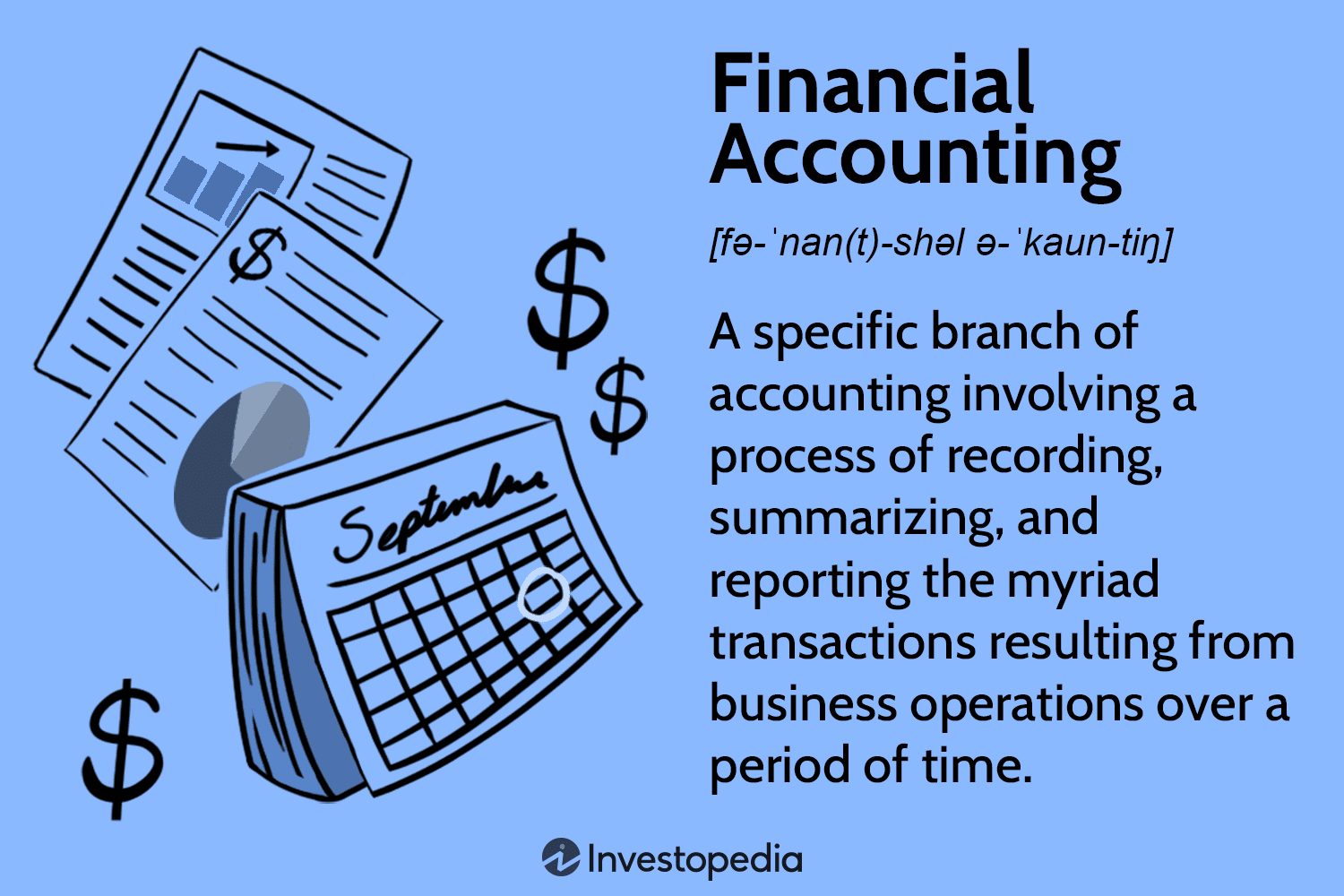
Financial accounting is a branch of accounting focused on recording, summarizing, and reporting the transactions from business operations over a period of time to present an accurate picture of a company’s financial position.
These transactions are summarized into financial statements, such as the balance sheet, income statement, and cash flow statement, that show a company’s performance and financial health. Unlike managerial accounting, which is used internally to guide decisions, financial accounting follows standards like generally accepted accounting principles (GAAP) or International Financial Reporting Standards (IFRS) to ensure consistency and reliability.
Investopedia / Laura Porter
Understanding the Mechanics of Financial Accounting
Financial accounting follows set principles that depend on a company’s rules and reporting needs. Companies and organizations often have an accounting manual that details the pertinent accounting rules.
U.S. public companies must follow GAAP to give consistent information to investors, creditors, regulators, and tax authorities.
The statements used in financial accounting cover the five main classifications of financial data or financial accounts, which are:
- Revenues – Included here is income from sales of products and services, plus other sources, including dividends and interest.
- Expenses – These are the costs of producing goods and services, from research and development to marketing to payroll.
- Assets – These consist of owned property, both tangible (buildings, computers) and intangible (patents, trademarks).
- Liabilities – These are all outstanding debts, such as loans or rent.
- Equity – If you paid off the company’s debts and liquidated its assets, you would get its equity, which is what a company is worth.
Revenues and expenses on the income statement help determine the net income. Assets, liabilities, and equity accounts are reported on the balance sheet, which utilizes financial accounting to report ownership of the company’s future economic benefits.
Essential Financial Statements Explained
Balance Sheet
A balance sheet reports a company’s financial position as of a specific date. It lists the company’s assets, liabilities, and equity, and the financial statement rolls over from one period to the next. Financial accounting guidance dictates how a company records cash, values assets, and reports debt.
A balance sheet is used by management, lenders, and investors to assess the liquidity and solvency of a company. Through financial ratio analysis, financial accounting allows these parties to compare one balance sheet account with another.
For example, the current ratio compares the amount of current assets with current liabilities to determine how likely a company is going to be able to meet short-term debt obligations.
Income Statement
An income statement, also known as a “profit and loss statement,” reports a company’s operating activity during a specific period of time.
Usually issued on a monthly, quarterly, or annual basis, the income statement lists the revenue, expenses, and net income of a company for a given period. Financial accounting guidance dictates how a company recognizes revenue, records expenses, and classifies types of expenses.
An income statement can be useful to management, but managerial accounting gives a company better insight into production and pricing strategies compared with financial accounting.
Financial accounting rules regarding an income statement are more useful for investors seeking to gauge a company’s profitability and external parties looking to assess the risk or consistency of operations.
Cash Flow Statement
A cash flow statement reports how a company used cash during a specific period. It is broken into three sections:
- Operations – These are the costs of a company’s core business activities.
- Financing – This is money the company receives from taking loans or issuing shares, as well as money paid in interest on loans and dividends to investors.
- Investments – This is money that comes from buying and selling the company’s investments, such as securities or fixed assets.
Financial accounting guidance dictates when transactions are to be recorded, though there is often little to no flexibility in the amount of cash to be reported per transaction.
A cash flow statement is used by management to better understand how cash is being spent and received. It extracts only items that impact cash, allowing for the clearest possible picture of how money is being used, which can be somewhat cloudy if the business is using accrual accounting.
Shareholders’ Equity Statement
A shareholders’ equity statement reports how a company’s equity changes from one period to another, as opposed to a balance sheet, which is a snapshot of equity at a single point in time.
It shows how the residual value of a company increases or decreases and why it changes. It gives details about the following components of equity:
- Share capital – Money raised by selling stock in the company
- Net income – Any profit after expenses and deductions
- Dividends – The part of the profit that is paid to shareholders
- Retained earnings – Whatever is left after paying dividends
Important
Nonprofit entities and government agencies use similar financial statements; however, their financial statements are more specific to their entity types and will vary from the statements listed above.
Comparing Accrual and Cash Accounting Methods
There are two primary types of financial accounting: the accrual method and the cash method. The main difference is when transactions are recorded.
Accrual Method
The accrual method of financial accounting records transactions independently of cash usage. Revenue is recorded when it is earned (when a bill is sent), not when it actually arrives (when the bill is paid). Expenses are recorded upon receiving an invoice, not when paying it. Accrual accounting recognizes the impact of a transaction over a period of time.
For example, imagine a company receiving a $1,000 payment for a consulting job to be completed next month. Under accrual accounting, the company is not allowed to recognize the $1,000 as revenue, as it has technically not yet performed the work and earned the income.
The transaction is recorded as a debit to cash and a credit to unearned revenue, a liability account. When the company earns the revenue next month, it clears the unearned revenue credit and records actual revenue, erasing the debt to cash.
Another example of the accrual method of accounting is expenses that have not yet been paid. Imagine a company received an invoice for $5,000 for July utility usage.
Even though the company won’t pay the bill until August, accrual accounting calls for the company to record the transaction in July, debiting utility expenses. The company records a credit to accounts payable. When the invoice is paid, the credit is cleared.
Cash Method
The cash method of financial accounting is an easier, less strict method of preparing financial statements: Transactions are recorded only when cash is involved. Revenue and expenses are only recorded when the transaction has been completed via the facilitation of money.
In the example above, the consulting firm would have recorded $1,000 of consulting revenue when it received the payment.
Even though it won’t actually perform the work until the next month, the cash method calls for revenue to be recognized when cash is received. When the company does the work in the following month, no journal entry is recorded, because the transaction will have been recorded in full the prior month.
In the other example, the utility expense would have been recorded in August (the period when the invoice was paid). Even though the charges relate to services incurred in July, the cash method of financial accounting requires expenses to be recorded when they are paid, not when they occur.
Financial Accounting
Accrual Method
-
Records transactions when benefit is received or liability is incurred
-
A more accurate method of accounting that depicts more realistic business operations
-
Required for larger, public companies as part of external reporting
Cash Method
-
Records transactions when cash is received or distributed
-
An easier method of accounting that simplifies a company down to what has already actually occurred
-
Primarily used by smaller, private companies with low to no reporting requirements
Core Principles Guiding Financial Accounting
Five main principles guide companies on how to prepare their financial statements. The type of accounting method should be determined at the outset. Changes to this method can happen later but require specific actions.
The principles are the basis of all financial accounting technical guidance. These five principles relate to the accrual method of accounting.
- Revenue recognition principle – This states that revenue should be recognized when it has been earned. It dictates how much revenue should be recorded, the timing of when that revenue is reported, and circumstances in which revenue should not be reflected within a set of financial statements.
- Cost principle – This states the basis for which costs are recorded. It dictates how much expenses should be recorded for (i.e. at transaction cost) in addition to properly recognizing expenses over time for appropriate situations (i.e. a depreciable asset is expensed over its useful life).
- Matching principle – This states that revenue and expenses should be recorded in the same period in which both are incurred. It strives to prevent a company from recording revenue in one year with the associated cost of generating that revenue in a different year. The principle dictates the timing in which transactions are recorded.
- Full disclosure principle – Companies should provide complete, honest, and accurate information on their finances. All information relevant to their financial situation should be disclosed. To achieve this, financial statements should be prepared using financial accounting guidance that includes footnotes, schedules, or commentary that transparently report the financial position of a company. This principle also dictates the amount of information provided within financial statements.
- Objectivity principle – Accounting should be based solely on facts and objective evidence. It should be free of bias and personal opinion. While financial accounting has aspects of estimation and professional judgment, a set of financial statements should be prepared objectively and factually.
Why Financial Accounting Matters
Companies engage in financial accounting for a number of important reasons.
- Creating a standard set of rules – Financial accounting sets rules that create consistency in financial reporting across companies and periods.
- Decreasing risk – Financial accounting does this by increasing accountability. Lenders, regulators, and tax authorities rely on financial accounting to ensure reports are prepared using accepted methods.
- Providing insight to management – While managerial accounting may offer more insights, financial accounting can guide strategic decisions.
- Promoting trust in financial reporting – Independent governing bodies oversee the rules of financial accounting, making the basis of reporting independent of management and a highly reliable source of accurate information.
- Encouraging transparency – Financial accounting requires companies to share information on operations and risks, showing true financial performance.
Note
Careers in financial accounting can include preparing financial statements, analyzing financial statements, auditing financial statements, and supporting the technology/systems that produce financial statements.
Key Users of Financial Accounting Reports
The entire purpose of financial accounting is to prepare financial statements, which are used by a variety of groups and are often required as part of agreements with the preparing company. In addition to management using financial accounting to gain information on operations, the following groups use financial accounting reporting.
- Investors – Before putting their money into a company, investors often seek reports prepared using financial accounting to understand how the company has been doing and set expectations about the company’s future.
- Auditors – Companies may be required to present their financial position to auditors, who analyze the financial statements and ensure that proper financial accounting guidance has been used and the reports are free from material misstatements.
- Regulatory agencies – Public companies are required to submit financial statements to governing bodies such as the Securities and Exchange Commission. These financial statements must be prepared in accordance with financial accounting rules, and companies face fines or exchange delisting if they do not comply with reporting requirements.
- Suppliers – Vendors or suppliers may ask for financial statements as part of their credit application process. Suppliers may require a credit history or evidence of profitability, such as a Piotroski Score, before issuing or increasing credit to a requested amount.
- Banks – Lenders and other similar financial institutions will almost always require financial statements as part of the business loan process. Lenders will need to see verifiable proof via financial accounting that a company is in good operational health prior to issuing a loan. The statements may also be used for determining the cost, covenants, or interest rate of the loan.
Distinguishing Financial and Managerial Accounting
The key difference between financial and managerial accounting is that financial accounting provides information to external parties, while managerial accounting helps managers within the organization make decisions.
Managerial accounting assesses financial performance and hopes to drive smarter decision-making through internal reports that analyze operations. It is not an allowable basis for financial statements.
Managerial accounting uses operational information in specific ways to glean information. For example, it may use cost accounting to track the variable costs, fixed costs, and overhead costs along a manufacturing process. Then, using this cost information, a company may decide to switch to a lower quality, less expensive type of raw materials.
Recognized Certifications in Financial Accounting
Members of financial accounting can carry several different professional designations.
- Certified Public Accountant (CPA) – The most common accounting designation demonstrating an ability to perform financial accounting within the United States is the CPA license.
- Chartered Accountant (CA) – Outside of the United States, holders of the CA license demonstrate the ability as well.
- Certified Management Accountant (CMA) – The CMA designation is more demonstrative of an ability to perform internal management functions than financial accounting. However, this license does test on financial analysis.
- Certified Internal Auditor (CIA) – Holding a CIA designation demonstrates credibility in maintaining the control environment within a company by overseeing processes and procedures related to financial accounting.
What Is an Example of Financial Accounting?
A public company’s income statement is an example of financial accounting. The company must follow specific guidance on what transactions to record. In addition, the format of the report is stipulated by governing bodies. The end result is a financial report that communicates the amount of revenue recognized in a given period.
What Is the Main Purpose of Financial Accounting?
Financial accounting is intended to provide financial information on a company’s operating performance. Though management can analyze reports generated using financial accounting, they often find it more useful to use managerial accounting, an internally geared method of calculating financial results that is not allowable for external reports. Financial accounting is the widely accepted method of preparing financial results for external use.
Who Uses Financial Accounting?
Public companies are required to perform financial accounting as part of the preparation of their financial statement reporting. Small or private companies may also use financial accounting, but they often operate with different reporting requirements. Financial statements generated through financial accounting are used by many parties outside of a company, including lenders, government agencies, auditors, insurance agencies, and investors.
The Bottom Line
Financial accounting provides a standardized framework for preparing financial statements, ensuring consistency and comparability across companies. These statements, like the balance sheet, income statement, and cash flow statement, show a company’s performance and position for external users such as investors and regulators.
Unlike managerial accounting, it focuses on external reporting and follows standards like GAAP or IFRS. By promoting transparency and accountability, financial accounting builds trust and supports informed stakeholder decisions.














Leave a comment