
In late June 2025, agents from the Federal Bureau of Investigation and officers with the Red Lake Tribal Department of Public Safety went on a manhunt, searching for a suspect in a homicide that took place on the evening of June 24 in the Heart Lake area, east of Red Lake. The law officers finally apprehended the suspect in a wooded area near where the crime had happened, but after a three-day search, they couldn’t find the gun allegedly used in the incident. It seemed all but to have vanished in the cover of leaves and trees.
Enter Jacob Swedberg, a conservation officer with the Minnesota Department of Natural Resources stationed in the Detroit Lakes area, and his partner, Axel, who were called in to find the missing weapon.
Once Axel was on the trail of the missing gun, he located it within 12 minutes.

Contributed / Minnesota DNR
“That has to be the most rewarding experience, that initial first find,” Swedberg says. “I know we’ve found guns and a bunch of other stuff in training, but to actually do it out in the field, it makes you feel like you’re making a difference. Seeing that hard work does pay off was awesome.”
Swedberg and Axel have been working and training together for more than a year and a half and like many law officers, they have become the best of buddies. What makes this team a little different is that Axel walks on four legs and has the nose of a Labrador retriever.
Swedberg has been with the DNR for nine years, but with its K9 unit for a little more than a year. That’s when he met Axel, who now lives with him as a work partner and pet.
“He’s a good boy,” Swedberg says of his partner, even if he does walk a little differently than the other dogs in the K9 unit. “He trots like a horse.”
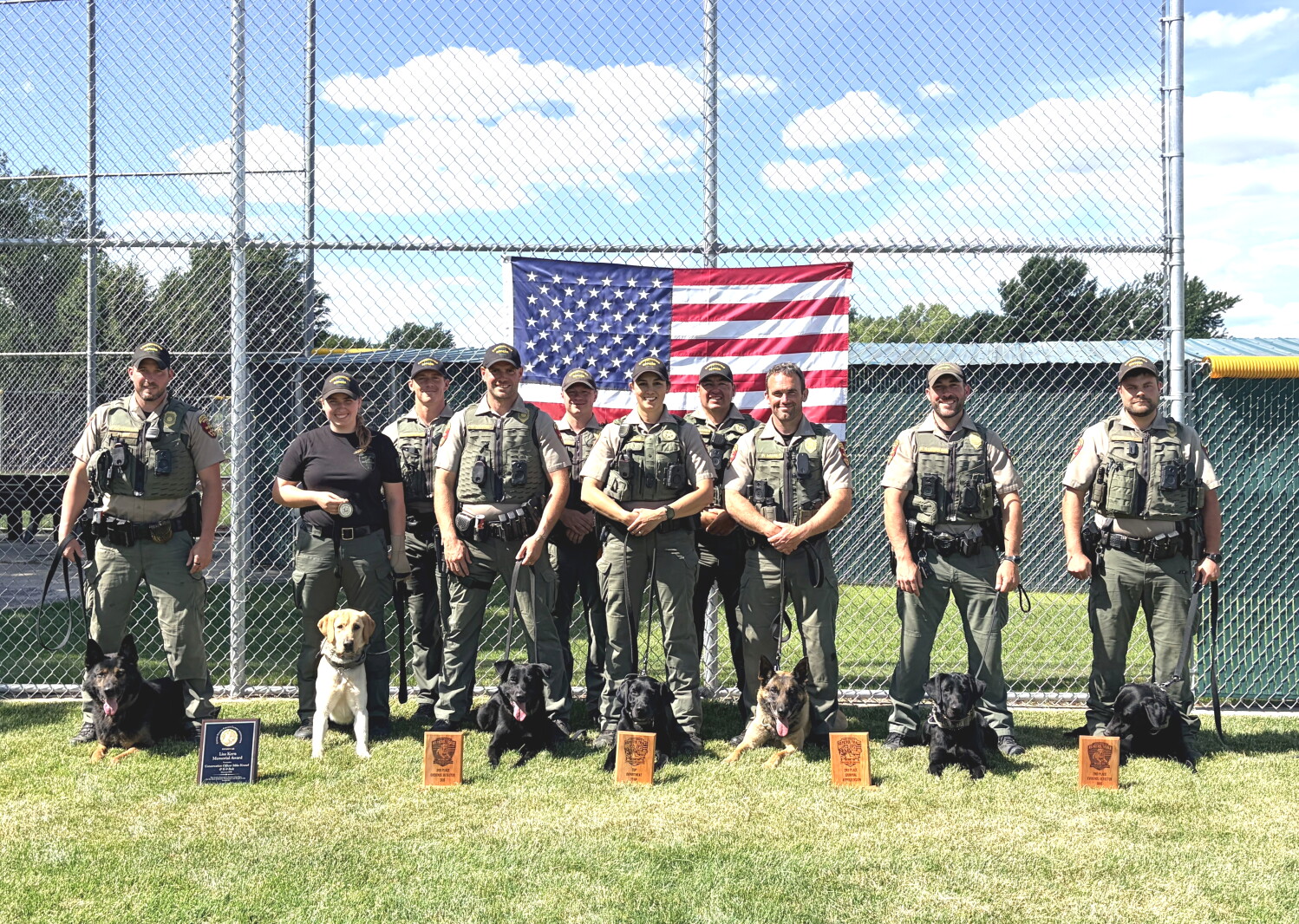
The department currently has nine dog handler teams — two dual-purpose teams with German shepherds, and seven single-purpose teams that include yellow and black labs. “They are trained for game detection, zebra mussel detection and gun detection,” he says. “The dual-purpose teams also have the handler protection or criminal apprehension component.”
The department recently welcomed two new K9 teams — Conservation Officers Matt Brodin and his dog Molly, stationed in Brainerd, and Mitch Nowak and his canine partner Hank, who will work in St. Peter. The other teams are scattered across the state.
Capt. Phil Mohs, the department’s K9 unit leader whose canine partner is Mack, said the human-dog teams play an integral part of the DNR’s mission.
“Our dog and handler teams increase the DNR’s ability to protect Minnesota’s people and natural resources,” he says, “ensuring future generations of Minnesotans have the same or better opportunities to enjoy our natural resources than we do today.”
Swedberg started training with Axel in May 2025. He said he had to meet certain criteria to make the change to the K9 Unit, but it has been a good way for him to take on more responsibility.
A year later, the team is still working and training together. For two days in June, he and Axel attended the United States Police K9 Association training in Delano, Minnesota, with other dog handler teams for obedience training and detection certification. It was part of the association’s Region 12 qualifier, which encompasses Minnesota and parts west of the Mississippi River.
Swedberg says the department’s K9 teams function in several roles, among them assisting in search and rescue, detecting possible game and fish violations and supporting local law enforcement with evidence detection needs. The dogs also are trained to detect aquatic invasive species, which Swedberg said is a proactive part of the team’s responsibilities.

Contributed / Minnesota DNR
Axel is a black lab, and like other dogs of his kind has around 300 million scent receptors compared to about 5 million in humans. A Labrador’s brain has 40 times more space to analyze odors than do humans. They also have specialized nostrils that allow them to exhale through slide slits that kick up scent molecules, further enhancing their sense of smell.
Because their olfactory abilities are so strong, some online groups offer tips for managing the dogs’ instinct to follow a scent — such as when walking a lab, keeping it on a shorter leash; or using treats to teach the dog to stay near its owner instead of wandering off in search of a scent.
One of the more interesting aspects about the dog breed is that, if properly trained, they can detect invasive species in water. That training involves teaching the dog to recognize the meat portion of a zebra mussel. Once they are familiar with the scent, the dogs can easily locate the mussels near water or on boats.
“We don’t have to wait for an incident to take place,” he says, noting they try to be proactively engaged with zebra mussel detection when time allows, visiting boater access points and water equipment sites. It is here where Axel again shows off his natural-born instinct to hit the scent trail and sniff out invasive species.
Once Axel locates a zebra mussel, perhaps on a boat, he alerts Swedberg to it so he can get a visual on the mussel. He also finds out if the boat is going into the lake or coming out of it. Whichever it is, he has to next figure out what the next steps are going to be; typically, it’s some sort of decontamination.
“We’ll send them to a local decontamination site or get the zebra mussels scraped off the boat,” Swedber says. Because transporting invasive species is illegal, he tries to use the experience as an educational opportunity for the boater. “At the same time, the DNR has been educating people for years now on why we try to stop the spread of invasive species. The dogs are another tool for that branding and they’ve been really nice to reinvigorate or bring new life to that message.”
A high drive and good motivation in dogs are key elements to successfully train animals, and Axel has both, although each learns differently and at different paces. It’s similar to how people learn.

Contributed / Minnesota DNR
“It’s kind of like humans; it depends on the animal,” Swedberg says. “Some learn a little quicker than others, some pick up on certain parts of the training faster than others, but other than that, eventually, as long as the dog has motivation, we can get them trained. They want to have purpose, and so as long as we can find something that motivates them to want to do something, we can get them trained.”
The training, including what’s learned on the job, isn’t only for Axel. Swedberg also has learned a lot from partnering with his dog. He says, “I joked during our first week of training that I learned more in one week of dog training than I did in 30 years of life.”
He’s had family pets while growing up and used to think the basic commands were all there was to training a dog. His perspective is different now.
“You realize quickly there are a million different ways to train a dog,” he says.
Some techniques work better than others, and some work better than others for different dogs. The idea is to start with basics, setting a good foundation, and build from there. He said it’s a lot like life.
“Dog training is about resolving one problem and discovering 10 other problems while you’re moving on from the first problem, but you can fall back to that foundation to usually fix your problems.”
Swedberg says he’s had several highlights working with Axel, but one of the most rewarding was locating the hidden gun in June 2025 near Red Lake.
Of the challenges, he says sometimes the day-to-day routines can be rough, depending on the scenario or training. However, training for the dogs is continuous; it happens every day.
When at home, if Axel comes inside the house, he often is wound up and thinks he’s still on the job and goes around sniffing, trying to track different scents. At bedtime, he is kenneled outside, depending on the weather, and knows then that it is time to relax and sleep. He is off the clock.
“Sometimes they need space to turn it off,” he says. “Axel and I get to hang out together all the time. He’s has super high-drive and is a highly motivated guy. Just like anything, if you work together all the time, you have your good days, you have your bad days. You have to enjoy every part of it.”
Axel does have a nickname: The K9 Unit calls him “The Horse.”
“He trots and gallops everywhere, and because of it, everyone says he’s part horse,” Swedberg says, noting there is something that makes his partner extremely happy. “If he gets his favorite toy, he’ll parade around and trot in circles.”










Leave a comment