

Zvamaida Murwira and Nyore Madzianike
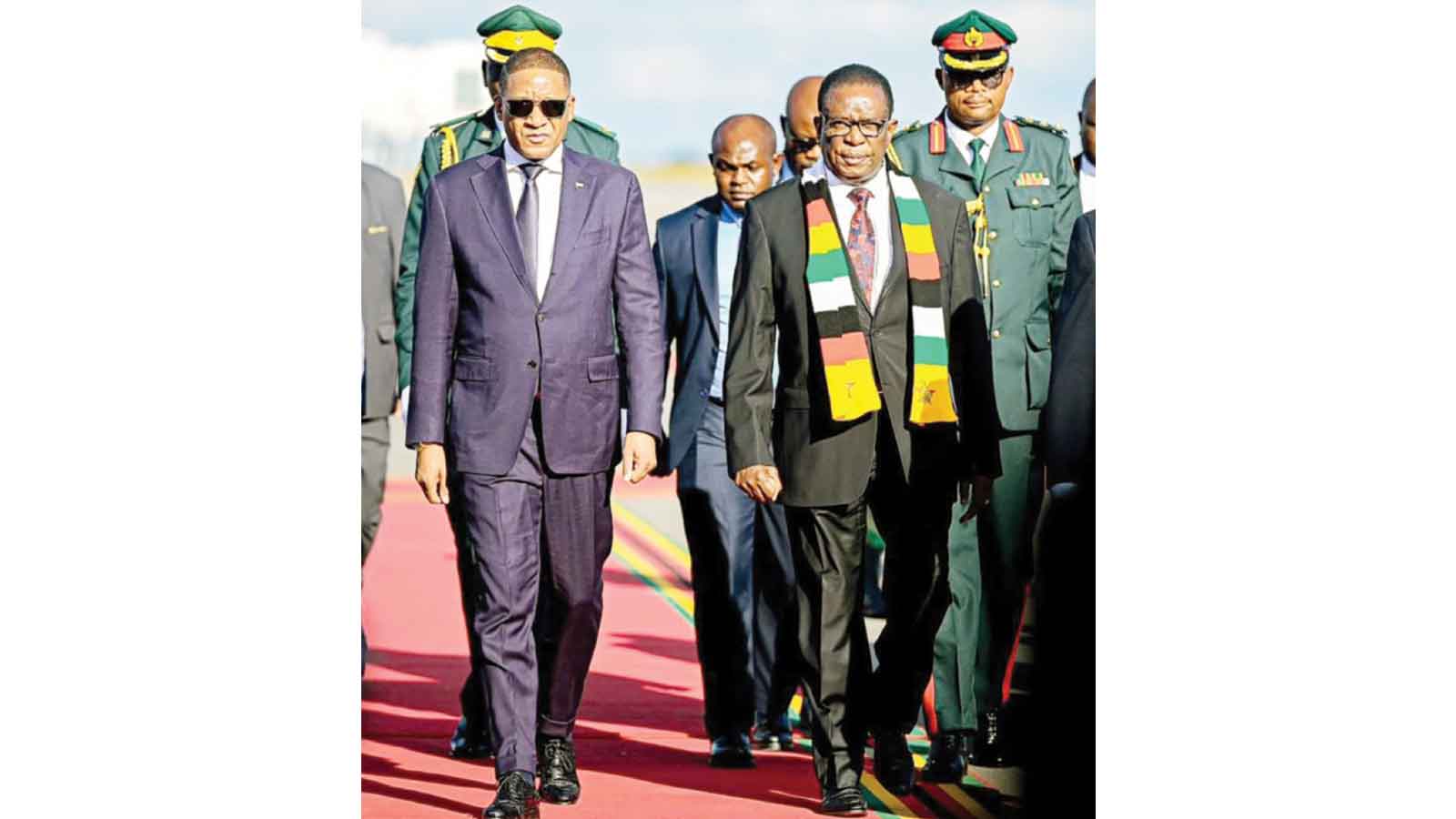
ZIMBABWE and Botswana must leverage their respective natural resources endowments and opportunities to help lift their people out of poverty into prosperity, President Mnangagwa has said.
The President said this last night at a State Banquet he hosted for his visiting counterpart, Botswana President Boko Duma, who is in the country on a three-day State visit.
“Our unique natural endowments must lift many more people out of poverty into a higher quality of life. Trade and investment relations are registering steady and encouraging progress. We must leverage our respective strengths and opportunities to position our economies as competitive and integrated hubs within the region, under the African Continental Free Trade Area and SADC,” said President Mnangagwa.
He said Botswana’s participation at the ongoing Zimbabwe International Trade Fair (ZITF) provides the impetus to deepen cooperation through the provision of a practical platform to showcase products, fostering partnerships and unlocking new market opportunities
“These efforts have resulted in the conclusion of trade deals and expansion of export opportunities across sectors such as manufacturing, agriculture and services. I am aware that a notable contingent of businesses from Botswana is exhibiting at this year’s Trade Fair. We thank you for this support,” President Mnangagwa said.
Today, the two leaders will co-chair the Fifth Session of the Zimbabwe-Botswana Bi-National Commission (BNC), where at least seven deals are expected to be sealed before proceeding to Bulawayo, where the Botswana leader is expected to officially open the oversubscribed Zimbabwe International Trade Fair (ZITF) tomorrow.
President Mnangagwa said beyond economic cooperation, it is critically important that the two nations strengthen social and cultural ties between their peoples, who must remain at the centre of this partnership.
“The need to facilitate the free movement between our nations cannot be over-emphasised,” he said.
The President commended Botswana for its role in Zimbabwe’s fight for independence from Ian Smith’s colonial regime, where it provided shelter and material support.
In his address, President Boko commended the two countries’ bilateral relations. He thanked President Mnangagwa for the hospitality he had shown each time he visited Zimbabwe.

President Boko said on all the occasions he visited Zimbabwe, President Mnangagwa personally received him at the airport, a demonstration of how much respect he had for him.
“I want to thank most heartily the President. When I first arrived in Zimbabwe, I was received by President Mnangagwa personally at the airport. When I arrived here this afternoon, I was pleasantly surprised again to be received by the President personally,” he said.
President Boko said it was imperative for them as leaders to continue carrying the torch of the aspirations of their countries.
“We who stand in leadership today are bearers of the flame. We dare not fail. We dare not falter,” he said.
The banquet was attended by Cabinet ministers from both countries, Zanu PF Politburo members and diplomats accredited to Zimbabwe, among others.
The BNC, which will be co-chaired by the two leaders today, has emerged as an effective instrument for advancing cooperation across key economic sectors for both countries.
Through its structured institutional framework — supported by a network of Memoranda of Understanding, bilateral agreements, and high-level decisions — the BNC has enabled the two governments to unlock shared opportunities and jointly address common challenges.
Writing on his micro-blogging platform X earlier yesterday, President Mnangagwa said the two countries will use the State visit to scale up relations, both politically and economically.
“It is my great pleasure to welcome His Excellency Advocate Duma Gideon Boko, my brother, to Zimbabwe on his three-day State visit. The deep-rooted historical ties and shared vision for a prosperous future underscore the relationship between our nations. I anticipate fruitful discussions that will further strengthen bilateral cooperation and the fraternal bonds between our two nations,” said the President.
Speaking during the Ministerial Segment, which is a precursor to the BNC, in the capital yesterday, Botswana’s Minister of International Relations Dr Phenyo Butale, said the two countries continue to enjoy enduring bonds of friendship and cooperation, firmly anchored on a shared history, common aspirations and mutual respect.
He said the ties were further strengthened by the establishment of the BNC in 2018.
Dr Butale was co-chairing the Ministerial Segment with Zimbabwe’s Minister of Foreign Affairs and International Trade, Professor Amon Murwira.
Dr Butale said the BNC is an effective tool in advancing cooperation.
“As we convene for the 5th Session of the BNC, I am pleased to note that the BNC has proven to be an effective and valuable instrument in advancing cooperation across a wide range of sectors, including agriculture, health, education, energy, immigration, transport, infrastructure development, trade and investment, defence and security.
“Through its structured institutional framework, supported by a network of Memoranda of Understanding (MoU), bilateral agreements, and high-level decisions, the BNC has enabled our two Governments to unlock shared opportunities and jointly address common challenges.”
On-going collaborative initiatives between Zimbabwe and Botswana include joint efforts in combating livestock rustling and other cross border crimes, the management of stray livestock, the provision of essential medicines by Zimbabwe to Botswana, and the supply of Foot and Mouth Disease (FMD) vaccines to Zimbabwe.
In strengthening government-to-government cooperation, the BNC mechanism also facilitates business-to-government and business-to-business engagement, including the forthcoming Botswana-Zimbabwe Business Forum scheduled for April 24 in Bulawayo during the Zimbabwe International Trade Fair (ZITF).
Dr Butale said the business forum will see 20 Botswana companies across diverse sectors participating.
“This engagement, alongside Botswana’s participation in the Zimbabwe International Trade Fair (ZITF), is a clear demonstration of our commitment towards advancing trade and investment between Botswana and Zimbabwe.
“It is indeed commendable to witness the strong relations we continue to cultivate at the diplomatic level, translate into tangible and meaningful economic benefits for our citizens.
“In this connection, we reaffirm our unwavering commitment and resolve to accelerate and scale up the implementation of all agreed commitments, projects and initiatives that will mutually benefit our economies,” he said.
Dr Butale commended Government officials from both countries who participated in the Senior Officials meetings for producing a consolidated report on their deliberations, which reflected a consensus and shared purpose.
He said from their briefings, the Senior Officials’ report includes concise and comprehensive updates on sectoral areas of cooperation, highlighting progress achieved, outstanding issues, and proposed deliverables under the BNC, including clear timelines for their implementation and delivery.
“I am also encouraged to note that at least seven (7) agreements are scheduled to be signed tomorrow, in the presence of our respective Heads of State, further expanding and strengthening the existing framework of cooperation.
“The responsibility now rests with us Honourable Ministers, as the custodians of the machinery of Government, to ensure that this 5th Session of our BNC remains responsive, dynamic, and fit-for-purpose as a strategic platform for high-level bilateral engagement.”
Speaking at the same occasion, Prof Murwira said the BNC affirms collective commitment to deepen bilateral cooperation in a structured, results-oriented manner.
He said the meeting was also an opportunity to take stock of progress since the last session and to inject renewed momentum into priority areas of cooperation.
Commenting on strategic focus areas for cooperation, Prof Murwira said deliberations must remain focused on delivering tangible outcomes, particularly in key areas of trade and Investment, regional integration and market access, free movement of people, transport and logistics connectivity and agriculture and livestock development.
“While our economic relations are on a positive trajectory, trade volumes remain below potential. We must prioritise the removal of tariff and non-tariff barriers, improve customs efficiency, and facilitate greater private sector participation,” he said.
“The forthcoming Business Forum is a critical step in unlocking investment opportunities and strengthening value chains in mining, agriculture, and manufacturing.”
Prof Murwira said cooperation between the two nations must be aligned with regional frameworks, particularly the Southern African Development Community and the African Continental Free Trade Area, to expand market access, enhance competitiveness, and position the two economies within continental value chains.
“In the spirit of deepening integration, facilitation of trade and tourism, we must give serious consideration to facilitating the movement of our citizens, including the progressive adoption of national identity cards as travel documents, to promote closer people-to-people interaction and economic participation,” he said.

“Efficient infrastructure is central to trade facilitation. We must accelerate efforts to improve border efficiency, advance cooperation on the Kazungula framework, and strengthen strategic corridors such as the Trans-Kalahari Corridor to enable seamless movement of goods and services.”
Prof Murwira said strengthening cooperation in veterinary services, particularly in the control of transboundary animal diseases such as Foot and Mouth Disease, remains critical.
Enhanced collaboration in research, surveillance and vaccine production, he said, will safeguard livestock industries and support exports.
“Our countries must deepen cooperation in energy security and the beneficiation of our mineral resources. By investing in value addition and sustainable processing, we can maximise the benefits of our natural endowments and drive industrialisation.”
On health cooperation, Prof Murwira said strengthened collaboration in the health sector will enhance resilience, improve service delivery, and support the well-being of citizens.
On defence and security, he said, continued cooperation in border management and combating transnational organised crime is essential to safeguarding the two countries’ shared development gains and promoting regional stability.
Commenting on the regional and global outlook, Prof Murwira said the two countries will continue to champion deeper integration within SADC, including initiatives such as the Regional Development Fund.
“At the global level, it is imperative that we exchange views on evolving geopolitical and economic dynamics, particularly their impact on developing economies, energy security, and sustainable development.”
Prof Murwira expressed appreciation for Botswana’s consistent support, including its principled call for the removal of illegal sanctions, and its endorsement of Zimbabwe’s candidature for a non-permanent seat on the United Nations Security Council for the period 2027–2028.
He said the vision for the Bi-National Commission must remain a strategic instrument for translating shared vision into practical outcomes.
“As we proceed with our deliberations, let us be guided by our shared history, mutual trust, and the clear objective of advancing trade, investment, regional integration, and the prosperity of our citizens,” he said.
Today, President Boko will tour the National Heroes Acre, the Museum of African Liberation and the Geo Pomona Waste Management Plant.
The two leaders will have a bilateral meeting at State House before attending a signing of agreements ceremony.
They will also address the media, giving their reflections on the engagements.









Leave a comment