
Key Takeaways
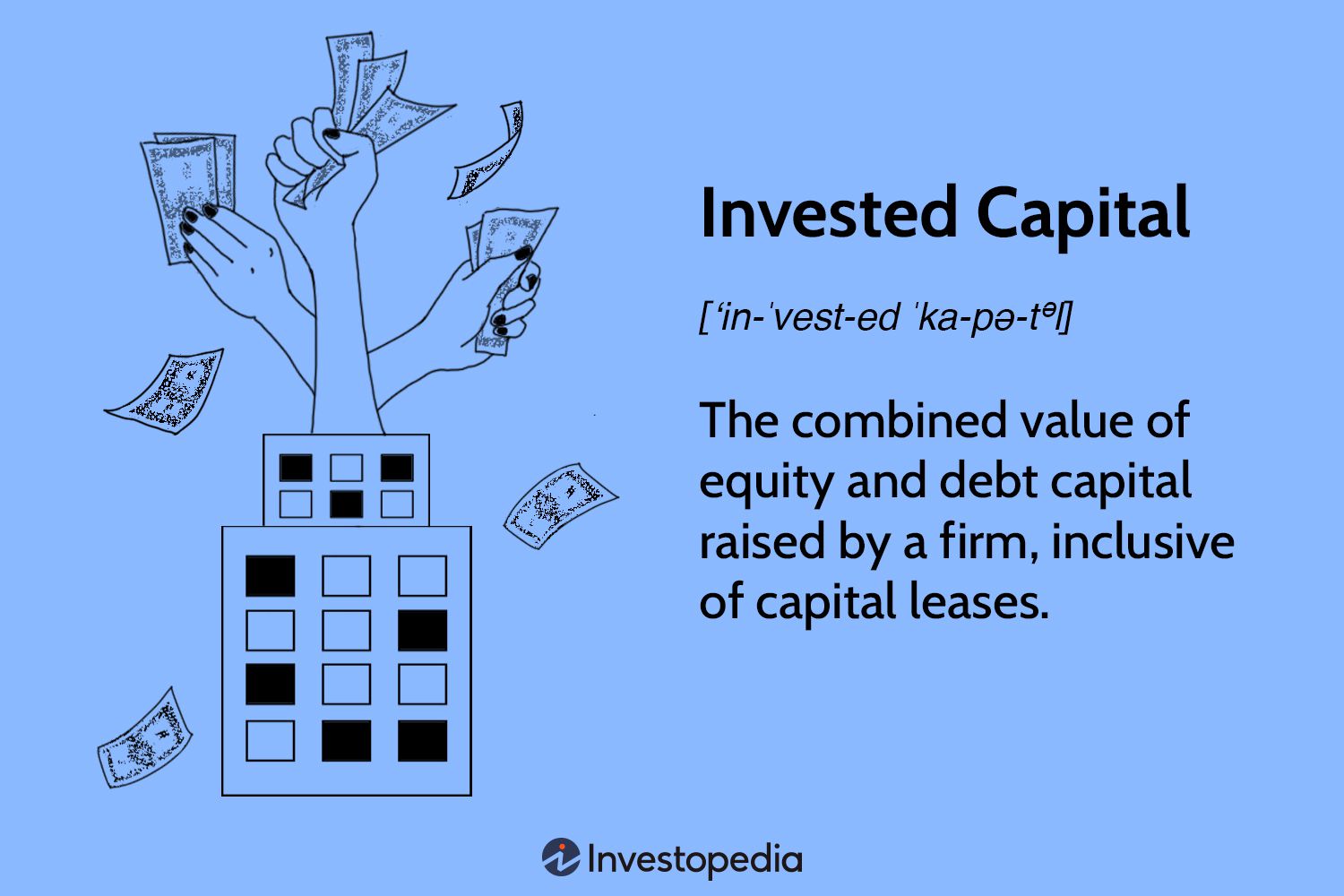
- The combined value of equity and debt raised by a company make up invested capital.
- Invested capital is used for a company’s growth and ongoing operations.
- Companies use their invested capital to buy assets and generate profits.
- You can measure how well a company uses its invested capital with its return on invested capital.
Get personalized, AI-powered answers built on 27+ years of trusted expertise.
What Is Invested Capital?
Invested capital represents the total amount of money a company raises, through equity and debt, to fund its operations and long-term growth. It reflects the resources put into the business by investors and lenders and is a key indicator of a company’s financial health and strategy.
A company’s return on invested capital (ROIC) can tell you how well its capital is used to make a profit. You won’t find invested capital on corporate financial statements because debt, capital leases, and stockholders’ equity are each listed separately on company balance sheets.
Understanding Invested Capital
Companies must generate more in earnings than the cost to raise the capital provided by bondholders, shareholders, and other financing sources, or else the firm does not earn an economic profit.
Businesses use several metrics to assess how well the company uses capital, including return on invested capital, economic value added, and return on capital employed.
A firm’s total capitalization is the sum total of debt, including capital leases, issued plus equity sold to investors, and the two types of capital are reported in different sections of the balance sheet. Assume, for example, that IBM issues 1,000 shares of $10 par value stock, and each share is sold for a total of $30 per share.
In the stockholder’s equity section of the balance sheet, IBM increases the common stock balance for the total par value of $10,000, and the remaining $20,000 received increases the additional paid-in capital account.
On the other hand, if IBM issues $50,000 in corporate bond debt, the long-term debt section of the balance sheet increases by $50,000. In total, IBM’s capitalization increases by $80,000, due to issuing both new stock and new debt.
How Issuers Earn a Return on Capital
A successful company maximizes the rate of return it earns on the capital it raises, and investors look carefully at how businesses use the proceeds received from issuing stock and debt.
Assume, for example, that a plumbing company issues $60,000 in additional shares of stock and uses the sales proceeds to buy more plumbing trucks and equipment.
If the plumbing firm can use the new assets to perform more residential plumbing work, the company’s earnings increase and the business can pay a dividend to shareholders. The dividend increases each investor’s rate of return on a stock investment, and investors also profit from stock price increases, which are driven by increasing company earnings and sales.
Companies may also use a portion of earnings to buy back stock previously issued to investors and retire the stock, and a stock repurchase plan reduces the number of shares outstanding and lowers the equity balance.
Analysts also look closely at a firm’s earnings per share (EPS), or the net income earned per share of stock. If the business repurchases shares, the number of outstanding shares decreases, and that means that the EPS increases, which makes the stock more attractive to investors.
Return on Invested Capital (ROIC)
Return on invested capital (ROIC) is a calculation used to assess a company’s efficiency in allocating the capital under its control to profitable investments.
The return on invested capital ratio gives a sense of how well a company is using its money to generate returns. Comparing a company’s return on invested capital with its weighted average cost of capital (WACC) reveals whether invested capital is being used effectively. This measure is known as return on capital.
ROIC is always calculated as a percentage and is usually expressed as an annualized or trailing 12-month value. It should be compared to a company’s cost of capital to determine whether the company is creating value. If ROIC is greater than a firm’s Weighted Average Cost of Capital (WACC), the most common cost of capital metric, value is being created and these firms will trade at a premium.
A common benchmark for evidence of value creation is a return of over 2% of the firm’s cost of capital. If a company’s ROIC is less than 2%, it is considered a value destroyer. Some firms run at a zero-return level, and while they may not be destroying value, these companies have no excess capital to invest in future growth.
ROIC is one of the most important and informative valuation metrics to calculate. That said, it is more important for some sectors than others since companies that operate oil rigs or manufacture semiconductors invest capital much more intensively than those that require less equipment.
How Do You Calculate Capital Invested?
Capital invested is calculated as, Capital Invested = Total Equity + Total Debt (including capital leases) + Non-Operating Cash.
What Is an Example of Capital Invested?
If a private company decides to go public, has an initial public offering, and sells one million shares to raise $17 million, that is an example of capital invested. Similarly, if a company decides to sell $10 million worth of bonds with a coupon of 3%, that is an example of capital invested. Capital investments are generally understood to be land, buildings, and equipment.
What Is a Good Return on Invested Capital?
A good return on invested capital (ROIC) is considered to be 2% and above. Conversely, a business is thought to be destroying capital if it has an ROIC of less than 2%.
The Bottom Line
Invested capital is the fuel that powers a business as it’s the money raised from equity and debt to fund operations and growth. But the real measure of success lies in how effectively that capital is used. ROIC is one of the best tools investors have to evaluate a company’s efficiency, profitability, and long-term potential.













Leave a comment